Welcome back. In our last lesson, you learned how to identify and safely prepare everyday household items for resistance training, with a special focus on the weighted backpack. This skill is the bridge between pure bodyweight training and the "hybrid" program you're aiming for, allowing you to systematically apply progressive overload even without a gym.
Today, we will put that knowledge into immediate action. This lesson focuses on two of the most fundamental lower-body exercises: the squat and the lunge. You will learn how to perform these movements with the improvised weights you've prepared, turning them into powerful tools for building strength and muscle in your legs. We'll cover proper form for these loaded variations and touch on the principles that make them so effective for home training.
Why Loaded Exercises Matter for Your Legs
Before we jump into the "how," let's briefly touch on the "why," which connects back to the core principle of muscle growth, or hypertrophy. Your chemical engineering background has likely given you an appreciation for fundamental drivers in any system, and the human body is no different.
To understand how we can build muscle at home, it helps to know the two primary drivers of hypertrophy.
How to Grow Leg Muscle at Home: The Science of Hypertrophy
This article from GXMMAT provides a concise explanation of the science behind building muscle in a home environment, which is central to our hybrid training approach.
Please read the section titled The Mechanics of Home Hypertrophy. Pay close attention to the distinction between mechanical tension and metabolic stress.
As the article explains, a commercial gym primarily uses heavy weights to maximize mechanical tension. At home, our strategy is slightly different. While adding weight with a backpack does increase mechanical tension, we also heavily leverage metabolic stress—that "burn" you feel from sustained effort. By combining improvised weights with controlled movements and higher repetitions, we create a powerful stimulus for growth that rivals what can be done in a gym.
The Loaded Squat
You've already practiced the bodyweight squat. Now, we'll add a load to increase the mechanical tension and challenge your muscles in a new way. One of the best variations for this is the Goblet Squat.
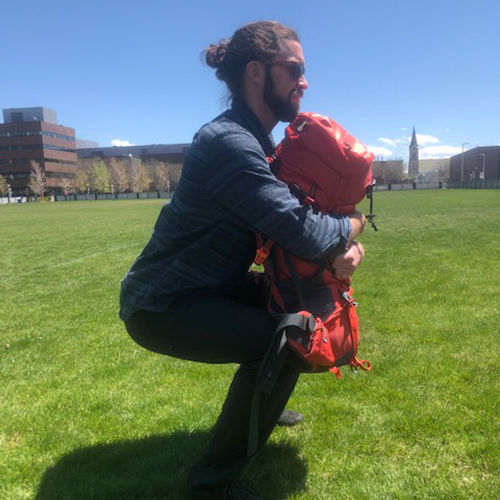
In a Goblet Squat, you hold the weight in front of your chest. This position acts as a counterbalance, making it easier to maintain an upright torso and achieve proper depth. It also heavily engages your core and upper back to stabilize the weight.
This Hiking Workout is a Spring Tune-Up for Your Body
This article from Backpacker magazine describes the Goblet Squat and its benefits, particularly in the context of functional strength.
Read the section titled Goblet Squats. Notice the emphasis on keeping an upright torso and how holding the weight at your chest helps with this.
To perform a loaded squat at home, you have two primary options:
- Goblet Squat: Use a heavy, grippable object like a large water jug or laundry detergent bottle. Hold it vertically against your chest with both hands. You can also hug your weighted backpack to your chest, as shown below.
- Backpack Squat: Wear your weighted backpack as you normally would. This is more stable for heavier loads once you've mastered the movement pattern.
The following video demonstrates how you can even combine these methods to add significant weight and balance the load between your front and back.
Squats with Dumbbells & Backpack at Home | GamerBody
This video from GamerBody shows a practical approach to progressing squats at home, combining different loading strategies.
First, watch the segment from combining weights where the presenter adds a backpack to his goblet squat to increase the total resistance while maintaining balance. Then, watch the section from on progression to understand how to manipulate variables like tempo and, most importantly, why form must always come first.
The key takeaway is to master the form before adding significant weight. Your goal is to perform 3 sets of 8-15 controlled repetitions. Once you can do this easily, it's time to add more weight to your backpack.
The Loaded Lunge
Lunges are a unilateral exercise, meaning they work one leg at a time. This is fantastic for building balanced strength, improving stability, and increasing the load on the working leg without needing immense external weight. We'll focus on the reverse lunge, which many people find more comfortable for their knees.
This Hiking Workout is a Spring Tune-Up for Your Body
We return to the Backpacker article for its clear instructions on the reverse lunge.
Read the section on Reverse Lunges. Focus on the cues: keeping your core tight, your front knee over your ankle, and your torso upright. The article explicitly mentions adding resistance with a loaded backpack.
The simplest and most stable way to load a lunge is by wearing your weighted backpack. This distributes the weight evenly across your torso, allowing you to focus purely on the movement of your legs.

As you perform the lunge, think about driving through the heel of your front foot to return to the starting position. This will ensure you're engaging your glutes and hamstrings effectively. Aim for 3 sets of 10-15 repetitions per leg.
For a more advanced challenge in the future, you can progress to a Bulgarian Split Squat. As described in the "How to Grow Leg Muscle at Home" article, this variation involves elevating your rear foot on a chair or couch. This places almost all the load on your front leg, creating immense tension and providing a significant training stimulus with even minimal weight in your backpack.
Conclusion
You now have the knowledge to execute two of the most effective loaded lower-body exercises in a home setting. By applying what you learned about improvised weights, you can now systematically increase the challenge on your squats and lunges, driving consistent progress.
Key Takeaways:
- Home leg training effectively builds muscle by combining moderate mechanical tension (from improvised weights) with high metabolic stress.
- The Goblet Squat is an excellent variation that uses a front-held weight to enforce good posture and engage the core.
- Squats can be loaded by holding a weight at your chest (goblet style) or by wearing a weighted backpack.
- Reverse Lunges are a knee-friendly way to train each leg individually, and they are most easily loaded by wearing a weighted backpack.
- Always prioritize perfect form over adding more weight. Master the movement, then increase the load.
In our next lesson, we'll continue building our hybrid training arsenal. You will learn to perform the bent-over row using your new improvised weights, a crucial exercise for developing a strong and balanced upper body.