Introduction
In our last lesson, we broke down the physical fuel your body needs, exploring how macronutrients provide the energy and raw materials for performance and growth. We concluded by noting that just as your body has an operating system for energy, so does your mind. Today, we shift our focus from physiology to neurochemistry to investigate the system that governs your motivation, desires, and habits.
This lesson addresses a challenge you've identified as significant: managing digital distractions. We will dissect the dopamine reward cycle, the fundamental brain mechanism behind motivation. As an engineering student, you can think of this as learning the process flow diagram of a critical internal system. By understanding how this circuit works—how it drives you toward rewarding experiences and how it can be hijacked by modern technology—you will gain a scientific framework for analyzing and eventually managing compulsive digital habits.
The Brain's Reward Circuit: More Than Just Pleasure
First, we need to clarify a common misconception. Dopamine is often called the "pleasure molecule," but that's not quite accurate. While it is involved in pleasure, its primary role is in motivation, anticipation, and reward-seeking. It's the neurochemical that says, "Pay attention! This is important for survival or reward. Go get it." This system evolved to drive us toward essential things like food, water, and social connection.
To understand the anatomy of this system, let's watch a brief video that maps out the key structures and pathways.
2-Minute Neuroscience: Reward System
This video from the "Neuroscientifically Challenged" channel provides a concise, scientific overview of the brain's reward system.
Watch from the beginning to get a clear picture of the main components. Pay close attention to the names of the key brain regions—the Ventral Tegmental Area (VTA) and the Nucleus Accumbens (NAc)—and the pathway that connects them, called the mesolimbic dopamine pathway. Then, continue watching from this point to understand the modern view of dopamine's role in motivation and reward-seeking.
As the video explains, when your brain perceives a rewarding stimulus, the VTA releases dopamine into the nucleus accumbens. This process creates a powerful signal to repeat the behavior that led to the reward. This forms the basis of a feedback loop that drives habit formation.
The Dopamine Loop: From Stimulus to Habit
This sequence of events can be visualized as a cycle. The brain perceives a stimulus, which triggers dopamine release, leading to feelings of pleasure or satisfaction. This reinforces the behavior, creating a desire to experience it again, which eventually solidifies into a habit.
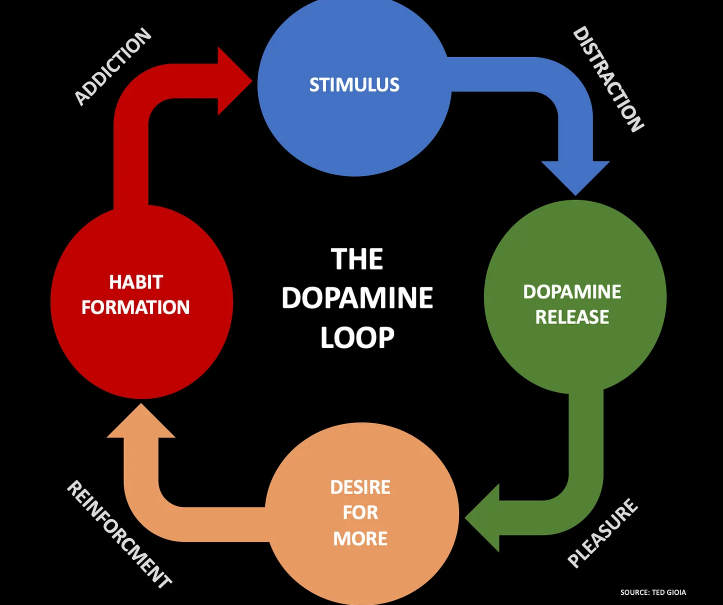
This natural learning process is highly effective for survival. However, it can be "hijacked" by activities and substances that provide an unnaturally large and rapid release of dopamine.
This section from Simply Psychology explains how this reward system, designed for natural rewards, can be overstimulated.
Read the section titled How Addiction Hijacks the Reward System. Focus on how the brain adapts to unnaturally high dopamine surges, leading it to become less responsive to normal, everyday pleasures.
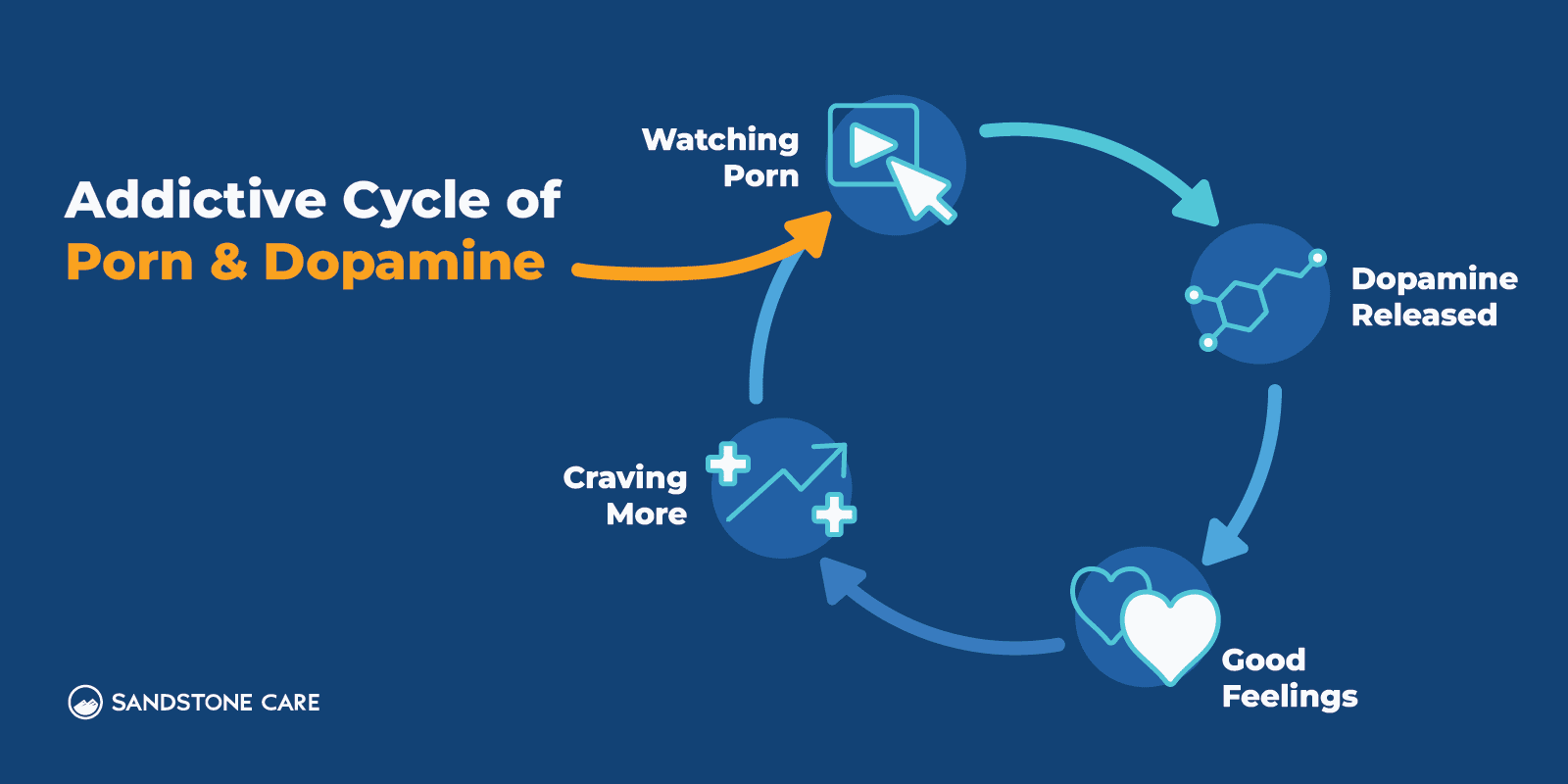
The article highlights a critical point: this hijacking isn't limited to drugs. Behaviors like gambling, binge eating, and, most relevantly for our discussion, compulsive use of social media, video games, and pornography can trigger the same powerful cycle.
The Crash: Why Peaks Lead to a Lower Baseline
Understanding the simple loop is only half the story. The key to why these habits can become so detrimental lies in what happens after the dopamine peak. Think of it like a chemical process reaching equilibrium; the brain strives for homeostasis and compensates for massive fluctuations.
Neuroscientist Dr. Andrew Huberman explains this with a powerful model: your dopamine level has a baseline (your tonic level) and experiences peaks (your phasic level). When you engage in a highly stimulating activity, you get a large peak of dopamine. However, after this peak, your brain compensates by temporarily dropping your baseline below its original level.
How to Quit Video Game, Pornography & Social Media Addiction | Dr. Andrew Huberman
In this clip, Dr. Huberman explains the crucial relationship between dopamine peaks and your baseline level of motivation and mood.
Watch carefully from the beginning. The most important concept to grasp is that after a large dopamine peak, your baseline drops. This explains why you can feel unmotivated, listless, or even depressed after a long session of gaming or scrolling.
This leads to a vicious cycle. You feel lousy because your baseline is low, and your brain mistakenly believes that the only way to feel good again is to seek out that same high-dopamine activity. But doing so only deepens the deficit, requiring more and more of the stimulus just to feel "normal," while making everyday, less stimulating activities (like studying, chores, or even quiet hobbies) feel dull and unrewarding. This is what Huberman calls "a progressive narrowing of the things that bring you pleasure."
Social Media and Gaming: Engineered for Compulsion
Modern digital platforms are exquisitely designed to exploit this neurochemical system. They are not neutral tools; they are engineered environments that deliver dopamine in the most effective ways possible, making them particularly hard to resist.
Factors that make social media and gaming so potent include:
- Novelty: Dopamine is triggered by new information. The "infinite scroll" on platforms like TikTok, Instagram, and X ensures a never-ending stream of novelty.
- Social Validation: As the "Simply Psychology" article noted, receiving "likes" and positive feedback activates the VTA and nucleus accumbens, just like a monetary reward.
- Intermittent Reinforcement: The unpredictability of rewards (you don't know when the next great post, match, or message will appear) is one of the most powerful schedules for driving compulsive behavior. This is the same mechanism that makes slot machines so addictive.
This article from Stanford Medicine succinctly describes the addictive potential of our modern digital environment.
Addictive potential of social media, explained
This interview with Dr. Anna Lembke, an addiction expert at Stanford, provides powerful analogies for understanding our relationship with technology.
Read the Q&A sections What are the risk factors for addiction? and What makes social media particularly addictive?. The comparison of the smartphone to a "hypodermic needle" delivering "digital dopamine" is a stark but accurate metaphor for its efficiency in hijacking your reward pathways.
Understanding this is not about assigning blame or inducing guilt. It's about recognizing that you are operating in an environment designed to capture your attention by leveraging deep-seated neurological processes. It is not a failure of willpower, but a predictable mismatch between our evolutionary wiring and our modern world.
Conclusion
You now have a working model of the dopamine reward cycle and its role in compulsive digital habits. This is the scientific "why" behind the struggle to manage distractions. Instead of a vague sense of "wasting time," you can now identify the neurochemical processes at play.
Key Takeaways:
- Dopamine is a neurotransmitter primarily responsible for motivation and reward-seeking, not just pleasure.
- The dopamine reward cycle (VTA -> NAc) is a fundamental feedback loop that reinforces behaviors the brain deems rewarding.
- Intense, novel, and easily accessible stimuli like social media, pornography, and video games can hijack this system, creating powerful dopamine peaks.
- After a significant dopamine peak, your baseline level of dopamine drops, leading to a state of lower motivation and mood, which creates cravings for more high-stimulus activity.
- This cycle can lead to a "dopamine-deficit state," where everyday activities feel less enjoyable and the urge to engage in the high-dopamine behavior becomes compulsive.
With this knowledge, you've taken the first step toward regaining control. You've diagnosed the system. In future lessons, we will explore practical strategies—the "how"—to intervene in this cycle.
In our next and final lesson of this foundational module, we will address another aspect of your lifestyle goals: time management. We'll examine why the rigid, minute-by-minute schedules often fail and introduce the concept of flexible planning as a more robust and sustainable way to organize your time.