In our last lesson, we established the fundamental principle of progressive overload—the "how" of getting stronger. Today, we'll build on that by creating a mental map of your body's major muscle systems. This is the "what" and "where" of your training. Understanding which muscles perform which actions is crucial for executing exercises correctly, ensuring balanced development, and building a strong mind-muscle connection.
Your engineering background has taught you to understand systems by their components. We'll take a similar approach to the human body, breaking it down not by individual muscles, but by functional movement patterns. By the end of this lesson, you will be able to identify the major muscle groups involved in pushing, pulling, squatting, and core stabilization. This knowledge will serve as the foundation for every exercise we introduce in this course.
The Blueprint: Fundamental Movement Patterns
Instead of memorizing hundreds of individual muscles, it's far more effective to think in terms of how your body moves. Strength training exercises can be categorized into a few fundamental movement patterns. For our purposes, we'll focus on four key categories that form the bedrock of a balanced calisthenics routine:
- Push: Movements where you push a resistance away from your body.
- Pull: Movements where you pull a resistance toward your body.
- Squat: A lower-body movement pattern dominated by bending at the knees and hips.
- Core Stabilization: The ability to resist unwanted motion and maintain a rigid torso.
To get a comprehensive overview of these patterns and the muscles they engage, let's start with a foundational article.
The Seven Fundamental Movement Patterns, Explained By ...
This article from Garage Gym Reviews provides a clear, structured breakdown of the primary movement patterns and the muscles they use.
Please read the section titled "The Physiology of Fundamental Movement Patterns". Pay close attention to the tables for the Squat, Push, Pull, and Rotation patterns. These tables offer a concise summary of the primary muscles and their functions, which we will explore in more detail.
Now, let's dissect each of these patterns.
1. The Push Pattern: Pectorals, Deltoids, and Triceps
Pushing movements involve extending your arms against resistance. They are fundamental for upper-body strength and can be divided into two main types:
- Horizontal Pushing: Moving resistance away from you horizontally, like in a push-up.
- Vertical Pushing: Moving resistance away from you vertically, like in a pike push-up or overhead press.
The primary muscles responsible for these actions are your chest, shoulders, and the back of your arms.
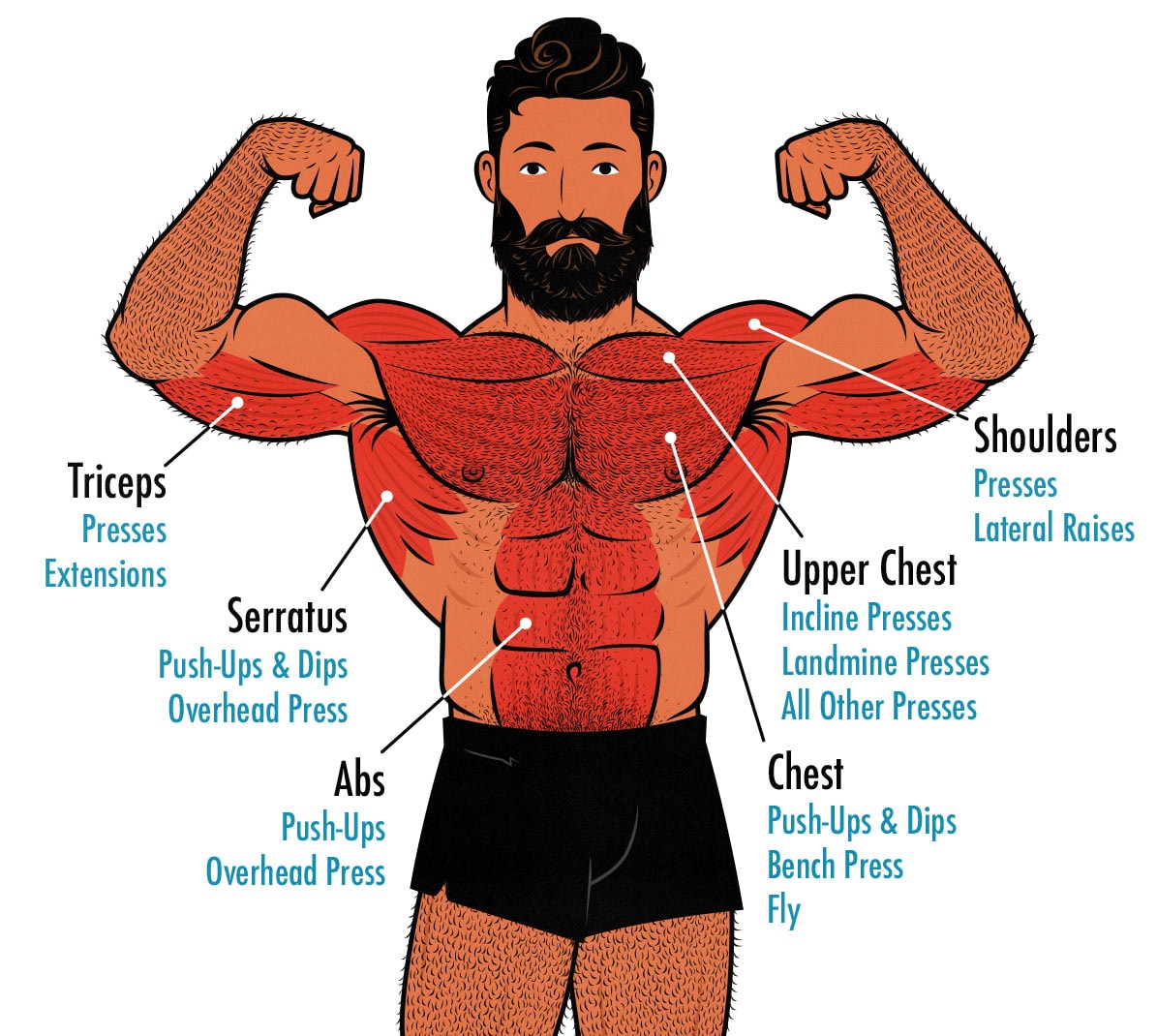
As you can see, the main players are:
- Pectorals (Chest): The large muscles on the front of your upper torso, responsible for bringing your arms across your body and pushing forward.
- Deltoids (Shoulders): The rounded muscles that cap your shoulders. They are involved in lifting your arms in all directions.
- Triceps: The muscles on the back of your upper arm, responsible for extending your elbow.
For a deeper understanding of how these muscles work together, the following reading breaks down the mechanics of horizontal and vertical pushing.
The 7 Fundamental Movement Patterns Your Program Needs
This article from Barbend provides excellent detail on the nuances of each movement pattern.
Please read the sections on Horizontal Push and Vertical Push. Notice how grip width can change muscle emphasis and the importance of stabilizer muscles like the serratus anterior.
2. The Pull Pattern: Lats, Traps, Rhomboids, and Biceps
Pulling movements are the functional opposite of pushing. They involve contracting your back and arm muscles to pull resistance toward you. A strong back is critical for posture, shoulder health, and overall power.
- Horizontal Pulling: Pulling resistance toward your torso horizontally, as in a bodyweight row.
- Vertical Pulling: Pulling your body up vertically, as in a pull-up or chin-up.
The primary muscles involved are a complex group on your back, assisted by the front of your arms.

The main muscles you'll be targeting are:
- Latissimus Dorsi ("Lats"): The large, wing-shaped muscles on the sides of your back. They are the prime movers for pulling your arms down and back.
- Trapezius and Rhomboids: These upper- and mid-back muscles are responsible for pulling your shoulder blades together and providing stability.
- Biceps: The muscles on the front of your upper arm, which assist in pulling by flexing the elbow.
To learn more about how different grips and angles affect these muscles, let's return to the Barbend article.
The 7 Fundamental Movement Patterns Your Program Needs
This reading continues our exploration of movement patterns.
Read the sections on Horizontal Pull and Vertical Pull. Pay attention to the distinction between how flared-elbow and tucked-elbow pulling target different parts of your back.
3. The Squat Pattern: Quadriceps, Glutes, and Hamstrings
The squat is arguably the most fundamental lower-body movement pattern. It involves coordinated bending at the hips, knees, and ankles to lower your center of mass and return to a standing position. It builds foundational strength for everything from walking upstairs to jumping.
The primary movers in a squat are the major muscles of your upper legs:
- Quadriceps ("Quads"): The large muscles on the front of your thighs, responsible for extending your knees.
- Glutes (Gluteus Maximus): The powerful muscles of your buttocks, responsible for extending your hips (driving you upward from the bottom of the squat).
- Hamstrings: The muscles on the back of your thighs, which assist the glutes in hip extension and help stabilize the knee.
4. Core Stabilization
The "core" is not just your abs. It is a 3D muscular corset that includes your rectus abdominis (the "six-pack"), obliques (sides), transverse abdominis (deepest layer), and spinal erectors (lower back).
In the context of compound movements like push-ups and squats, the core's primary job is anti-movement, or stabilization. It locks your spine in a safe, neutral position, allowing the force generated by your limbs to be transferred efficiently without energy leaks or risk of injury. Every movement pattern we've discussed relies on a strong, braced core.
Seeing It All in Action
Now, let's connect these anatomical concepts to the actual exercises. The following video demonstrates beginner versions of exercises from each movement category. As you watch, try to identify the movement pattern and visualize the primary muscles at work.
Calisthenics for Complete Beginners (Tips, Exercise Form, Programming)
This video, "Calisthenics for Complete Beginners," shows the foundational exercises of bodyweight training.
Watch the following segments, focusing on the movements being performed: Pushing: Push-ups and their variations work the chest, shoulders, and triceps. Pulling: Rows and pull-up progressions target the lats, traps, and biceps. Core: L-sit progressions directly challenge the abdominal muscles and hip flexors for stabilization. Squatting: Bodyweight squats and single-leg variations engage the quads, glutes, and hamstrings.
Conclusion
You now have a functional map of your body's major muscle systems. This understanding shifts the focus from simply "doing an exercise" to purposefully engaging a specific set of muscles to perform a movement pattern.
Key Takeaways:
- Exercises are best understood through fundamental movement patterns: push, pull, squat, and core stabilization.
- Pushing movements primarily use the pectorals (chest), deltoids (shoulders), and triceps.
- Pulling movements primarily use the back muscles (lats, traps, rhomboids) and biceps.
- Squatting movements primarily use the quadriceps, glutes, and hamstrings.
- The core is a 3D system of muscles that stabilizes the spine during all major movements, acting as a crucial link for force transfer.
In our next lesson, we will put this knowledge into practice. We'll move from identifying the core muscles to learning how to consciously activate them. You will learn to create tension and maintain proper body alignment—the essential skills for performing every exercise safely and effectively.