Welcome back to our course on Symmetry Methods in Physics. In the previous lesson, we moved from the abstract classification of representations to their concrete construction, deriving the explicit matrix elements for the generators and for any spin . We now have a complete mathematical toolkit for describing these irreducible representations.
This lesson bridges the gap between that mathematical formalism and the physical world. We will explore how the irreducible representations of SU(2) are not just abstract mathematical objects, but are in fact the fundamental language of angular momentum in quantum mechanics. We will uncover why the distinction between integer and half-integer spin representations is so profound, tracing it back to the subtle and beautiful relationship between the rotation groups SO(3) and SU(2).
From Rotational Symmetry to Lie Algebras
The story begins with a cornerstone of classical and quantum physics: rotational invariance. For a system described by a Hamiltonian , if the physics is unchanged by rotations, then must commute with the operators that generate rotations. In quantum mechanics, these generators are the angular momentum operators, . As you know from your quantum mechanics courses, these operators satisfy the commutation relations:
If we define dimensionless operators , the relations become . These are precisely the commutation relations for the Lie algebra , the algebra of infinitesimal rotations in three dimensions. We also established in a prior lesson that is isomorphic to .
This isomorphism is the crucial first link: the algebra governing angular momentum in quantum mechanics is the very algebra whose representations we have just classified. This implies that any quantum system with rotational symmetry must have its states organize themselves into the irreducible representations of that we found.
The following video segment provides a concise review of this connection, reminding us that rotational symmetry in a quantum system necessitates that its Hilbert space carries a representation of the rotation group.
Quantum Theory, Lecture 16: Angular Momentum. Spin. Representations of SU(2).
This segment from "Quantum Theory, Lecture 16" by Alexander Maloney sets the stage by reviewing rotation symmetry and orbital angular momentum, leading to the central question of what other types of Hilbert spaces can carry a representation of the rotation algebra.
Please watch from the introduction on rotation symmetry and its connection to the \mathfrak{so}(3) / \mathfrak{su}(2) algebra. Then continue from the review of orbital angular momentum, culminating in the question of what other representations might exist.
Two Faces of Angular Momentum: Orbital vs. Spin
The representation theory of predicts an infinite tower of representations labeled by . In the physical world, these representations manifest in two distinct forms of angular momentum.
-
Orbital Angular Momentum (): This is the familiar angular momentum from classical mechanics, defined as . In quantum mechanics, this becomes , which can be expressed as differential operators in position space. When solving for the eigenfunctions of and in spherical coordinates, we find the spherical harmonics, . A key constraint emerges: for the wavefunction to be single-valued (i.e., ), the quantum number must be an integer. Our ladder operator formalism then forces to also be an integer. Thus, orbital angular momentum can only realize the integer-spin representations () of the rotation algebra.
-
Intrinsic Spin (): Experiments like the Stern-Gerlach experiment revealed a type of angular momentum that could not be explained by orbital motion. An electron, for example, possesses an intrinsic magnetic moment, as if it were a spinning charge. This "spin" angular momentum is an inherent property of the particle, like its mass or charge. It is not described by differential operators in position space but exists in an internal, abstract vector space. Our classification of representations shows that this framework naturally accommodates the existence of half-integer spin (). These representations, which are forbidden for orbital angular momentum, are perfectly valid solutions to the algebra. Particles that live in these representations are called spinors.
So, a fundamental question arises: If the algebra is the same, why does one physical manifestation (orbital) only permit integer j, while the other (spin) allows for half-integers as well? The answer lies not in the local structure of the algebra, but in the global, topological properties of the full rotation group.
For a rigorous discussion connecting the abstract representation theory to physical solutions, the following reading is highly recommended. It shows explicitly how integer quantum numbers arise for orbital angular momentum from the properties of spherical harmonics, and how spin is handled by introducing a separate vector space.
Understanding Quantum Mechanical Systems with Spherical ...
This excerpt from the paper "Understanding Quantum Mechanical Systems with Spherical Symmetry" by Greg Greif demonstrates how the irreducible representations of \mathfrak{so}(3) are realized in solutions to the Schrödinger equation.
Focus on Section 5.1, "Realizing Solutions in L2(R3)", which shows how requiring single-valued wavefunctions leads to integer l and spherical harmonics. Then, read Section 5.2, "Spin and Projective Representations", which introduces the concept of spin as an additional degree of freedom and explains the necessity of considering a larger space, L^2(\mathbb{R}^3) \otimes V_l, to account for it.
The Double Cover: SU(2) vs. SO(3)
We have seen that the Lie algebras and are isomorphic. This means they are identical from the perspective of infinitesimal transformations. However, the Lie groups SU(2) and SO(3) are not. SU(2) is the universal double cover of SO(3). This means there is a two-to-one homomorphism from SU(2) to SO(3); for every rotation in SO(3), there are two corresponding elements in SU(2).
Let's see how this plays out. A finite rotation by an angle about an axis is generated by exponentiating the algebra element:
Now consider a rotation by . In our everyday experience (SO(3)), this is equivalent to doing nothing. The rotation matrix is the identity. Let's see what happens in our SU(2) representation. Let's pick the z-axis ():
When this operator acts on a basis state , we get:
Here is the crucial result:
- If (and therefore ) is an integer, . The operator is the identity.
- If (and therefore ) is a half-integer (e.g., ), . The operator is minus the identity!
This means that for half-integer spin representations, a rotation does not bring the state vector back to itself, but to its negative. You must rotate by to return to the original state vector.
This profound difference is explained beautifully in the next video segment.
Quantum Theory, Lecture 16: Angular Momentum. Spin. Representations of SU(2).
Professor Maloney now connects the matrix representations to finite rotations and derives this key result about the behavior of spin-1/2 particles under a 2π rotation.
Please watch from this detailed explanation. It covers the exponentiation of generators to get finite rotations, explicitly calculates the rotation matrix for spin-1/2, demonstrates the -1 sign after a 2π rotation, and formally discusses the relationship between the SU(2) and SO(3) groups.
The Topology of Rotations
Why does this happen? The deep reason is topological. The space of rotations, SO(3), is not simply connected. It can be visualized as a solid ball of radius , where any two opposite points on the surface are identified. A rotation is represented by a point in this ball: the direction from the origin gives the axis, and the distance from the origin gives the angle.
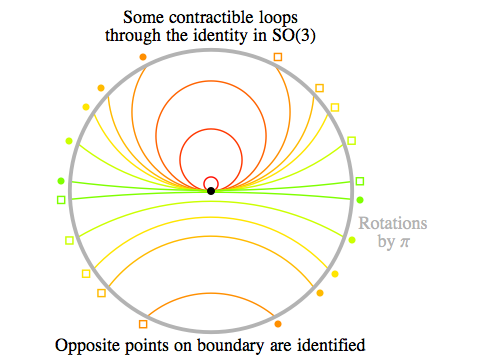
A rotation by is a path from the center to the surface at and then from the antipodal point (which is the same rotation) back to the center. This loop cannot be "untangled" or shrunk to a point. However, a path corresponding to a rotation can be shrunk to a point. In contrast, the group SU(2), which is topologically equivalent to the 3-sphere , is simply connected: all loops can be shrunk to a point. This topological distinction is at the heart of why SU(2) can support representations that SO(3) cannot.
Conclusion: Nature's Choice is SU(2)
This might seem like a mathematical curiosity, but it has profound physical meaning. In quantum mechanics, the overall phase of a state vector is unobservable. A state and are physically indistinguishable. Therefore, rotating an electron by results in a state , which describes the same physical situation if measured in isolation. However, this relative phase difference is physically real and can be observed in interference experiments.
This forces us to conclude that the true, fundamental symmetry group for rotations in quantum mechanics is SU(2).
- Particles with integer spin (bosons, like photons or the Higgs boson) transform under representations of SU(2) which are also "faithful" representations of SO(3). They are unaffected by the 2-to-1 mapping.
- Particles with half-integer spin (fermions, like electrons and quarks) transform under representations of SU(2) that are not true representations of SO(3). They are often called spinor representations or projective representations of SO(3).
The mathematical structures we have been developing are not mere abstractions; they are the bedrock of how we describe the fundamental particles of our universe. Even in modern condensed matter and optics, these concepts reappear. For example, structured light beams can carry orbital angular momentum, and their states can be mapped onto a sphere analogous to the Bloch sphere for a spin-1/2 particle, demonstrating the universality of this mathematical framework.

Key Takeaways:
- The Lie algebra of quantum mechanical angular momentum operators, , is isomorphic to and .
- The irreducible representations of this algebra are labeled by an integer or half-integer .
- Orbital angular momentum, described by single-valued wavefunctions (spherical harmonics), can only realize the integer representations.
- Intrinsic spin can realize both integer and half-integer representations.
- The existence of half-integer spin representations is a consequence of the global topology of the rotation group. The true symmetry group is the simply connected SU(2), which is the double cover of SO(3).
- Under a rotation, integer-spin states (bosons) return to themselves, while half-integer-spin states (fermions/spinors) acquire a phase of -1.
In this lesson, we have cemented the physical meaning of the representations. In our next lesson, we will learn how to combine these representations. We will tackle the problem of adding two angular momenta, such as the orbital and spin angular momentum of an electron, which involves decomposing the tensor product of two SU(2) representations. This will lead us to the Clebsch-Gordan series and coefficients.