Welcome back. In our previous lesson, we achieved a significant milestone by using the method of highest weight to classify all possible finite-dimensional irreducible representations of the algebra. We found that these irreps are uniquely labeled by a number , the "spin," which can be any non-negative integer or half-integer. For each , there exists a -dimensional representation space spanned by states , where the weight ranges from to in integer steps.
Having established what representations exist, our goal in this lesson is to move from abstract classification to concrete construction. We will derive the explicit matrix elements for the generators and in the basis for any arbitrary spin . This process will provide us with the actual matrices that act on quantum states, turning our abstract algebraic framework into a powerful computational tool for quantum mechanics.
The Standard Angular Momentum Basis
Let's begin by formally setting up our workspace. For a given irreducible representation labeled by spin , we work in a -dimensional complex vector space. The standard orthonormal basis for this space consists of the kets , where . These are, by definition, the simultaneous eigenvectors of the Casimir operator and the generator :
Our objective is to find the matrix elements of the algebra generators in this basis: , where can be . Note that since these operators are constructed from the algebra generators, they cannot change the total spin . An operator acting within a given irrep cannot connect states of different ; hence, matrix elements like are zero unless .
Matrix Elements of and
Constructing the matrices for and is straightforward, as our basis states are their eigenvectors. The matrix elements are:
This means that in the basis, the matrix for is simply the identity matrix multiplied by . The matrix for is a diagonal matrix whose entries are the possible values of . If we order our basis vectors from down to , the matrix for will have the entries along its diagonal.
Matrix Elements of the Ladder Operators
The most crucial part of the construction is finding the matrix elements for the ladder operators, and . We know from the previous lesson that they act on a state to produce a state proportional to :
Our task is to determine the coefficients . The standard approach is to compute the squared norm of the state .
\begin{align*}
| J_+ |j,m\rangle |^2 &= \langle j,m | J_+^\dagger J_+ | j,m \rangle \
&= \langle j,m | J_- J_+ | j,m \rangle \
&= |C_{+}(j,m)|^2 \langle j,m+1 | j,m+1 \rangle = |C_{+}(j,m)|^2
\end{align*}
To evaluate this, we use the identity , which you can derive from the fundamental commutation relations. Applying this to our state:
\begin{align*}
\langle j,m | J_- J_+ | j,m \rangle &= \langle j,m | (J^2 - J_3^2 - \hbar J_3) | j,m \rangle \
&= [j(j+1)\hbar^2 - (m\hbar)^2 - \hbar(m\hbar)] \langle j,m|j,m \rangle \
&= \hbar^2 [j(j+1) - m(m+1)] \
&= \hbar^2 (j-m)(j+m+1)
\end{align*}
This gives us the magnitude of the coefficient: . The coefficient is, in general, a complex number. However, the relative phases of the basis states for a fixed are not physically determined. We can use this freedom to make a convenient choice. The Condon-Shortley phase convention sets these coefficients to be real and positive.
Thus, we have our final expressions for the action of the ladder operators:
where the second equation can be derived in a completely analogous way using the identity .
The following video provides an excellent, detailed walkthrough of this derivation.
Spinors for Beginners 18: Irreducible Representations of SU(2) (Ladder Operators)
In the video "Spinors for Beginners 18" by eigenchris, the narrator derives these proportionality constants, which he calls \alpha and \beta. His notation corresponds to a choice of \hbar=1, but the algebraic steps are identical.
Please watch from this segment. Pay close attention to how the Casimir operator (g^2, our J^2/\hbar^2) is used to establish the eigenvalue j(j+1) for all states in the multiplet, which is then plugged into the identities for g_\pm^\dagger g_\pm to find the coefficients.
The corresponding matrix elements are found by taking the inner product with :
Notice that only has non-zero matrix elements one position above the main diagonal (the superdiagonal), and only has them one position below (the subdiagonal). Since , the matrix for is the conjugate transpose of the matrix for .
For a more formal and complete treatment of this derivation, the following notes are an excellent resource.
[PDF] Copyright c 2021 by Robert G. Littlejohn
These notes from Robert Littlejohn's graduate quantum mechanics course at UC Berkeley provide a rigorous derivation of the matrix elements.
Please read Sections 4 ("Phase Conventions and Matrix Elements of J±") and 5 ("Matrices in the Standard Angular Momentum Basis"). This reading formalizes the Condon-Shortley phase convention and explicitly writes out the matrix elements for J_3, J_\pm, and by extension J_1 and J_2.
Examples: Constructing the Matrices
With the general formulae in hand, let's construct the matrices for the two most important cases in physics: spin-1/2 and spin-1.
Spin (Dimension = 2)
The basis is .
- : The matrix is diagonal with eigenvalues .
- : The only non-zero element is . Using our formula with :
. - : This is the conjugate transpose of .
- and : We can now find the matrices for the Cartesian generators using and .
As expected, the generators of the spin-1/2 representation are proportional to the Pauli matrices.
Spin (Dimension = 3)
The basis is .
- :
- : We have two non-zero elements:
- : Taking the conjugate transpose:
- and :
This procedure can be systematically applied for any . The eigenchris video also walks through these constructions.
Spinors for Beginners 18: Irreducible Representations of SU(2) (Ladder Operators)
The video now applies the derived formulas to construct the matrices for specific spin values.
Watch the construction for spin-1 (spin-1) and you can also see the resulting matrices for spin-3/2 and spin-2 (higher spins) to appreciate how the pattern continues.
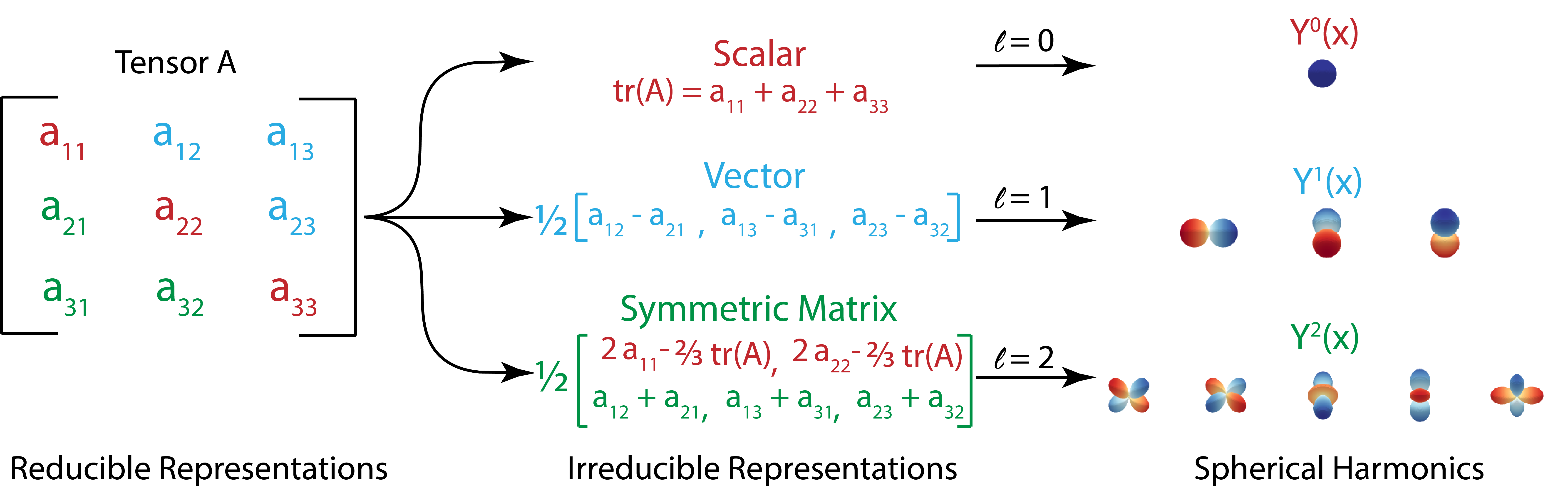
This construction reveals a deep truth. The abstract commutation relations of the algebra contain all the information needed to build the entire family of angular momentum matrices that form the foundation of quantum mechanics.
Conclusion
In this lesson, we have successfully bridged the gap from the abstract classification of representations to their concrete construction. By systematically evaluating the matrix elements of the algebra generators in the standard basis, we have developed a universal algorithm to build the matrix for any arbitrary spin .
Key Takeaways:
- The matrix elements of the generators can be fully determined from the algebra's commutation relations and the definition of the basis.
- The matrices for and are diagonal in this basis, with eigenvalues and , respectively.
- The crucial step is determining the matrix elements of the ladder operators, and , which are found to be .
- The Condon-Shortley phase convention is a standard choice that simplifies these matrices by making their non-zero elements real and positive.
- This procedure yields the familiar Pauli matrices for and provides a blueprint for constructing the matrices for .
We now possess the explicit matrices that represent the action of angular momentum operators. In the next lesson, we will solidify the physical interpretation of this mathematical machinery, explicitly connecting the irreducible representations of SU(2) to the quantum theory of angular momentum and the behavior of particles with spin.