Welcome back to our course on Symmetry Methods in Physics. In the last lesson, we established the profound connection between the irreducible representations of SU(2) and the quantum theory of angular momentum. We saw that the states of any quantum system with rotational symmetry must fall into these irreps, which we label by a spin quantum number . We also uncovered the subtle topological distinction between SO(3) and its double cover SU(2), explaining why nature accommodates both integer-spin particles (bosons) and half-integer-spin particles (fermions).
So far, we have treated systems with a single source of angular momentum. However, many physical systems are more complex. An electron in an atom has both orbital angular momentum () and intrinsic spin angular momentum (). A helium atom has two electrons, each with its own spin. How do we describe the total angular momentum of such a composite system? This lesson will answer that question. We will develop the machinery to combine angular momenta, which in the language of group theory means constructing and then decomposing the tensor product of SU(2) representations. This process will lead us to a fundamental result known as the Clebsch-Gordan series.
The Problem of Combining Angular Momenta
In classical mechanics, combining two angular momenta, and , is straightforward: the total angular momentum is simply their vector sum, . The magnitude and direction of can be found using standard vector addition.

In quantum mechanics, this simple picture breaks down. The components of an angular momentum operator do not commute with each other (e.g., ). This is a manifestation of the uncertainty principle: we cannot simultaneously know the precise values of all three components of an angular momentum vector. Consequently, we cannot simply add the components of and as if they were classical vectors. We need a new formalism that respects the rules of quantum mechanics.
The video below provides an excellent introduction, contrasting the classical approach with the operator-based formalism required in quantum mechanics.
Addition of Angular Momentum (Clebsch-Gordan Coefficients)
This video from the channel "Let's Get Complex" begins by explaining why the classical method of adding angular momentum vectors is insufficient in quantum mechanics and introduces the language of operators and states that we must use instead.
Please watch the introductory segment from the beginning to 3:52. This will set the stage for the quantum mechanical treatment of the problem.
The Tensor Product Space
Let's consider two quantum systems, 1 and 2, described by Hilbert spaces and . Suppose system 1 is in a state from an irrep of spin , and system 2 is in a state from an irrep of spin . The composite system is described by a state in the tensor product space .
A basis for this new space can be formed by taking all possible tensor products of the basis vectors from and . These basis states are written as , or more compactly as . The dimension of this composite space is the product of the individual dimensions: . This basis is often called the uncoupled basis because it's built from states where the individual angular momenta of the subsystems are well-defined.
Now, how do operators corresponding to physical observables act on this new space?
- An operator that acts only on system 1 becomes , where is the identity on .
- An operator that acts only on system 2 becomes .
- The total angular momentum operator is the sum of the individual operators:
This rule for adding operators in a tensor product space might seem non-intuitive. It arises directly from the way Lie algebra generators combine when we take the tensor product of the Lie group representations they generate. An infinitesimal rotation on the composite system is the product of the infinitesimal rotations on the subsystems. The rule for the generators follows from taking the derivative of this product, as the following video explains masterfully.
Spinors for Beginners 19: Tensor Product Representations of su(2) [Clebsch-Gordan coefficients]
This video from the channel eigenchris provides an excellent walkthrough of tensor product representations. It starts with the physical motivation, reviews the mathematics of tensor products, and critically, derives how Lie algebra generators act on the product space.
Watch the introduction (0:00-2:41) for physical motivation (e.g., Cooper pairs in superconductivity). Review the formal definitions of direct sums and tensor products (2:41-7:22). Pay close attention to the derivation of how Lie algebra generators combine in a tensor product space (7:22-12:24). The result X_{tot} = X_1 \otimes I_2 + I_1 \otimes X_2 is crucial.
Decomposing the Product Space: A Canonical Example
The uncoupled basis states are eigenstates of . However, they are generally not eigenstates of the total angular momentum squared, .
Since the composite system is also a physical system with rotational symmetry, its states must also organize themselves into irreducible representations of SU(2). This means there must exist a different basis, the coupled basis, whose states are simultaneous eigenstates of and , labeled as .
Finding this new basis is equivalent to decomposing the reducible tensor product representation into a direct sum of irreducible representations. Let's work through the foundational example: combining two spin-1/2 particles.
The uncoupled space has dimension . The basis states are:
Using up/down arrow notation: .
The total operator is . Its eigenvalues are just the sum of the individual and :
- For :
- For :
- For :
- For :
We see that we have one state with , one with , and two with . The state with the highest value, , must be a highest-weight state. Since , this state must belong to an irrep with total spin . This is the state .
We can generate the rest of the multiplet by applying the lowering operator . This procedure, along with the identification of the remaining state, is shown in detail in the next segment of the eigenchris video.
Spinors for Beginners 19: Tensor Product Representations of su(2) [Clebsch-Gordan coefficients]
This part of the video works through the detailed decomposition of the spin-1/2 ⊗ spin-1/2 case. It explicitly shows how to use ladder operators to generate the new basis states and demonstrates how the 4-dimensional space splits into two separate irreducible subspaces.
Please watch the segment from 12:24 to 23:12.
As the video demonstrates, the four uncoupled states recombine into two separate, irreducible multiplets:
- A spin-1 triplet () with three states corresponding to .
- A spin-0 singlet () with one state corresponding to .
The tensor product space decomposes into a direct sum of these irreducible subspaces:
In the language of representations, we write this decomposition as:
Or, using dimensions:
The General Rule: The Clebsch-Gordan Series
This decomposition is an example of a general rule. When we take the tensor product of two SU(2) irreps with spins and , the resulting reducible representation decomposes into a direct sum of irreps with total spin ranging from to in integer steps.
This is the Clebsch-Gordan series:
The following excerpt from Peter Woit's notes provides a concise, formal statement of this rule.
SU(2) Representations and Their Applications 1 Review of ...
This excerpt provides a clear statement of the Clebsch-Gordan decomposition formula.
Please read the paragraph starting "If one takes the tensor product". Focus on the formula itself. The notation in the notes uses V_n for the representation of dimension n+1, which corresponds to a spin of j=n/2. The formula given is V_n \otimes V_m = V_{n+m} \oplus V_{n+m-2} \oplus \dots \oplus V_{|n-m|}. You can verify that by setting j_1=n/2 and j_2=m/2, this is equivalent to the rule j_1 \otimes j_2 = \bigoplus_{J=|j_1-j_2|}^{j_1+j_2} J.
Let's check this formula with some examples:
- Two spin-1/2 particles: . Total spin ranges from to . So, . The decomposition is . This matches our detailed calculation.
- A spin-1 particle and a spin-1/2 particle: . Total spin ranges from to . So, . The decomposition is . Let's check dimensions: . On the right side: . The dimensions match.
Visualizing the Decomposition
Since you have an interest in computational work and modeling, you'll appreciate that there is a wonderfully simple graphical algorithm for finding these decompositions, which connects to the weight diagrams we will study for more complex algebras like .
Imagine the weight diagram for an irrep is just a set of nodes on a line at positions . To find the decomposition of , you take the weight diagram of and "add" the weight diagram of to each of its nodes. You then count how many nodes land on each position. The result gives you the structure of the decomposed irreps.
Spinors for Beginners 19: Tensor Product Representations of su(2) [Clebsch-Gordan coefficients]
The eigenchris video introduces this powerful visual method for finding the decomposition using "weight diagrams". This provides a quick, intuitive way to get the result of the Clebsch-Gordan series.
Watch the segment from 32:41 to 34:45 to see how this works for combining spin-1/2 representations. The video also briefly shows how it extends to other cases like spin-1 ⊗ spin-1 from 39:03 to 39:42, which results in the decomposition 1 \otimes 1 = 2 \oplus 1 \oplus 0.
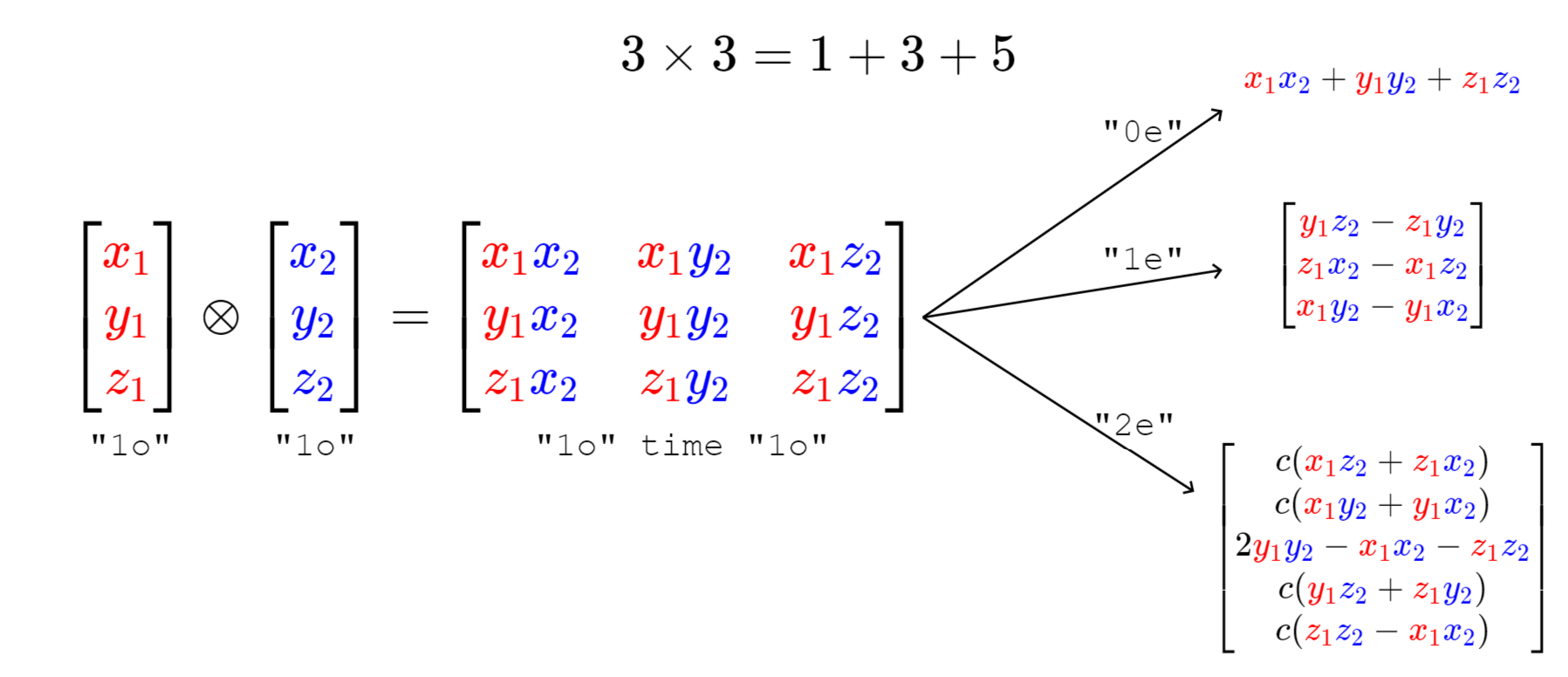
The image below shows the decomposition for using a more abstract tensor notation, which is another way to visualize how the nine components of the product space regroup into multiplets of dimension 5 (), 3 (), and 1 ().
Conclusion
In this lesson, we have developed the formal procedure for combining angular momenta in quantum mechanics. This is a cornerstone of quantum theory with vast applications, from atomic and molecular physics (understanding term symbols and spectral lines) to particle physics (combining quark spins to form hadrons) and condensed matter physics (describing magnetic interactions and collective excitations).
The key step is to form the tensor product of the individual state spaces and then decompose this product space into a direct sum of irreducible representations. This decomposition is governed by the Clebsch-Gordan series, a simple and elegant rule that dictates the possible values of the total angular momentum .
Key Takeaways:
- Combining quantum systems requires forming the tensor product of their Hilbert spaces, .
- Lie algebra generators for the composite system are formed by the rule .
- The tensor product of two SU(2) irreps is generally reducible.
- This reducible representation decomposes into a direct sum of irreps according to the Clebsch-Gordan series:
- This decomposition corresponds physically to finding the possible values for the total angular momentum of the combined system.
We have now answered which irreps appear in the decomposition. The next natural question is, how are the new basis states explicitly constructed from the old basis states ? The coefficients of this change-of-basis transformation are the famous Clebsch-Gordan coefficients. In our next lesson, we will learn how to calculate them.