Welcome to the next stage of our exploration into the deep connection between symmetry and the laws of physics. In our last lesson, we saw how Noether's theorem allows us to derive fundamental conservation laws, like the conservation of energy and momentum, from the invariance of a Lagrangian under global spacetime symmetries. The key word there is "global": the transformations we considered—shifts in time or space—were the same everywhere.
Today, we will challenge this assumption. We will ask a seemingly simple but profoundly consequential question: What if we require a theory to be invariant under transformations that can vary from one point in spacetime to another? This will lead us to distinguish between global symmetries and a more restrictive, powerful class known as local or gauge symmetries. By understanding this distinction, we will motivate the principle of local gauge invariance—a cornerstone of modern physics that provides a systematic way to derive the fundamental forces of nature. This principle is not just an idle mathematical curiosity; it is the very foundation upon which the Standard Model of particle physics is built.
Global vs. Local Symmetry: An Intuitive Picture
Let's begin with a concept you are familiar with from quantum mechanics: the wave function of a particle, which is a complex-valued field. The absolute phase of this wave function is not observable; only relative phases are. This suggests a symmetry: we can change the phase of the wave function everywhere by the same amount, and the physical predictions will remain unchanged. This is a global phase symmetry.
Consider the classic double-slit experiment with electrons. The interference pattern observed on the screen depends on the relative phase of the electron waves arriving from each slit.
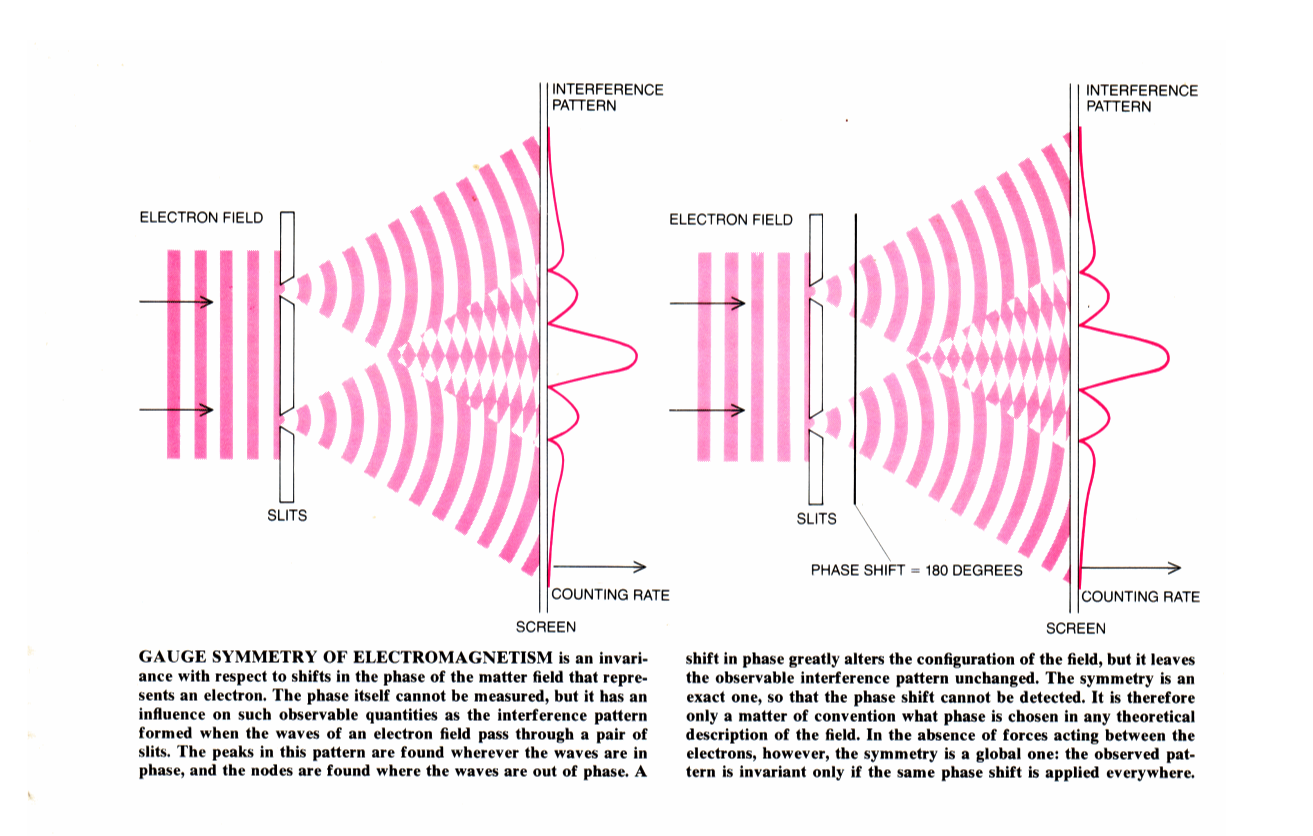
If we apply a uniform phase shift to the entire electron field, the relative phase between the two paths remains the same, and the interference pattern is unaffected. This is a global symmetry. The transformation parameter (the phase angle) is a constant throughout space and time.
Now, imagine we could apply a different phase shift to the electron wave depending on its position. For instance, what if the phase of the wave passing through the top slit was shifted differently from the wave passing through the bottom slit? This would change their relative phase upon recombination, altering the interference pattern. This is a local symmetry transformation, where the phase angle is a function of the spacetime coordinate, . A simple theory of a free electron is clearly not invariant under such arbitrary local phase shifts.
Let's formalize this distinction.
gauge.dvi - Department of Physics
This reading from a set of notes on gauge theories provides a crisp and direct definition of global and local symmetries.
Please read the introductory section, up to but not including the "Abelian Example". Focus on the definitions provided for global symmetry and local (or gauge) symmetry. Also, note the important point on terminology, which clarifies potential confusion between physics and mathematics literature.
As the text highlights, a global symmetry involves a transformation that is identical at all spacetime points. In contrast, a local (or gauge) symmetry involves a transformation whose parameters can vary independently at each spacetime point.
The Breakdown of Local Invariance
We have established that a typical theory of free particles, while possessing global symmetries, is not invariant under the corresponding local transformations. Let's see precisely why this happens.
Recall the Lagrangian for a free Dirac field, which describes a free electron:
This Lagrangian is invariant under a global U(1) phase transformation:
where is a constant. The mass term, , transforms into , which is trivially invariant. The kinetic term is also invariant because the constant phase factor commutes with the derivative operator .
Now, let's "gauge" this symmetry by promoting the constant parameter to a function of spacetime, . The transformation becomes:
The mass term is still invariant. However, the derivative in the kinetic term now acts on the product of and . Using the product rule:
When we substitute this into the kinetic term , the desired transformation factor from will cancel the first part, but an unwanted extra term remains:
The symmetry is broken. The derivative , which compares the value of the field at infinitesimally separated points and , is the source of the problem. Under a local transformation, the phase reference frame changes from point to point, so a simple derivative is no longer a meaningful comparison.
This problem and the path towards its solution are the main topics of the following video.
Particle Physics Lecture 12: Interactions via Local Gauge Symmetry (The Abelian Case)
The video "Interactions via Local Gauge Symmetry" by Alex Flournoy provides a detailed walkthrough of promoting a global symmetry to a local one and shows exactly how the invariance breaks down.
Please watch the following two segments: From 10:43 to 14:56, the lecturer demonstrates the global U(1) invariance of the Dirac Lagrangian. This should be a familiar review. Then, watch from 14:56 to 18:14. This is the crucial part where the global symmetry is promoted to a local one, and it's shown explicitly how the derivative term breaks the invariance of the Lagrangian.
The Principle of Local Gauge Invariance
The failure of our free-particle Lagrangian to be locally symmetric presents a choice. We could conclude that nature simply doesn't possess such local symmetries. Or, we could take a more audacious path and elevate local symmetry to a fundamental principle. This is the Principle of Local Gauge Invariance: we postulate that the fundamental laws of physics must be invariant under local gauge transformations.
This is a profoundly powerful idea. If we insist on local symmetry, we are forced to modify our theory to restore it. To cancel the unwanted term , we must introduce a new component to our theory that transforms in just the right way. As we'll see in the next lesson, this requires two modifications:
- Replacing the ordinary derivative with a covariant derivative .
- Introducing a new vector field, called a gauge field, which couples to the matter field. This coupling is the interaction.
The requirement of local gauge invariance, therefore, acts as a guiding principle that dictates the existence and form of interactions (forces) in our universe. By demanding that the U(1) phase symmetry of the Dirac Lagrangian be local, we are forced to introduce the electromagnetic field. The theory of quantum electrodynamics (QED) is, at its heart, the theory of a Dirac field with a local U(1) gauge symmetry.
The following text provides a compact and insightful summary of this motivation.
[PDF] Chapter 13 Local Symmetry
This text from Joel Shapiro's lecture notes offers a concise theoretical perspective on why local symmetry requires a new field.
Please read the following two passages: The central problem with derivatives under local transformations is beautifully explained here. The author draws an analogy to the need for a common coordinate system to compare vectors. Given your background in General Relativity, this should resonate with the concept of parallel transport and the connection. This passage directly states the main consequence of our discussion: demanding local invariance forces us to expand the theory by introducing a new dynamical field and replacing the ordinary derivative with a covariant derivative.
As Shapiro's notes suggest, the gauge field acts as a "connection," allowing us to compare the phase of the matter field at different spacetime points in a consistent way. The demand for local symmetry is not just a mathematical game; it's a profound physical principle that generates the structure of interactions from a symmetry requirement.
Conclusion
In this lesson, we have moved beyond the global symmetries that lead to conservation laws and into the more restrictive and creative realm of local symmetries.
Key Takeaways:
- A global symmetry is a transformation whose parameters are constant throughout spacetime (e.g., a constant phase shift ).
- A local (gauge) symmetry is one whose parameters are functions of spacetime coordinates (e.g., a position-dependent phase shift ).
- Lagrangians for free fields, such as the Dirac Lagrangian, are typically invariant under global symmetries but not under the corresponding local symmetries. The failure point is the derivative term, which compares fields at different points.
- The Principle of Local Gauge Invariance is the postulate that fundamental theories must be invariant under local gauge transformations.
- This principle is not descriptive but prescriptive: it forces the introduction of new gauge fields that mediate interactions and compels the replacement of ordinary derivatives with covariant derivatives.
We have laid the conceptual groundwork. We've seen why local symmetry is a problem for simple theories and have motivated the principle that turns this problem into a powerful tool for theory construction. In our next lesson, we will put this principle into action. We will explicitly construct the U(1) gauge field and the covariant derivative needed to make the Dirac Lagrangian locally symmetric, and in doing so, we will derive the famous interaction term of Quantum Electrodynamics from first principles.