Welcome back. In our previous lesson, we generalized Noether's theorem to classical field theory, discovering that continuous symmetries lead to conserved currents that obey a local conservation law, . This provided a deeper understanding of conservation, moving from globally conserved quantities to the continuous flow of "stuff" described by continuity equations.
Today, we will apply this powerful formalism to one of the most fundamental symmetries of nature: the invariance of physical laws under translations in space and time. By demanding that our Lagrangian density be invariant under these shifts, we will derive the energy-momentum tensor, . This rank-2 tensor is a cornerstone of modern physics, describing the density and flow of energy and momentum. It is the source of gravity in Einstein's field equations and a fundamental observable in quantum field theory and condensed matter systems.
Spacetime Translations and the Noether Current
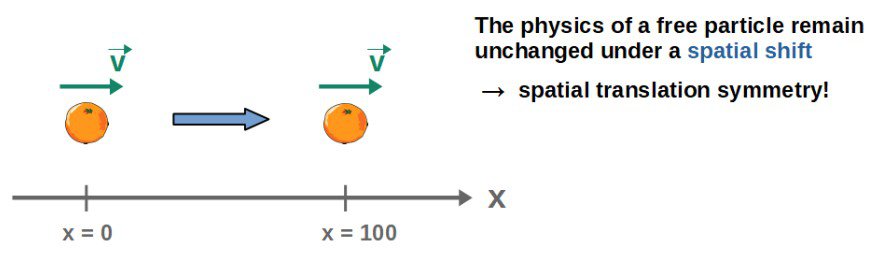
Let's begin by considering an infinitesimal translation in spacetime. We perform an active transformation, shifting the physical field configuration itself. A point with coordinates is moved to , where is a set of four small, constant parameters. For a field theory to be translationally invariant, its Lagrangian density, , cannot have any explicit dependence on the spacetime coordinates ; it can only depend on implicitly through the fields and their derivatives.
Under such a transformation, the field and the Lagrangian density transform as scalars. Following the standard convention in field theory for an active translation:
- The field variation is .
- The variation of the Lagrangian density is .
The change in the Lagrangian density can be written as a total four-divergence. Since is constant, we can write . This is a slight abuse of notation, as the indices must match. A more careful way is to write .
This is precisely the condition required to apply Noether's theorem, where the term corresponding to in our general formula is .
Substituting and into the formula for the Noether current, we get:
Since the parameters are arbitrary and independent for each , we can factor them out. This reveals that we don't have a single conserved current, but four of them, one for each direction of translation.
The quantity inside the parentheses is the conserved current associated with translations in the -direction. We assemble these four currents into a single object with two indices, the canonical energy-momentum tensor:
Each of these four currents is conserved, a fact expressed by the single equation .
The following reading provides a concise derivation of this crucial result.
This section from David Tong's renowned lecture notes on Quantum Field Theory applies the general proof of Noether's theorem to the specific and foundational case of spacetime translations. It's a direct and elegant derivation of the energy-momentum tensor.
Please read the section titled "Translations and the Energy-Momentum Tensor". As you read, focus on these key steps: The transformation rules for the field \phi_a(x) and the Lagrangian density \mathcal{L}(x) under an infinitesimal translation. Note how these are identified with the \delta\phi_a and \delta\mathcal{L} = \partial_\mu F^\mu terms from the general theorem. The substitution of these terms into the Noether current formula to obtain a set of four conserved currents. The definition of the energy-momentum tensor T^\mu_\nu (or T^\nu_\mu in the text's convention) as the collection of these currents.
The Physical Meaning of the Energy-Momentum Tensor
We have derived a conserved tensor , but what physics does it contain? The four conservation laws (for ) correspond to the conservation of energy and the three components of momentum.
Conservation of Energy ()
For , we consider invariance under time translations. The corresponding conserved Noether current is , and the conserved charge is . Let's examine the component :
Recognizing the canonical momentum density as , this becomes:
This is precisely the Hamiltonian density. Therefore, represents the energy density of the field. The conserved charge is the total energy, . The spatial components represent the energy flux (flow of energy) in the -th direction. The conservation law is the continuity equation for energy:
where is the energy flux vector with components .
Conservation of Momentum ()
For , we consider invariance under spatial translations. The conserved charge associated with translations in the -th direction is . Let's examine :
This quantity, , is the momentum density in the -th direction. The total conserved charge is the total momentum of the field in that direction.
The components represent the flux of -momentum across a surface with a normal in the -direction. This is the stress tensor, which includes pressure (diagonal terms) and shear stresses (off-diagonal terms).
Example: The Klein-Gordon Field
To make these concepts concrete, let's derive the energy-momentum tensor for the simplest relativistic field theory: a real scalar field with the Lagrangian density you've encountered in your QFT course.
We use the formula for the energy-momentum tensor .
First, we compute the derivative:
Substituting this back into the formula for :
It is often more convenient to work with the fully contravariant or covariant tensor. Raising the index using the metric , we get :
This is the famous energy-momentum tensor for a scalar field. Notice that for this example, is symmetric, i.e., . This is a crucial property for theories that are also Lorentz invariant (Poincaré invariant), as it connects the conservation of angular momentum to the properties of . This symmetry ensures that the energy flux equals the momentum density .
The following video walks through this exact calculation and explores the physical meaning of the resulting components.
Noether's Theorem and the Momentum of the Klein-Gordon Field
This video from Nick Heumann University provides a concrete application of the general formalism we've just developed. It meticulously derives the energy-momentum tensor for the Klein-Gordon field and then identifies the components corresponding to energy and momentum.
I recommend watching the following two segments: First, watch the derivation from the general formula. Follow how the general expression for T^\mu_\nu is applied to the specific Lagrangian of the Klein-Gordon field. Next, watch from the physical interpretation. Here, the presenter calculates the T^{00} component and shows it is the Hamiltonian density, and then calculates the T^{0i} components, identifying them with the momentum density of the field.
Conclusion
In this lesson, we have taken a significant step by applying Noether's theorem to the fundamental symmetries of spacetime. This has allowed us to derive from first principles one of the most important objects in theoretical physics.
Key Takeaways:
- Invariance of a Lagrangian density under spacetime translations implies the existence of four conserved Noether currents.
- These four currents can be assembled into a single rank-2 tensor, the energy-momentum tensor .
- The conservation law is expressed compactly as .
- The components of have direct physical interpretations:
- is the energy density (the Hamiltonian density ).
- is the momentum density.
- is the energy flux.
- is the stress tensor, describing the flux of momentum.
- The general formula for the canonical energy-momentum tensor is .
We have seen how the abstract principle of symmetry gives rise to concrete, physical quantities like energy and momentum density. In our next lesson, we will continue this exploration by distinguishing between global symmetries, like the ones we've studied so far, and a more powerful and restrictive class: local (gauge) symmetries. This will lead us to the principle of local gauge invariance, which forms the very foundation of the Standard Model of particle physics.