Introduction
In our last lesson, we explored Landau theory, seeing how phase transitions can be elegantly described as a process of spontaneous symmetry breaking (SSB). We saw that the equilibrium state of a system is determined by the value of an order parameter that minimizes the Landau free energy. For a system with a broken continuous symmetry, like a Heisenberg ferromagnet, there isn't just one minimum but a continuous landscape of degenerate ground states.
This lesson delves into the crucial concept of that landscape. We will formally define and explore the order parameter space, also known in quantum field theory as the vacuum manifold. This is the set of all possible ground states a system can settle into after a symmetry-breaking phase transition. As we will see, the geometry and topology—the very "shape"—of this space are not just mathematical curiosities. They have profound physical consequences, dictating the existence of stable, large-scale structures known as topological defects. Your background in both condensed matter and QFT will be invaluable here, as we will see this is a powerful unifying concept between the two fields.
From Potential Minima to a Space of States
Let's begin by revisiting the scalar field theories that are the canonical models for SSB. The shape of the potential directly determines the structure of the vacuum manifold. A lecture by Prof. Sunil Mukhi provides a clear illustration of the two fundamental cases.
Quantum Field Theory II: Lecture 23 - Spontaneous symmetry breaking
This lecture from Prof. Mukhi's QFT II course clearly contrasts the vacua of real and complex scalar fields.
Please watch two segments: Start by reviewing the potential for a real scalar field with a Z_2 symmetry from this section. Notice that the vacuum is comprised of two discrete, disconnected points. Next, watch the analysis of the complex scalar field with U(1) symmetry from this segment. Here, the potential has a continuous "circle of minima".
As the video shows, the structure of the lowest-energy states is entirely different in these two cases:
- For the real scalar field with Lagrangian , the potential has minima at . The vacuum manifold is a discrete set of two points, which we can denote as where .
- For the complex scalar field , with Lagrangian , the potential is minimized for any field configuration where . This condition defines a circle in the field space. The vacuum manifold is thus the circle .
This second case is the classic "Mexican hat" or "wine bottle" potential.
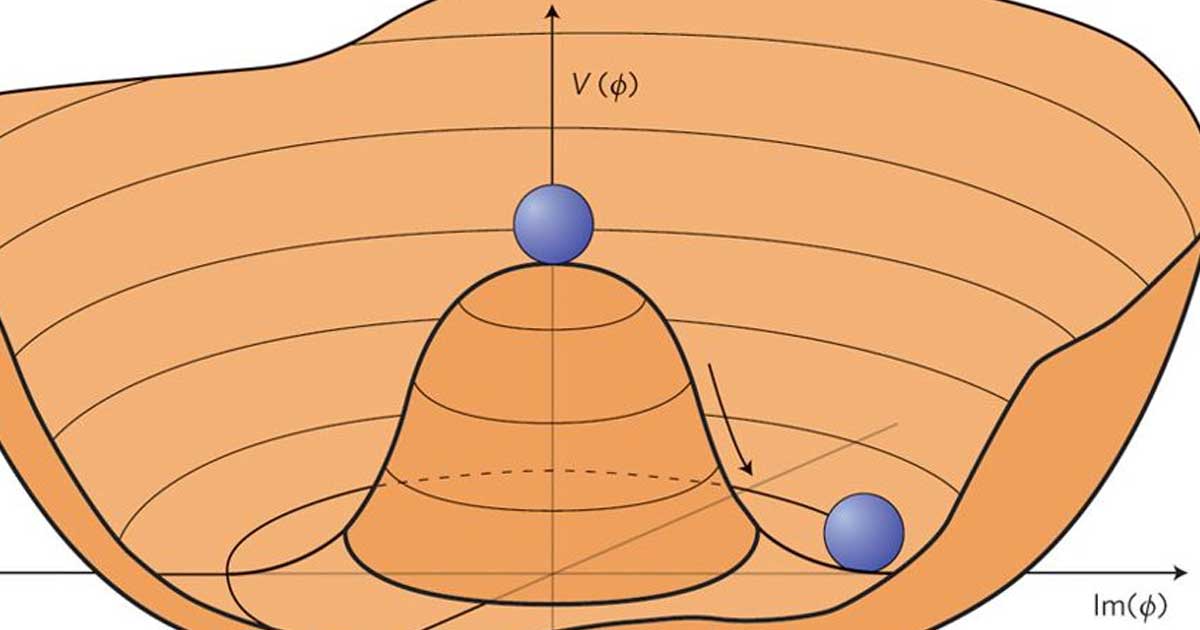
The key idea is this: in the broken-symmetry phase, the field at any point in space must, at least locally, take a value that lies within this manifold of minima. This manifold is what we call the order parameter space (in condensed matter) or the vacuum manifold (in QFT).
The Rich Zoology of Order Parameter Spaces
The simple examples of two points or a circle only scratch the surface. Different physical systems, with different order parameters and symmetries, give rise to a fascinating variety of order parameter spaces. A wonderful exposition of this idea comes from the condensed matter perspective.
Order Parameters, Broken Symmetry, and Topology
This classic chapter by James Sethna provides an exceptionally clear, physics-driven introduction to the concept of order parameter space, with excellent illustrations.
Please read section II, "Define the Order Parameter". Focus on the examples given and how each one defines a distinct mathematical space.
Let's consolidate and expand upon these crucial examples:
- Heisenberg Ferromagnet: The order parameter is the magnetization vector , which has a fixed magnitude below but can point in any direction. The space of all possible directions is the surface of a sphere. Thus, the order parameter space is the 2-sphere, .
- Nematic Liquid Crystal: The order parameter describes the average orientation of rod-like molecules. Since the molecules have head-tail symmetry, the direction is equivalent to . The order parameter is a headless vector, or a line. The space of all such lines in 3D is called the real projective plane, . This is a more exotic space; you can visualize it as a hemisphere where opposite points on the equatorial boundary are identified.
- Superfluid or Superconductor: The order parameter is a complex scalar field , the macroscopic wavefunction. Below the transition temperature, the magnitude is fixed, but the phase can take any value from 0 to . The order parameter space is the set of all possible phases, which is a circle, .
- Crystal: A crystal breaks continuous translational symmetry. The order parameter can be thought of as a displacement vector that tells us how to shift a reference lattice to align with the crystal at a given point. However, a shift by any lattice vector brings the lattice back onto itself. So, is equivalent to . This means the order parameter space for a 3D crystal is a 3-torus, .
The Formal Structure: Coset Space
We can generalize these examples with a powerful mathematical construction. The order parameter space can be determined directly from the symmetries of the theory.
Let be the symmetry group of the full, high-temperature Lagrangian. When the system spontaneously breaks this symmetry, it chooses a particular ground state, . This chosen state will generally not be invariant under all transformations in . However, there might be a subgroup that does leave invariant. is called the residual symmetry group or the unbroken subgroup.
All other degenerate ground states can be generated by acting on with elements of that are not in . Two elements will produce the same new ground state if they are related by an element of , i.e., for some . This is precisely the definition of a left coset . Therefore, the set of all distinct ground states—the vacuum manifold—is the set of all cosets of in .
The vacuum manifold is mathematically identified with the coset space .
This is a profoundly important result. Let's see how it works for our ferromagnet example.
- System: 3D Heisenberg Ferromagnet.
- High-T Symmetry Group: , the group of all rotations in 3D space, since the Hamiltonian is rotationally invariant.
- Spontaneous Symmetry Breaking: Below the Curie temperature, the system picks a specific direction for its magnetization, say along the z-axis: .
- Unbroken Subgroup: Which rotations leave unchanged? Only rotations around the z-axis. This subgroup is .
- Order Parameter Space: The manifold of degenerate vacua is therefore . This coset space is the space of ways you can orient a vector, which is precisely the 2-sphere, . Our formal result matches our physical intuition perfectly.
The following reading formalizes this crucial identification.
arXiv:hep-ph/9710292v1 9 Oct 1997
This paper by Tanmay Vachaspati provides a concise and clear statement of the formal definition of the vacuum manifold as a coset space.
Please read the first paragraph of Section 3.6, starting from "The Coset Space G/H". This paragraph masterfully connects the symmetry groups G and H to the vacuum manifold.
Why This Matters: A Preview of Topological Defects
We have gone to great lengths to define this space . Why? Because its topological properties—whether it is connected, has "holes," "tunnels," etc.—determine if the system can support stable, non-trivial field configurations called topological defects.
Imagine the order parameter field must take a value in at every point in space. If has a non-trivial shape, the field can "twist" or "wrap around" this shape as we move through space. If this wrapping is topologically non-trivial, it cannot be smoothly undone, creating a stable defect. A brilliant talk by Mark Trodden provides a vivid introduction to this idea.
Topological Defects in Cosmology - Mark Trodden
In this talk for the Institute for Advanced Study, Prof. Trodden explains how the structure of the vacuum manifold leads to different kinds of topological defects in cosmology.
Please watch the segment from this point. He provides concrete examples linking symmetry breaking patterns to domain walls, cosmic strings, and monopoles, which correspond to vacuum manifolds that are disconnected, have non-contractible loops, or non-contractible spheres, respectively.
The video gives a beautiful preview of where we are heading.
- If is disconnected (like the two points for the Ising model, from ), you can have regions of space in one vacuum separated from regions in the other. The interface is a domain wall.
- If contains non-contractible loops (like the circle for a superfluid), the phase of the order parameter can wind as you go around a loop in real space. This creates a line defect—a vortex in a superfluid or a cosmic string in the early universe.
- If contains non-contractible spheres (like for a GUT), the order parameter field can adopt a "hedgehog" configuration, pointing outwards in all directions from a central point. This is a point defect, a magnetic monopole.

These defects are not just small fluctuations; they are stable, macroscopic objects whose existence is protected by topology. Their study is a cornerstone of modern condensed matter physics and cosmology.
Conclusion
In this lesson, we have formally defined the space of degenerate ground states that emerges from spontaneous symmetry breaking. This concept, known as the order parameter space in condensed matter and the vacuum manifold in QFT, is the essential link between symmetry and the large-scale structure of matter.
Key Takeaways:
- The order parameter space (or vacuum manifold) is the set of all degenerate, lowest-energy states of a system in its broken-symmetry phase.
- Physically, is the space of all possible values the order parameter can take (e.g., for a magnet's direction, for a superfluid's phase).
- Formally, it is constructed as the coset space , where is the symmetry group of the theory and is the unbroken subgroup that leaves a particular ground state invariant.
- The topological properties of are physically crucial, as they determine the types of stable topological defects (domain walls, vortices, monopoles) the system can support.
Preview of the Next Lesson:
We have talked intuitively about the "shape," "connectedness," and "holes" of the order parameter space. In our next lesson, we will introduce the rigorous mathematical toolkit for classifying these topological features: homotopy groups (). These groups will provide a powerful and precise method for predicting the existence and type of topological defects simply by analyzing the structure of .