Introduction
In our last lesson, we explored the Abelian Higgs mechanism, discovering how the spontaneous breaking of a local U(1) gauge symmetry leads to a massive gauge boson, which "eats" the would-be Goldstone boson to gain its longitudinal degree of freedom. We saw this principle in action as the theoretical basis for the Meissner effect in superconductors.
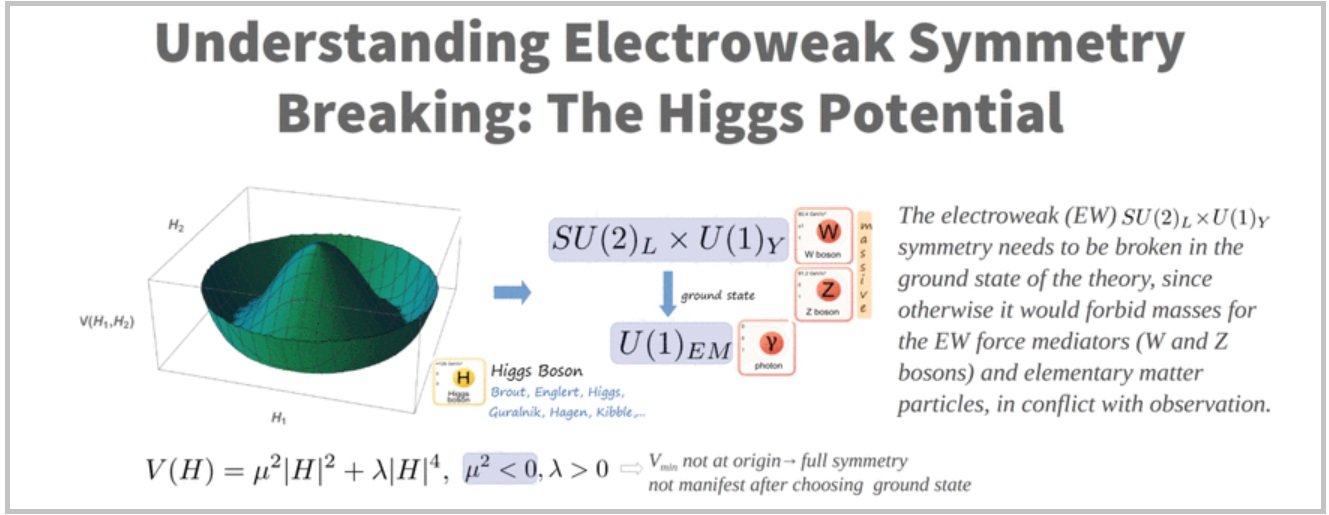
We now arrive at a pivotal application of this idea: explaining the masses of the carriers of the weak nuclear force. The Standard Model of particle physics is built upon the gauge group SU(3)xSU(2)xU(1). While the SU(3) of quantum chromodynamics remains unbroken, giving us massless gluons, the electroweak sector, described by SU(2)L × U(1)Y, is spontaneously broken. This lesson will outline how the non-Abelian Higgs mechanism operates within this electroweak theory to generate masses for the W and Z bosons while leaving the photon of electromagnetism massless. This is one of the crowing achievements of 20th-century theoretical physics.
The Electroweak Unification: SU(2)L × U(1)Y
Before diving into the mechanism, it's essential to understand why this particular gauge group structure was chosen. The goal is to unify the electromagnetic and weak forces. A successful theory must account for several key experimental facts:
- Massive Bosons: The weak force is mediated by massive gauge bosons: the charged and , and the neutral .
- Massless Photon: The electromagnetic force is mediated by the massless photon, .
- Parity Violation: The weak force violates parity symmetry. In fact, the charged-current weak interactions (mediated by W bosons) are maximally parity-violating: they only couple to left-handed fermions.
- Neutral Currents: Both weak and electromagnetic forces have neutral carriers ( and ).
This complex set of observations is elegantly captured by the gauge group SU(2)L × U(1)Y.
- The SU(2)L part ("L" for left) is a non-Abelian group with three generators, corresponding to three gauge bosons. Crucially, it is postulated to act only on left-handed fermions, which are arranged in doublets (e.g., the electron and its neutrino). This builds maximal parity violation directly into the theory. This symmetry is associated with a property called weak isospin, .
- The U(1)Y part ("Y" for hypercharge) is an Abelian group, like in QED, with one associated gauge boson. It couples to a charge called weak hypercharge, . Both left- and right-handed fermions carry hypercharge.
The familiar electric charge, , is then a specific combination of weak isospin's third component, , and weak hypercharge:
This relation is fundamental, as it connects the symmetries of the unified theory to the well-understood charge of electromagnetism.
The following video provides an excellent, non-technical overview of the motivations and components of electroweak theory.
Unifying the Forces: Electroweak Theory (Standard Model Part 7)
This video from ZAP Physics, "Unifying the Forces: Electroweak Theory", masterfully lays out the physical reasoning behind the construction of the electroweak model.
Please watch the entire video from start to finish. Pay close attention to how the experimental facts (massive W bosons, parity violation, fermion pairings) lead to the choice of the SU(2)L × U(1)Y gauge group and the necessity of spontaneous symmetry breaking.
The Higgs Mechanism in the Electroweak Model
With the stage set, we can now implement spontaneous symmetry breaking. To break SU(2)L × U(1)Y down to the U(1)EM of electromagnetism, we introduce a new field—the Higgs field—which transforms under the electroweak group. The simplest choice that accomplishes the task is a complex scalar doublet under SU(2)L, which also carries weak hypercharge .
This field has four real degrees of freedom. As in the Abelian case, we give it a "Mexican hat" potential:
This potential forces the field to acquire a non-zero vacuum expectation value (VEV), . We must choose a specific ground state. The standard choice, which preserves electric charge in the vacuum, is:
The key physics emerges from the kinetic term for the Higgs field in the Lagrangian, . The covariant derivative now includes the gauge fields for both SU(2)L (, with coupling ) and U(1)Y (, with coupling ):
where are the SU(2) generators (the Pauli matrices divided by 2).
When we substitute the VEV into this kinetic term, the interactions with the gauge fields generate mass terms. The following reading provides a detailed and rigorous derivation of this process.
[PDF] Spontaneous Symmetry Breaking and the Higgs Mechanism - arXiv
This section from the paper "Spontaneous Symmetry Breaking and the Higgs Mechanism" provides a complete derivation of mass generation in the Standard Model. It is mathematically dense but exceptionally clear.
Please read the subsection "The Electroweak Standard Model" carefully. As you read, focus on these points: The setup: The Higgs doublet, the covariant derivative, and the choice of vacuum. How the kinetic term (D_\mu \langle\Phi\rangle)^\dagger (D^\mu \langle\Phi\rangle) expands into terms quadratic in the gauge fields. The emergence of the charged W^\pm_\mu bosons as combinations of W^1_\mu and W^2_\mu, and the calculation of their mass, M_W. The mixing of the neutral W^3_\mu and B_\mu fields, which forms a mass matrix. The diagonalization of this matrix to find the physical mass eigenstates: a massive Z_\mu boson and a massless A_\mu (photon). Pay attention to how the Weinberg angle \theta_W defines this mixing.
Let's summarize the results of that derivation.
Mass Generation for Gauge Bosons
The term expands to:
From this, we can identify the physical particles and their masses:
-
Charged W Bosons: The and fields combine to form the mass eigenstates . The Lagrangian contains the term , which gives the W bosons a mass:
-
Neutral Z Boson and Photon: The and fields mix. We define two orthogonal combinations, which are the physical mass eigenstates:
- The Photon :
- The Z Boson :
The mixing angle , known as the Weinberg angle, is defined by . With this definition, the combination corresponding to the photon has exactly zero mass, while the Z boson acquires a mass:
This is a remarkable result. The Higgs mechanism not only gives mass to the weak bosons but also predicts a specific relationship between their masses, , which has been confirmed experimentally to high precision.
To solidify your understanding of the matrix algebra involved, the following resource provides a very explicit, step-by-step calculation.
Electroweak Theory, Spontaneous Symmetry Breaking, ...
These notes walk through the expansion of the Higgs kinetic term in a very practical, matrix-based way, showing how the mass terms for the W, Z, and photon naturally arise.
Read Section 4, "The Higgs Mechanism," focusing on the algebraic steps that lead from the full interaction matrix to the final mass terms. Then, quickly review Section 5, "Measured Masses," to see how these theoretical results connect directly to experimental values.
The Fate of the Higgs Field and Fermion Masses
What happened to our four initial scalar degrees of freedom in the Higgs doublet?
- Three have been "eaten" to become the longitudinal polarization modes of the now-massive , , and bosons.
- One degree of freedom remains as a physical, massive scalar particle: the Higgs boson, . Its mass, , is determined by the parameters of the Higgs potential.
Finally, the Higgs mechanism also provides a way to give mass to fermions. A standard mass term like is forbidden by the SU(2)L symmetry, which treats left- and right-handed fields differently.
The solution is to introduce Yukawa couplings between the fermions and the Higgs field. For the electron, this takes the form:
This entire term is constructed to be gauge invariant. When the Higgs field acquires its VEV, , this Lagrangian term generates a mass for the electron, , and an interaction term between the physical Higgs boson and the electron. This same mechanism applies to all quarks and leptons, with their vastly different masses reflecting different Yukawa coupling constants .
Conclusion
This lesson has outlined the application of the Higgs mechanism to the full electroweak theory, one of the foundational pillars of the Standard Model. You have seen how a carefully chosen gauge symmetry and a scalar Higgs doublet can spontaneously break, producing precisely the observed spectrum of massive W/Z bosons and a massless photon.
Key Takeaways:
- The electroweak force is described by the gauge group SU(2)L × U(1)Y, which accommodates parity violation and unifies the weak and electromagnetic interactions.
- Spontaneous symmetry breaking is achieved via a complex Higgs doublet that acquires a non-zero vacuum expectation value (VEV).
- The interaction of the gauge fields with the Higgs VEV generates masses for the and bosons.
- A specific linear combination of the and fields, identified as the photon , remains massless because the corresponding generator of electric charge, , leaves the Higgs vacuum invariant.
- The mixing of the neutral gauge bosons is described by the Weinberg angle, , which relates the masses of the W and Z bosons.
- Three of the four degrees of freedom of the Higgs doublet are "eaten" by the and bosons; the one remaining physical particle is the massive Higgs boson.
- Fermion masses are generated through gauge-invariant Yukawa couplings to the Higgs field.
Preview of the Next Lesson:
We will now shift gears to the final module of the course, which deals with the fascinating interplay between symmetry and topology. The concept of the vacuum manifold, or the space of degenerate ground states, which you saw is central to spontaneous symmetry breaking, is also a topological space. In the next lesson, we will introduce the mathematical tools of homotopy theory to classify topological defects—such as domain walls, vortices, and monopoles—that can arise in systems with spontaneously broken symmetries.