Introduction
In our previous lesson, we established that gapped quantum systems can be classified by topological invariants. For 2D systems that break time-reversal symmetry (TRS), this invariant is the integer Chern number, which corresponds to the quantized Hall conductivity. For systems that preserve TRS, the classification is more subtle, governed by a invariant that distinguishes between a conventional insulator () and a topological insulator (). We concluded by stating that this non-trivial topological phase is "protected" by time-reversal symmetry.
Today, we will uncover the precise mechanism of this protection. This lesson will explore the physical manifestation of the non-trivial topology: the Quantum Spin Hall (QSH) effect. We will see how time-reversal symmetry gives rise to unique conducting edge states and, crucially, how it shields them from the scattering and localization that would normally destroy one-dimensional conduction. This will provide a concrete physical basis for the robustness of the topological phase, connecting the abstract bulk invariant to measurable transport properties at the boundary.
The Quantum Spin Hall Effect and Helical Edge States
A 2D topological insulator, also known as a QSH insulator, exhibits a remarkable property: while its interior (the "bulk") is an electrical insulator, its one-dimensional edges host conducting states. These are not ordinary 1D conductors. The direction of an electron's motion along the edge is locked to its spin orientation. For instance, on a given edge, spin-up electrons might only be able to move to the right, while spin-down electrons can only move to the left. This spin-momentum locking defines what are known as helical edge states.
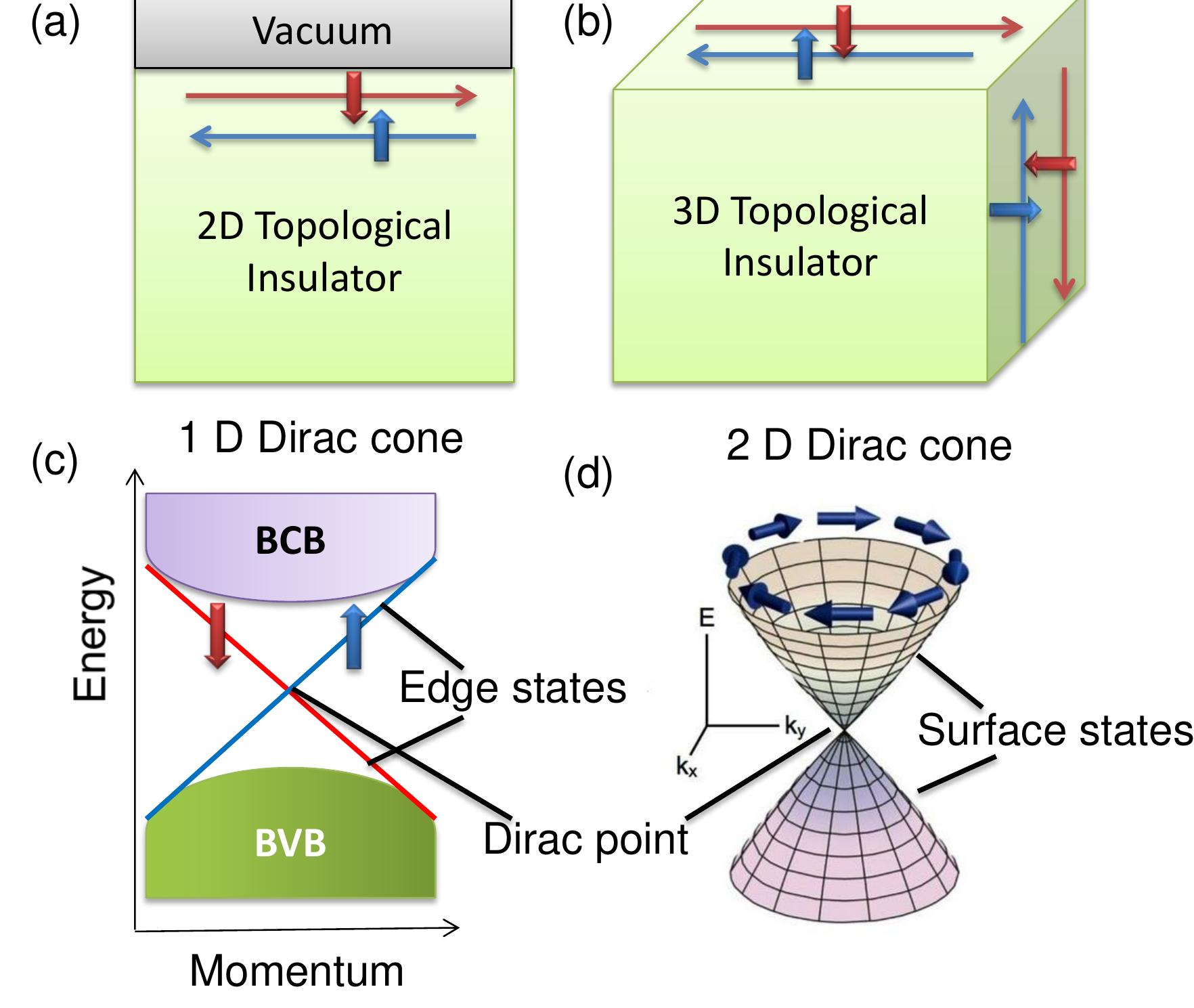
To see how this state of matter arises, let's watch a brief introduction by one of its discoverers, Prof. Charles Kane.
Quantum spin Hall effect intro (by Charles Kane)
This clip from a lecture by Charles Kane provides the foundational concept of the Quantum Spin Hall effect.
Please watch from the beginning. He explains the core idea: The QSH state can be conceptualized as two copies of the integer quantum Hall (IQH) state—one for spin-up electrons and one for spin-down electrons. While each IQH state breaks time-reversal symmetry, combining them with opposite "magnetic fields" for each spin restores the overall TRS of the system. The result is a zero charge Hall current but a non-zero spin Hall current, where up and down spins flow in opposite transverse directions.
The consequence of this "two-copy" structure is the emergence of counter-propagating edge states with opposite spin, as depicted in the image above. The energy-momentum relationship for these 1D edge states shows a linear crossing at a specific momentum. This crossing is protected; it cannot be removed to create a gap without breaking time-reversal symmetry.
Kramers' Theorem and the Protection of Edge States
Why is this crossing point so special? The answer lies in a fundamental consequence of time-reversal symmetry for particles with half-integer spin, a result you may recall from our module on quantum mechanics: Kramers' Degeneracy Theorem.
Let's briefly formalize this. The time-reversal operator for a spin-1/2 particle can be written as , where is the Pauli matrix and is the complex conjugation operator. A key property is that applying it twice gives . Kramers' theorem states that for any Hamiltonian that commutes with (i.e., is time-reversal invariant), every energy eigenstate is at least twofold degenerate. If is an eigenstate with energy , then its "Kramers partner" is also an eigenstate with the same energy , and importantly, is guaranteed to be orthogonal to .
Lecture notes on topological insulators
These lecture notes provide a concise mathematical summary of time-reversal symmetry and Kramers' degeneracy.
Please read the section titled A. Time-reversal symmetry, focusing on the text from this part. Pay attention to the derivation showing that if \Theta^2 = -1, an eigenstate |\psi\rangle and its time-reversed partner \Theta|\psi\rangle must be orthogonal, proving the degeneracy. Also, note the application to Bloch states: the time-reversal partner of a state with momentum \vec{k} and spin \uparrow, i.e., |\psi_{n\vec{k}\uparrow}\rangle, is a state with momentum -\vec{k} and spin \downarrow, i.e., |\psi_{n,-\vec{k},\downarrow}\rangle.
Now, consider the edge states at the crossing point in the dispersion relation (the Dirac point in panel (c) of the figure). At a time-reversal invariant momentum (TRIM) like , a right-moving state with spin-up and a left-moving state with spin-down are time-reversal partners. Kramers' theorem guarantees that these two states must be degenerate at the TRIM. Any TRS-preserving perturbation (like spin-orbit coupling terms or non-magnetic impurities) can shift the energy of this degenerate pair, but it cannot lift the degeneracy and open a gap.
Prof. Kane vividly describes his own realization of this fact when first developing the theory.
Quantum spin Hall effect intro (by Charles Kane)
Continuing with Prof. Kane's lecture, this segment describes the discovery that the helical edge states are robust.
Please watch from this section. He recounts how he initially thought the band crossing was an artifact that would be destroyed by realistic perturbations that mix spins. However, he found it impossible to get rid of the crossing and realized that the two crossing states form a Kramers pair, whose degeneracy is protected by time-reversal symmetry.
Immunity to Backscattering
The protection of the crossing point has a profound physical consequence: it makes the helical edge states immune to backscattering from non-magnetic impurities. This is why the edge of a QSH insulator is such a robust one-dimensional conductor, unlike a typical 1D wire where even weak disorder can cause Anderson localization.
Consider an electron with spin-up moving to the right. To scatter backwards, it must transition into a left-moving state. Due to the spin-momentum locking of the helical edge, this left-moving state must have spin-down. Thus, backscattering is equivalent to a spin-flip process. Time-reversal symmetry forbids this process for a non-magnetic impurity.
A beautiful way to understand this is through a quantum interference argument.
The quantum spin Hall effect and topological insulators
This review article by Qi and Zhang provides a wonderfully intuitive explanation for the absence of backscattering, using an analogy to anti-reflection coatings.
Read the two paragraphs starting from this point. The key idea is that an electron can backscatter from an impurity via two paths related by time-reversal (e.g., clockwise and counter-clockwise around the impurity). For a spin-1/2 particle, a full 2\pi rotation of its spin—which is the difference between these two paths—imparts a phase factor of -1 to the wavefunction. This leads to perfect destructive interference between the two paths, forcing the backscattering amplitude to be exactly zero.
This perfect destructive interference is not an accident; it is a direct result of the underlying TRS. If an impurity has a magnetic moment, it locally breaks TRS, and backscattering becomes possible. Prof. Kane's thought experiment provides a powerful conclusion about the consequences of this protection.
Quantum spin Hall effect intro (by Charles Kane)
In this final clip from Prof. Kane's talk, he explains a thought experiment that reveals the ultimate robustness of the helical edge.
Watch from this section. He considers an electron incident on an arbitrarily long and disordered region of the edge. Because the reflection amplitude must be odd under time-reversal, a time-reversal symmetric system must have a reflection amplitude of exactly zero. This implies perfect transmission, meaning the helical edge is immune to Anderson localization.
The Z2 Invariant and the Bulk-Boundary Correspondence
We can now connect this robust physical property back to the abstract invariant. The even-odd nature of the classification corresponds to the number of pairs of helical edge states.
- Trivial Insulator (): Has an even number of pairs of Kramers-degenerate edge states (including zero). In this case, a right-mover with spin-up can scatter into a different left-moving state that also has spin-up, but belongs to another Kramers pair. This process is not forbidden by TRS, allowing for localization. The edge states are not robust.
- Topological Insulator (): Has an odd number of pairs of Kramers-degenerate edge states. No matter how you try to mix and gap them out, TRS ensures that at least one pair remains, with its backscattering completely suppressed.
This is the essence of the bulk-boundary correspondence: the topological property of the bulk material (quantified by ) dictates the existence of protected states at its boundary. The vacuum is a trivial insulator (). Therefore, at the interface between a topological insulator and the vacuum, the topological invariant must change. As a general principle, a change in topological invariant can only happen if the energy gap closes. This gap-closing manifests as the required presence of the metallic, gapless edge states.
Topological Insulators in a Nutshell - Theory and Experiment
This video provides a concise and clear explanation of the bulk-boundary correspondence.
Please watch the clip from this section. The main point is that since the vacuum is topologically trivial (\nu=0) and the insulator is not (\nu=1), the boundary between them must host a transition where the gap closes, leading to the formation of gapless edge states.
Conclusion
In this lesson, we have seen how time-reversal symmetry acts as the guardian of the topological phase in Quantum Spin Hall insulators. It is not merely an abstract property but a powerful physical constraint with observable consequences.
Key Takeaways:
- Helical Edge States: The hallmark of a QSH insulator is the presence of edge states where spin and momentum are locked, with opposite spins propagating in opposite directions.
- Kramers' Theorem: For spin-1/2 particles, TRS guarantees that energy levels come in degenerate "Kramers pairs." The crossing point in the edge state dispersion is a protected degeneracy between two such partners.
- Suppression of Backscattering: The most critical role of TRS is to forbid backscattering of electrons from non-magnetic impurities. This is due to destructive quantum interference, which ensures the edge states are robust, perfect 1D conductors.
- Z2 Invariant as a Guarantee: The non-trivial bulk invariant topologically guarantees that an odd number of these protected helical edge state pairs must exist at the boundary with a trivial insulator (like vacuum), providing a deep connection between bulk topology and boundary physics.
Preview of the Next Lesson:
We have now explored the classification of topological phases and the symmetry protection that makes them robust. In our final lesson of this module, we will fully formalize the bulk-boundary correspondence. We will synthesize the concepts from the last few lessons—spontaneous symmetry breaking, order parameter spaces, homotopy, and topological invariants—to show how the topological properties of the bulk material universally dictate the existence and nature of phenomena at its boundaries, from the edge states of topological insulators to the vortices and defects in superfluids and magnets.