Introduction
In our previous lesson, we explored the physical consequences of the non-trivial topology in Quantum Spin Hall insulators. We saw that time-reversal symmetry (TRS) leads to the existence of "helical" edge states, which are remarkably robust against scattering from non-magnetic impurities. This protection, rooted in Kramers' theorem, guarantees that these edges are perfect one-dimensional conductors. We concluded with the assertion that the abstract topological invariant of the bulk material, , somehow necessitates this exotic boundary behavior.
Today, we will formalize this connection and explore one of the most profound and elegant principles in modern condensed matter physics: the bulk-boundary correspondence. This principle states that the topological classification of a material's bulk universally dictates the physical phenomena that must occur at its boundary. We will see that the existence of protected edge states is not a coincidence but a direct and unavoidable consequence of the bulk's topological character. We'll ground this principle in a simple, intuitive argument before examining it through the lenses of archetypal models, from Chern insulators to the systems we've just studied.
The Core Principle: A Topological Mismatch Requires a Gapless Boundary
The most direct way to understand the bulk-boundary correspondence is to consider the interface between two phases that are topologically distinct. Let's take a 2D topological insulator (TI) with a invariant and place it in a vacuum. The vacuum, having no electronic states at all, is the most trivial insulator imaginable; its topological invariant is .
The topological invariant is a robust, quantized property of the gapped bulk. It cannot change its value during any adiabatic process—that is, any continuous deformation of the Hamiltonian that does not close the energy gap. Now, consider moving from the bulk of the TI () across the boundary into the vacuum (). The topological invariant must change from 1 to 0. Since this change cannot happen in a gapped, insulating system, the energy gap must close somewhere along this path. This forced gap-closing occurs precisely at the boundary. The resulting gapless states are the protected edge states.
This beautifully simple argument is the conceptual heart of the bulk-boundary correspondence.
Topological Insulators in a Nutshell - Theory and Experiment
This video from the channel Condensed Matter Cat provides an excellent and concise visualization of this core argument.
Please watch from this segment. The key takeaway is that to transition from a non-trivial topological invariant inside the material to a trivial one in the vacuum, the system must pass through a gapless state, which is physically realized at the boundary.
Archetype 1: The Chern Insulator
The simplest and cleanest illustration of this principle is the Chern insulator, the lattice model of the integer quantum Hall effect (IQHE). As we've discussed, these 2D systems break TRS and are classified by an integer topological invariant, the Chern number . The physical manifestation is a quantized Hall conductance .
The bulk-boundary correspondence for a Chern insulator states that the bulk Chern number is precisely equal to the number of gapless edge states that traverse the bulk energy gap.
TMS21 Lecture 2. Jennifer Cano. Introduction to Topological Insulators, part 1
This lecture by Prof. Jennifer Cano provides a clear visual and conceptual link between the bulk and the edge in the context of the quantum Hall effect.
First, watch from this part to see how the bulk energy levels (Landau levels) of a quantum Hall system must bend at the edges to satisfy boundary conditions, creating states that necessarily cross the Fermi energy. Then, jump to the segment from Bulk-Edge Correspondence which explicitly states that the Chern number, a bulk invariant, predicts the existence of these surface states. The number of states connecting the valence and conduction bands is dictated by the value of the Chern number.
This is a powerful demonstration. The Hall conductance is a bulk property, calculated via the TKNN formula (an integral of the Berry curvature over the entire Brillouin zone). Yet, physically, the current is carried by the conducting edge states. The bulk-boundary correspondence guarantees that these two descriptions are consistent: a bulk calculation tells you exactly what must happen at the edge. The deep reason for this quantization, as you might appreciate from your QFT studies, is rooted in gauge invariance, as elegantly shown by Laughlin's flux-threading argument.
Archetype 2: The Su-Schrieffer-Heeger (SSH) Model
To make this even more concrete, let's look at the simplest possible topological model: the 1D Su-Schrieffer-Heeger (SSH) chain. This model describes a 1D chain of atoms with alternating single and double bonds.
There are two distinct, gapped "dimerization" patterns, which are topologically inequivalent. One can be smoothly deformed into an atomic limit with electrons centered on the bonds, while the other has electrons centered between the bonds. These two phases are characterized by different bulk topological invariants (a winding number, related to the Berry phase, of 0 or 1).
What happens at a domain wall—an interface between a region of one phase and a region of the other?
TMS21 Lecture 2. Jennifer Cano. Introduction to Topological Insulators, part 1
Prof. Cano's lecture again provides the perfect illustration using the SSH model.
Watch the section from this explanation. It shows that if you create a boundary between the two different topological phases, a localized state appears right at the boundary, with its energy in the middle of the bulk gap. This is a solvable, explicit demonstration of a bulk invariant predicting a boundary state.
The Correspondence in Z₂ Topological Insulators
We now have the tools to fully understand the situation for the QSH insulators from our previous lesson. These systems preserve TRS and are classified by the invariant . How does guarantee helical edge states?
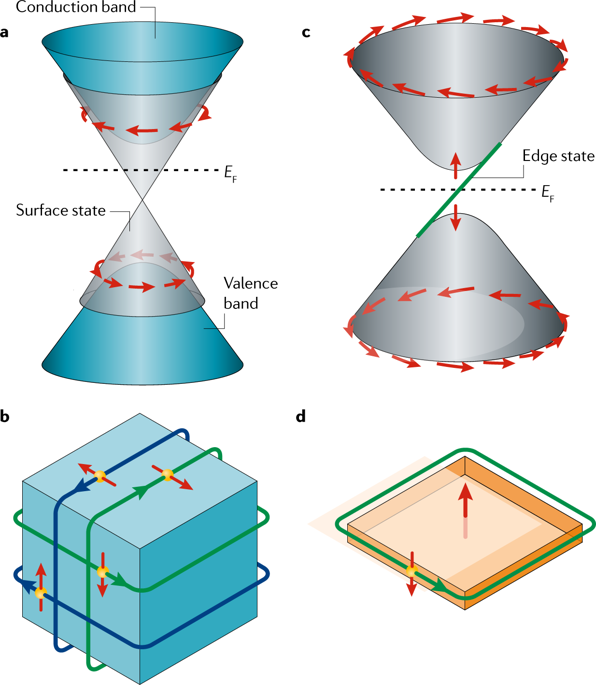
A powerful approach is to see the QSH state as two copies of the IQH state, one for spin-up electrons with Chern number and one for spin-down electrons with . The total charge Chern number is , consistent with the absence of a quantum Hall effect. However, we can define a spin Chern number , which is non-zero.
Applying the bulk-boundary correspondence to each spin species separately:
- The bulk guarantees one spin-up edge state moving in one direction (say, chiral).
- The bulk guarantees one spin-down edge state moving in the opposite direction (antichiral).
The combination is exactly the helical edge state we studied: a pair of counter-propagating, spin-polarized states protected by TRS.
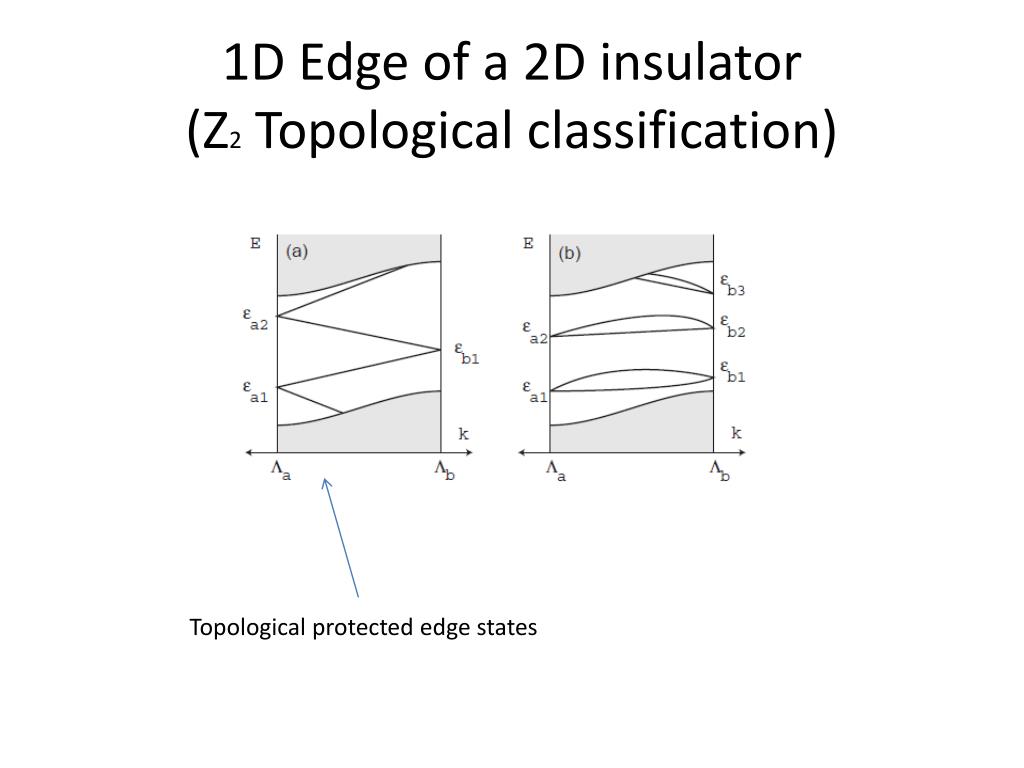
A paradigmatic model for this is the Bernevig-Hughes-Zhang (BHZ) model, which successfully described the first experimentally discovered QSH insulator in HgTe/CdTe quantum wells—a topic connected to your own research experience with semiconductor spectroscopy. The topology of the system is controlled by the thickness of the quantum well. Below a critical thickness, the system is a trivial insulator (). Above it, a "band inversion" occurs, flipping the parity of the states at a TRIM point in the Brillouin zone, which in turn flips the invariant to .
Lecture notes on topological insulators
These notes by Ming-Che Chang provide a tight-binding derivation for the BHZ model, explicitly demonstrating the bulk-boundary correspondence for a Z_2 system.
First, read the section on the Bernevig-Hughes-Zhang model to get an overview of the system (BHZ model setup). Next, focus on the subsection Z2 topological number. It shows how to calculate the invariant \nu from the parities of the bulk Bloch states at the TRIMs. Follow the logic for how a band inversion changes the product of parities, leading to a transition from a trivial insulator to a topological insulator. Finally, read the subsection QWZ model versus BHZ model. This part is key, as it explains how the BHZ model decouples into two subsystems with opposite spin Hall conductivities, providing a direct link from the bulk topology to the helical edge states.
A Formal Link: The Wilson Loop
To formalize the connection between bulk band structure and boundary states, condensed matter theorists use a tool called the Wilson loop. In essence, the Wilson loop operator, , captures the evolution of the occupied Bloch states as momentum is traversed along a closed path in the Brillouin zone. It is a generalization of the Berry phase to the case of multiple occupied bands.
Its eigenvalues, , known as the Wilson loop spectrum, are gauge-invariant and thus contain physical information. It can be shown that this spectrum is equivalent to the spectrum of the projected position operator. The phases represent the centers of charge for a set of maximally localized wavefunctions known as hybrid Wannier states.
The profound connection to the bulk-boundary correspondence is this: the spectrum of a Hamiltonian with a boundary is topologically equivalent to the spectrum of the Wilson loop computed from the bulk Hamiltonian.
Week 3 Lecture Notes: Topological Condensed Matter ...
These advanced lecture notes from ETH Zürich provide the formal statement of this equivalence. You don't need to follow every step of the proof, but understanding the statement itself is a powerful capstone to this topic.
First, read the section 3.3 Wilson loop and position operator to understand the definition and the key result. Focus on the paragraph beginning Wilson loop and position and the paragraph establishing the spectral equivalence. Next, read section 3.5 Bulk-boundary correspondence. The crucial statement is right at the beginning: the central claim. The subsequent text outlines how one can continuously deform the boundary Hamiltonian into an operator whose spectrum is the Wilson loop spectrum, proving that they are topologically identical.
This establishes a direct, computable mapping: you can calculate a property of the infinite, periodic bulk system (the Wilson loop spectrum) and it will tell you the structure of the states that appear at a finite boundary.
Conclusion
Today we have formalized the profound connection between the inside and the outside of topological materials. The bulk-boundary correspondence is not just a feature of a few specific models but a deep organizing principle of topological matter.
Key Takeaways:
- The Principle: A boundary between two topologically distinct gapped phases (e.g., a TI and a vacuum) must host gapless states. The energy gap must close to allow the topological invariant to change.
- Chern Insulators: The integer bulk Chern number directly corresponds to the number of chiral (unidirectional) edge states.
- Z₂ Topological Insulators: The non-trivial bulk invariant guarantees an odd number of Kramers pairs of helical edge states. This can be understood by viewing the QSH insulator as two copies of a Chern insulator with opposite spins and Chern numbers.
- Formalism via Wilson Loops: The bulk-boundary correspondence can be made mathematically precise. The spectrum of states at a physical boundary is topologically equivalent to the spectrum of the Wilson loop, an object computed entirely from the bulk Bloch wavefunctions.
Preview of the Next Module:
Having explored symmetries in the context of quantum mechanics, field theory, and now the abstract topological properties of matter, we will pivot to a more concrete application of symmetry analysis. In the next module, Point Groups and Molecular Symmetries, we will apply the formal group theory we've developed to classify the discrete spatial symmetries of molecules and crystals. This will allow us to predict degeneracies in electronic orbitals, derive selection rules for spectroscopy, and understand the vibrational modes of molecules, demonstrating the predictive power of symmetry in tangible physical systems.