Introduction
In our last lesson, we uncovered the Berry phase, a geometric phase acquired by a quantum state during a cyclic adiabatic evolution. We saw that for a spin-1/2 particle in a slowly rotating magnetic field, this phase is proportional to the solid angle traced by the field's direction. The key insight was that the integral of the Berry connection around a closed loop in parameter space is gauge-invariant and physically meaningful.
Today, we take this a step further. What happens if we integrate the curvature of this connection not just over a patch, but over an entire closed manifold in parameter space, like the 2D Brillouin zone of a crystal? As we will discover, this integral yields a quantized integer—a topological invariant. This lesson will define these powerful numbers, such as the Chern number and the Z2 invariant, and show how they serve as robust classifiers for distinct phases of matter, separating states that cannot be smoothly transformed into one another without a drastic change, like closing an energy gap.
What is a Topological Invariant?
In physics, we often classify states of matter by their symmetries. For example, a ferromagnet breaks rotational symmetry, while a paramagnet does not. However, some phases of matter are distinct not because of symmetry, but because of their underlying topology.
A topological invariant is a quantity, typically an integer, that characterizes a global property of the system's quantum ground state. Its defining feature is its robustness: it remains constant under any smooth, continuous deformation of the system's Hamiltonian, as long as the energy gap between the ground state and the excited states remains open.
To build intuition, let's watch a short introductory clip.
Charlie Kane Introduction to Topological Band Theory
This video by Prof. Charlie Kane, one of the pioneers of topological insulators, provides a clear conceptual introduction to topology in the context of quantum phases.
Please watch the first few minutes, from the beginning. Focus on the core idea: Topological Equivalence: He explains that two quantum states are topologically equivalent if you can smoothly deform one into the other without closing the energy gap. Topological Phases: States with different topological properties are in different phases, and any path between them must pass through a gapless "critical point".
The classic analogy is the number of holes in an object, known as its genus. A coffee mug (genus 1) can be continuously deformed into a doughnut (genus 1), but not into a sphere (genus 0) without tearing it. The genus is a topological invariant. Similarly, gapped quantum Hamiltonians can be grouped into equivalence classes. Those within the same class can be adiabatically deformed into one another. Those in different classes cannot, and they are distinguished by a topological invariant.
The Chern Number: An Integer Invariant in Two Dimensions
Let's make this concrete. The Brillouin zone (BZ) of a 2D crystal is a natural parameter space for the Bloch Hamiltonian . Since opposite sides of the BZ are identified, its topology is that of a torus, . For an insulating state with a filled band , we can define a Berry curvature at each point in the BZ.
The Chern number, , of the -th band is defined as the total flux of the Berry curvature integrated over the entire 2D Brillouin zone, normalized by :
where is the Berry connection for the periodic part of the Bloch wavefunction, .
A remarkable result from mathematics (the Gauss-Bonnet-Chern theorem) guarantees that must be an integer. The following video offers a beautiful physical argument for this quantization, starting from the concept of polarization we discussed in the context of 1D Berry phases.
Charlie Kane Introduction to Topological Band Theory
Continuing with Prof. Kane's lecture, this segment provides a physically motivated derivation of why the integral of the Berry curvature over the 2D torus (the BZ) must be an integer.
Please watch the segment from this section. The key line of reasoning is: The Berry phase along a 1D loop in the BZ (say, at constant k_y) gives the electric polarization in that direction. This polarization is only defined up to an integer multiple of the electric charge e, which corresponds to the Berry phase being defined up to a multiple of 2\pi. On a torus, the loop at k_y=0 and the loop at k_y=2\pi are the same. So the polarization calculated along both must be the same, but they can differ by an integer. By Stokes' theorem, the difference between these two loop integrals is the integral of the Berry curvature over the area between them (the whole BZ). Therefore, the integral of the Berry curvature over the BZ must be an integer multiple of 2\pi. This integer is the Chern number.
Physical Meaning: The Quantum Hall Effect
The Chern number is not just a mathematical curiosity; it has a profound physical meaning. The total Hall conductivity of a 2D insulator is quantized and given by the sum of the Chern numbers of all the occupied (valence) bands, in fundamental units of :
This is the essence of the Integer Quantum Hall Effect. A system with a non-zero total Chern number is called a Chern insulator. The following video explains this connection via the elegant Laughlin gauge argument, which is conceptually similar to the Thouless pump we saw earlier.
TMS21 Lecture 2. Jennifer Cano. Introduction to Topological Insulators, part 1
In this lecture by Prof. Jennifer Cano, the quantization of Hall conductivity is derived from fundamental principles of gauge invariance, known as the Laughlin flux argument.
Watch the segment from this section. The argument involves wrapping the 2D system into a cylinder and threading a magnetic flux quantum through its center. The key takeaways are: Threading one flux quantum is a cyclic process that returns the Hamiltonian to its original state. During this process, an integer number of electrons must be pumped from one side of the cylinder to the other. This pumped charge is directly proportional to the Hall conductivity, \sigma_{xy}. Equating these facts forces \sigma_{xy} to be an integer multiple of e^2/h, with the integer being precisely the Chern number.
Example: The Haldane Model
The first model of a Chern insulator on a lattice was proposed by F.D.M. Haldane in 1988. It describes spinless fermions on a honeycomb lattice with specially engineered complex next-nearest-neighbor hopping terms. These terms break time-reversal symmetry and generate a non-zero Berry curvature, leading to a quantized Hall effect even with zero net magnetic field.
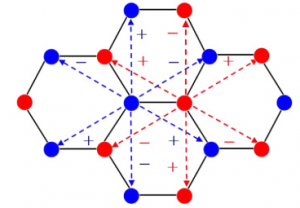
By tuning a mass parameter in the model, one can drive it through a topological phase transition where the Chern number jumps from 0 to , changing the system from a normal insulator to a Chern insulator.
Time-Reversal Symmetry and Z2 Invariants
What happens in a system that preserves time-reversal symmetry (TRS)? For spinful systems where the time-reversal operator squares to -1 (), TRS imposes a strict constraint on the Berry curvature: . Since the Brillouin zone is symmetric under , the integral of the Berry curvature over the entire BZ must vanish.
This implies that the charge Hall conductivity is always zero in a time-reversal invariant insulator. For a long time, this was thought to mean that no interesting topological phenomena like the Hall effect could exist without breaking TRS.
The breakthrough came with the realization that TRS can protect a new kind of topological invariant. Consider a system with spin-orbit coupling. We can think of it as two separate subsystems: one for spin-up electrons and one for spin-down electrons.
- The spin-up electrons might live in bands with a Chern number .
- Because they are related by time reversal, the spin-down electrons must live in bands with the opposite Chern number, .
- The total charge Chern number is , as required by TRS.
- However, we can define a spin Chern number, .
This integer seems to define a new classification. However, the protection offered by TRS is more subtle. What matters is not the integer value of itself, but its value modulo 2.
- If is even, the corresponding edge states can be mixed and gapped out by TRS-preserving perturbations. This phase is topologically "trivial".
- If is odd, at least one pair of edge states remains protected by TRS (Kramers' theorem forbids them from scattering into each other). This phase is topologically "non-trivial".
This even/odd distinction gives rise to a Z2 topological invariant, often denoted , which can take two values:
- for a trivial insulator.
- for a topological insulator (or Quantum Spin Hall insulator).
The following image and video provide an excellent summary of this concept.

TMS21 Lecture 2. Jennifer Cano. Introduction to Topological Insulators, part 1
Prof. Cano's lecture continues to explain how time-reversal symmetry leads to the concept of the Z2 topological invariant, which classifies 2D topological insulators.
Please watch from this section. She explains: Why a non-zero Chern number is inconsistent with TRS. How a 2D topological insulator has counter-propagating edge states protected by TRS. The definition of the Z2 invariant based on an "even" vs "odd" number of band crossings, which can be practically computed by tracking the Berry phase.
The "10-fold Way": A Grand Classification
The Chern number (Class A, no symmetry) and the Z2 invariant (Class AII, TRS) are just two examples. A complete classification of non-interacting topological insulators and superconductors was achieved by considering all possible fundamental local symmetries: Time-Reversal (T), Particle-Hole (P), and Chiral (S). This leads to ten distinct symmetry classes. For each class and each spatial dimension, one can determine the type of topological invariant, if any. The result is a "periodic table" of topological phases.
Week 7 Lecture Notes: Topological Condensed Matter ...
These lecture notes from ETH Zurich provide the famous periodic table that classifies topological insulators and superconductors.
Please focus on Table 7.1 found within the text from this section. You don't need to understand the origin of every entry, but observe the structure: The rows correspond to the 10 symmetry classes (e.g., A, AIII, AI, AII...). The columns correspond to spatial dimension d. The entries show the classification: Z (integer), Z_2 (binary), or 0 (trivial). Notice that in d=2, class A has a Z invariant (the Chern number) and class AII has a Z_2 invariant, just as we discussed.
This table provides a powerful and predictive framework, guiding the search for new topological materials.
Conclusion
In this lesson, we have moved beyond the Berry phase itself to the topological invariants that arise from the global structure of the Berry curvature. These invariants provide a robust way to classify gapped quantum phases of matter.
Key Takeaways:
- Topological invariants are quantized numbers that are robust against smooth deformations of a gapped Hamiltonian, classifying distinct phases of matter.
- The Chern number is an integer () invariant for 2D systems, defined as the integral of the Berry curvature over the Brillouin zone. It is physically realized as the quantized Hall conductivity.
- Time-reversal symmetry forces the Chern number to be zero but can protect a different kind of invariant.
- The Z2 invariant ( or ) classifies time-reversal invariant topological insulators, distinguishing between trivial and non-trivial phases based on an even/odd principle.
- Symmetry, dimensionality, and topology are intimately linked, leading to a comprehensive "periodic table" of topological phases.
Preview of the Next Lesson:
We have stated that the Z2 invariant in a Quantum Spin Hall insulator is "protected" by time-reversal symmetry. In our next lesson, we will delve into the mechanism of this protection. We will examine the properties of the edge states in more detail and use the principles of TRS, particularly Kramers' theorem, to show precisely why these states are robust against backscattering and cannot be easily removed. This will connect the abstract bulk invariant to the concrete, physically observable properties at the system's boundary.