Hello! Welcome to the final lesson in our first module, "Plant Biology for Hydroponics."
In our last three lessons, we've built a solid foundation. We've identified the essential nutrients plants need, demystified the process of photosynthesis they use to create energy, and explored how they absorb those nutrients through ion exchange. Now, we'll put all of that knowledge into a broader context by examining the complete journey of a plant from seed to harvest.
Today's lesson addresses the learning outcome: Describe the key stages of a plant's life cycle: germination, vegetative growth, flowering, and fruiting.
Understanding these distinct stages is one of the most powerful tools a grower has. Each phase has unique environmental and nutritional needs. For your future hydroponic business, knowing how to cater to each stage will be the key to maximizing your yields, controlling your crop cycles, and ultimately, boosting your profitability.
Let's begin with a visual overview of the journey we'll be exploring.
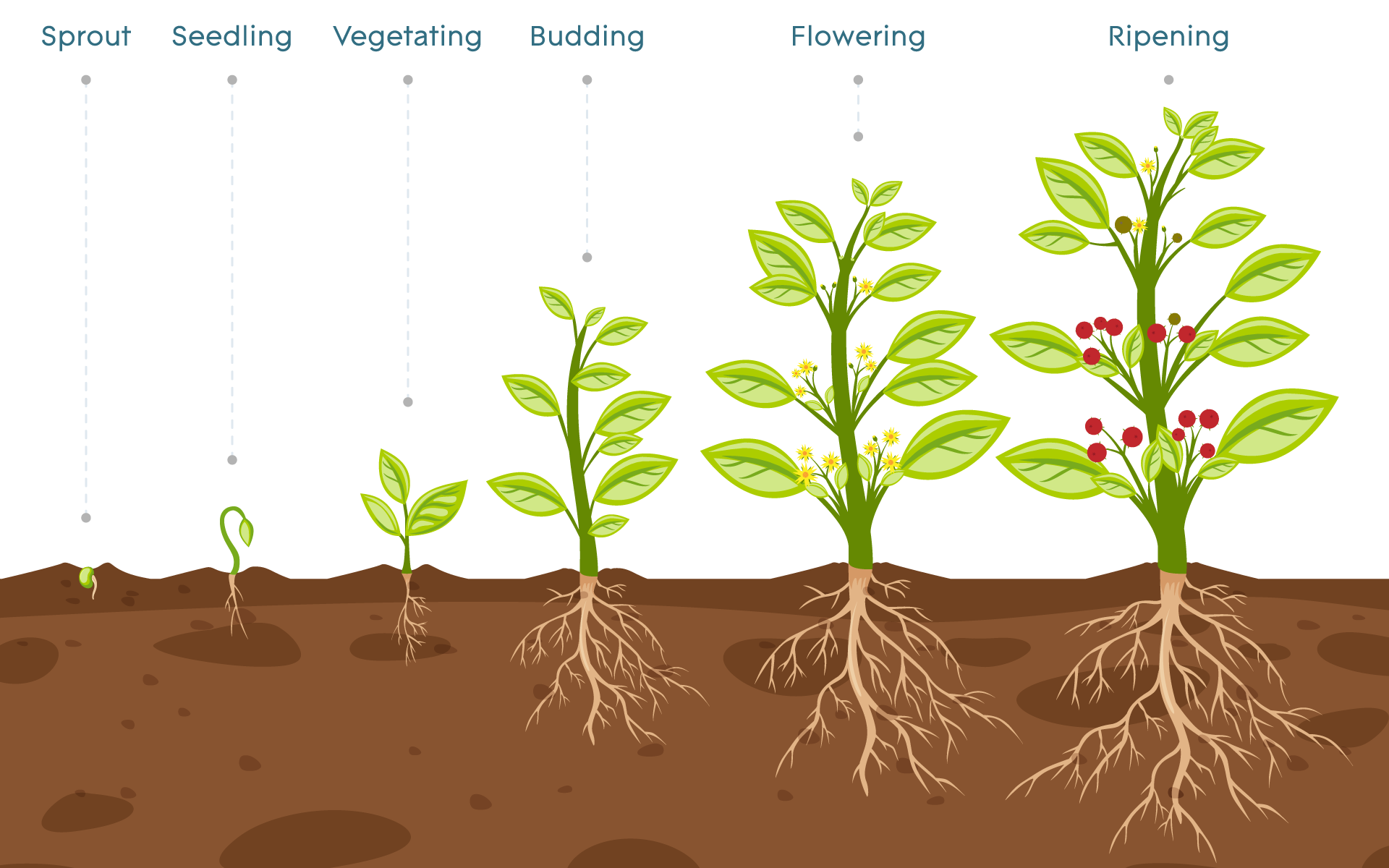
Stage 1: Germination - The Beginning of Life
Germination is the process where a plant embryo inside a seed awakens and begins to grow into a seedling. A successful germination phase is critical for establishing a healthy crop.
To understand what's happening inside the seed and what it needs to get started, let's watch a short, clear explanation.
Seeds and Germination Explained
The video 'Seeds and Germination Explained' by Science Sauce provides an excellent breakdown of a seed's internal structure and the essential conditions required for it to sprout.
Please watch from 00:18 to 04:20. As you watch, focus on: The function of the cotyledons, the seed's initial food source. The three essential conditions required for germination. The conditions that are not required for germination, and why.
As the video explained, germination isn't magic; it's a biological process that requires a specific recipe. Let's recap the key takeaways, which are especially important in a soilless context like hydroponics:
- Water: Activates the metabolic processes within the seed.
- Oxygen: Required for respiration, which provides the energy for the embryo to grow.
- Warmth: Ensures that enzymatic reactions happen at an efficient rate.
Notice what isn't on the list: soil and sunlight. The seed gets its initial energy from its internal food store (the cotyledons), not from photosynthesis. This is why seeds can germinate in complete darkness and in soilless media like rockwool or peat plugs.
Application in Hydroponics:
For your future system, germination will typically happen outside the main system in a dedicated space. You'll place seeds in a moist growing medium (like a rockwool cube), and keep them in a warm, humid environment (often using a simple tray with a plastic dome) until the first roots and leaves appear. The resource "Managing Plant Growth Cycles in Commercial Hydroponic Systems" suggests an ideal temperature of 21-29°C (70-85°F) and 70-80% relative humidity.
Stage 2: Vegetative Growth - Building the Factory
Once the seedling has established its first "true leaves" (the ones that appear after the initial seed leaves, or cotyledons), it enters the vegetative stage. The plant's entire focus during this phase is on rapid growth, creating a strong framework of leaves, stems, and roots. Think of this as building the "factory" for photosynthesis. More leaves mean more solar panels to capture light and produce energy.
The engine of this growth is found in specialized tissues called meristems.
To understand how a plant grows, we need to look at the cellular level. This clip from 'Mechanisms of Plant Growth' by Professor Dave Explains introduces the concept of meristematic cells and primary growth.
Watch the first part of the video, from 00:25 to 02:16. Pay attention to the role of apical meristems and the definition of primary growth (growth in length).
This primary growth is driven by a complex interplay of hormones. The most important hormone in the vegetative stage is auxin, which promotes the elongation of cells in stems and roots.
Application in Hydroponics:
This is the stage where your management has a huge impact on the final size and health of your plants. Your goal is to provide ideal conditions for photosynthesis and structural growth.
Managing Plant Growth Cycles in Commercial Hydroponic Systems ...
The article 'Managing Plant Growth Cycles in Commercial Hydroponic Systems' provides a concise checklist for managing the vegetative stage.
Please read section 2, 'Vegetative Growth Stage'. Focus on the recommended parameters for light, nutrients, temperature, and humidity.
To summarize the key management tasks for the vegetative stage:
- Light: Provide long days. A light cycle of 14-18 hours on, 6-10 hours off is common to maximize photosynthesis.
- Nutrients: The plant is building leaves and stems, which are rich in nitrogen. Therefore, your nutrient solution should be high in Nitrogen (N). This is often referred to as a "grow" formula.
- Environment: Maintain a stable temperature (around 21-27°C or 70-80°F) and moderate humidity (60-70%).
Stages 3 & 4: Flowering and Fruiting - The Reproductive Phase
Once the plant has built up enough energy and size, it can switch its focus from growing to reproducing. This begins with the flowering stage and, for many crops, culminates in the fruiting stage.
This transition is not accidental. It's a carefully orchestrated event triggered by both internal hormonal signals and external environmental cues.
Let's return to the 'Mechanisms of Plant Growth' video to learn about the hormones that regulate this shift.
Watch from 02:16 to 07:03. This time, focus on the functions of these key hormones: Gibberellins: Related to flowering and fruit development. Ethylene: A gas that triggers ripening. Also, note the concept of a photoperiod as a trigger.
The photoperiod, or the length of the light/dark cycle, is one of the most powerful tools a hydroponic grower has to control when plants start flowering.
Application in Hydroponics:
When you want to initiate flowering for crops like tomatoes, peppers, or strawberries, you need to change the environmental signals you are sending the plant.
Managing Plant Growth Cycles in Commercial Hydroponic Systems ...
The article on 'Managing Plant Growth Cycles' outlines the specific changes needed to encourage plants to enter the flowering and fruiting stages.
Now read sections 3 and 4, 'Flowering Stage' and 'Fruiting Stage'. Note the critical changes in the light cycle and the nutrient formula.
Here's how you'll manage this reproductive phase:
- Light: For many plants (known as "short-day" plants), you will trigger flowering by switching to a 12-hour on, 12-hour off light cycle. The extended, uninterrupted period of darkness is the signal.
- Nutrients: The plant's needs shift. It now requires less nitrogen and more Phosphorus (P) and Potassium (K) to develop flowers, fruits, and seeds. You will switch to a "bloom" nutrient formula. This directly relates back to our first lesson on the roles of macronutrients.
- Environment: A slightly cooler temperature and lower humidity are often beneficial, as noted in the article (around 18-24°C or 65-75°F and 40-50% humidity).
Conclusion
You've now walked through the entire life of a plant, from a dormant seed to a mature, fruit-bearing adult. You've seen that it's not one continuous process, but a series of distinct stages, each with its own biological purpose and unique requirements.
For your business, mastering the management of these stages is what separates hobby growing from controlled, productive agriculture.
Key Takeaways:
| Stage | Biological Focus | Hydroponic Management Focus |
|---|---|---|
| Germination | Awaken embryo, sprout | Provide water, oxygen, and warmth in a seedling tray. |
| Vegetative | Grow leaves, stems, roots | Long light periods (14-18 hrs); High-Nitrogen nutrients. |
| Flowering | Develop reproductive organs | Shorter light periods (e.g., 12/12); High-Phosphorus/Potassium nutrients. |
| Fruiting | Produce fruit and seeds | Maintain flowering conditions; ensure adequate nutrients for fruit quality. |
This lesson concludes our module on Plant Biology. You now have the essential scientific knowledge—the "why"—behind how plants function.
In our next lesson, we will begin Module 2, "Principles of Hydroponic Systems." We'll officially define hydroponics, contrast it with traditional agriculture, and start exploring the ingenious systems that make it all possible.