Hello! Welcome to the first lesson of our second module, "Principles of Hydroponic Systems."
In the first module, we established a strong foundation in plant biology—the "why" behind plant growth. We covered everything from essential nutrients to the stages of a plant's life cycle. Now, we'll shift our focus to the "how" by exploring the innovative systems that put this biological knowledge into practice.
This lesson addresses the learning outcome: Define hydroponics and contrast it with traditional soil-based agriculture.
Understanding this fundamental distinction is the first step in appreciating the technology and strategy behind soilless cultivation. For your goal of starting a hydroponic business, grasping this contrast is essential for articulating your value proposition and making informed decisions about your production model.
What is Hydroponics?
At its core, hydroponics is a method of growing plants without soil. The name itself gives us a clue. It comes from two Greek words: 'hydro,' meaning water, and 'ponos,' meaning labor. In essence, it's "water-working."
Instead of roots searching through soil for nutrients, the plants are grown in an inert medium or with their roots suspended directly in a liquid solution containing all the essential minerals they need.
Let's watch a quick introduction to solidify this concept.
The Ultimate Comparison: Which Reigns Supreme - Hydroponics or Soil?
The channel Everything Hydroponics provides a concise opening that defines hydroponics and contrasts it with traditional gardening.
Please watch the segment from 00:17 to 00:44. Focus on how the video describes the delivery of nutrients, water, and oxygen in hydroponics versus soil.
As the video mentions, this is a technology-driven approach to cultivation. It replaces the natural, and often unpredictable, soil environment with a controlled system. Here is a general illustration of what such a system involves.
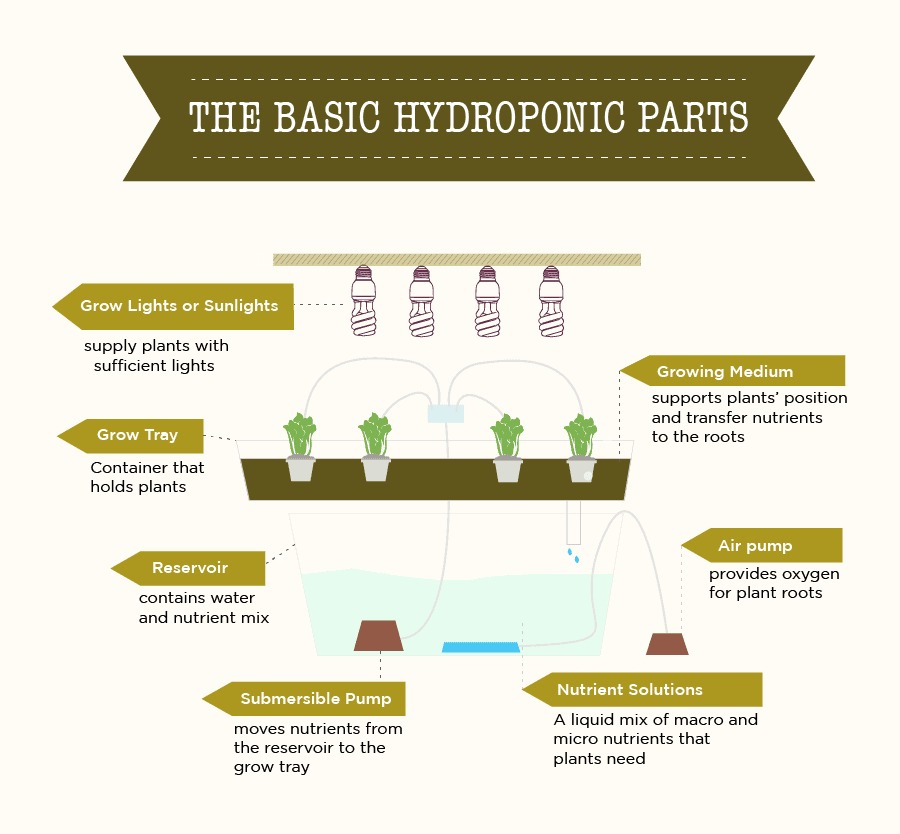
We will explore each of these components in detail in a future lesson. For now, this visual helps in understanding hydroponics as a complete, engineered environment for plant growth.
The Counterpart: Traditional Agriculture
To fully understand hydroponics, it's crucial to have a clear picture of what we are comparing it against: traditional, soil-based agriculture. This is the method of farming that has been practiced for thousands of years.
Traditional Farming vs. Hydroponics: A Comparative Analysis
The article 'Traditional Farming vs. Hydroponics' from VicPlas clearly outlines the defining characteristics of soil-based farming. Reading this will give us a structured basis for comparison.
Please read the section titled 'Traditional Farming'. Pay close attention to the five key characteristics described, such as soil dependence and reliance on weather.
As you've just read, traditional agriculture is fundamentally reliant on a complex, living ecosystem: the soil. It is also subject to the whims of weather, requires significant land area, and involves managing the soil itself as much as the plants.
The Core Contrast: Nutrient Delivery
Now for the most important distinction, which gets to the "why" you're interested in. How does a plant's experience differ between the two systems?
You might be surprised to learn that from a physiological standpoint, there is no difference in how a plant's roots absorb nutrients. The process of ion exchange we discussed in Module 1 is the same. The crucial difference lies in how those nutrients are made available to the roots in the first place.
This fact sheet from Oklahoma State University Extension provides an excellent, science-based explanation of the fundamental difference between soil and hydroponic nutrient availability.
Read the section titled 'Soil Versus Hydroponics'. Focus on the explanation of how elements become available in soil (decomposition) versus how they are available in hydroponics (dissolved in solution). The diagram 'Figure 7' in this section is a key visual aid.
Let's break down that key point:
- In Soil: Nutrients are locked up in organic and inorganic materials. They must be broken down by microorganisms and chemical weathering over time to become simple mineral ions. These ions then dissolve into the water present in the soil (the "soil solution"), from which the plant roots can finally absorb them. This is an indirect and uncontrolled process.
- In Hydroponics: We bypass the soil entirely. We dissolve a precise mixture of purified mineral salts (the nutrients from our first lesson!) directly into water to create a nutrient solution. This solution is then delivered straight to the roots. This is a direct and highly controlled process.
This single difference—controlled, direct delivery versus uncontrolled, indirect availability—is the source of most of the other contrasts between the two methods.
Comparing Key Characteristics
Because hydroponics offers direct control over nutrient delivery and the immediate environment, it differs from traditional agriculture in several practical ways.

Let's dive a bit deeper into these points.
What Is Hydroponics: Amazing Advantages Over Soil-Based Agriculture
The video 'What Is Hydroponics' by Valorian provides some compelling statistics that quantify the differences in resource efficiency.
Watch from the beginning (00:00) to 02:00. As you watch, note the specific figures mentioned for water savings, space efficiency, and potential yield increases.
Based on the resources, we can draw a direct comparison across several key factors:
| Feature | Traditional Soil Agriculture | Hydroponics |
|---|---|---|
| Nutrient Delivery | Indirect and variable; relies on soil health and microbial action. | Direct and precise; nutrient solution is formulated for optimal uptake. |
| Water Usage | High; significant loss to evaporation, runoff, and deep percolation. | Extremely efficient; uses up to 90-95% less water via recirculation. |
| Space Efficiency | Low; plants need extensive root systems and spacing in open fields. | High; roots are compact, allowing for vertical stacking and dense planting. |
| Growth Rate & Yield | Limited by soil quality, weather, and nutrient availability. | Faster growth (30-50%) and higher yields due to optimal, constant nutrition. |
| Environmental Control | Dependent on external climate, seasons, and weather patterns. | Independent of external climate; allows for year-round, indoor production. |
| Pest & Weed Control | Constant battle with soil-borne pests, diseases, and weeds. | Drastically reduced risk of soil-borne issues; no weeds. |
This comparison makes it clear that hydroponics is not just "farming without soil." It is a fundamental shift from relying on a natural ecosystem to engineering a controlled one.
Conclusion
In this lesson, we have defined hydroponics as a soilless cultivation method and contrasted it sharply with traditional agriculture. You've learned that while the plant's biology remains the same, the method of providing for the plant's needs is radically different.
Key Takeaways:
- Hydroponics is defined by the direct delivery of a nutrient-rich water solution to plant roots in a soilless system.
- Traditional agriculture relies on the complex and less controllable ecosystem of soil to provide plant support and nutrition.
- The core contrast is control. Hydroponics allows for precise control over nutrients, water, and the growing environment, while traditional farming is subject to the variability of nature.
- This control leads to significant differences in resource efficiency (water, space), productivity (growth rate, yield), and independence from climate.
Now that we've established what hydroponics is and how it differs from traditional methods, our next lesson will delve into the specific advantages and limitations of this approach. This will be crucial for you as you begin to evaluate whether this model is the right fit for your business aspirations.