Hello! Welcome to your next lesson in our "Principles of Hydroponic Systems" module.
In our last session, we established the fundamental difference between hydroponics and traditional agriculture. We concluded that the core distinction is control—hydroponics replaces the unpredictable natural environment of soil with a highly controlled, engineered one.
Today, we'll explore the direct consequences of that control. This lesson addresses the learning outcome: Describe the primary advantages and limitations of hydroponic cultivation. For your goal of launching a hydroponics business, this is a critical step. Think of this lesson as a preliminary SWOT analysis (Strengths, Weaknesses, Opportunities, Threats) for the technology itself. A clear-eyed view of both the upsides and downsides is essential for building a robust business plan.
The Advantages: Why Choose Hydroponics?
The high degree of control in hydroponics leads to a number of significant advantages in productivity, resource use, and business strategy.
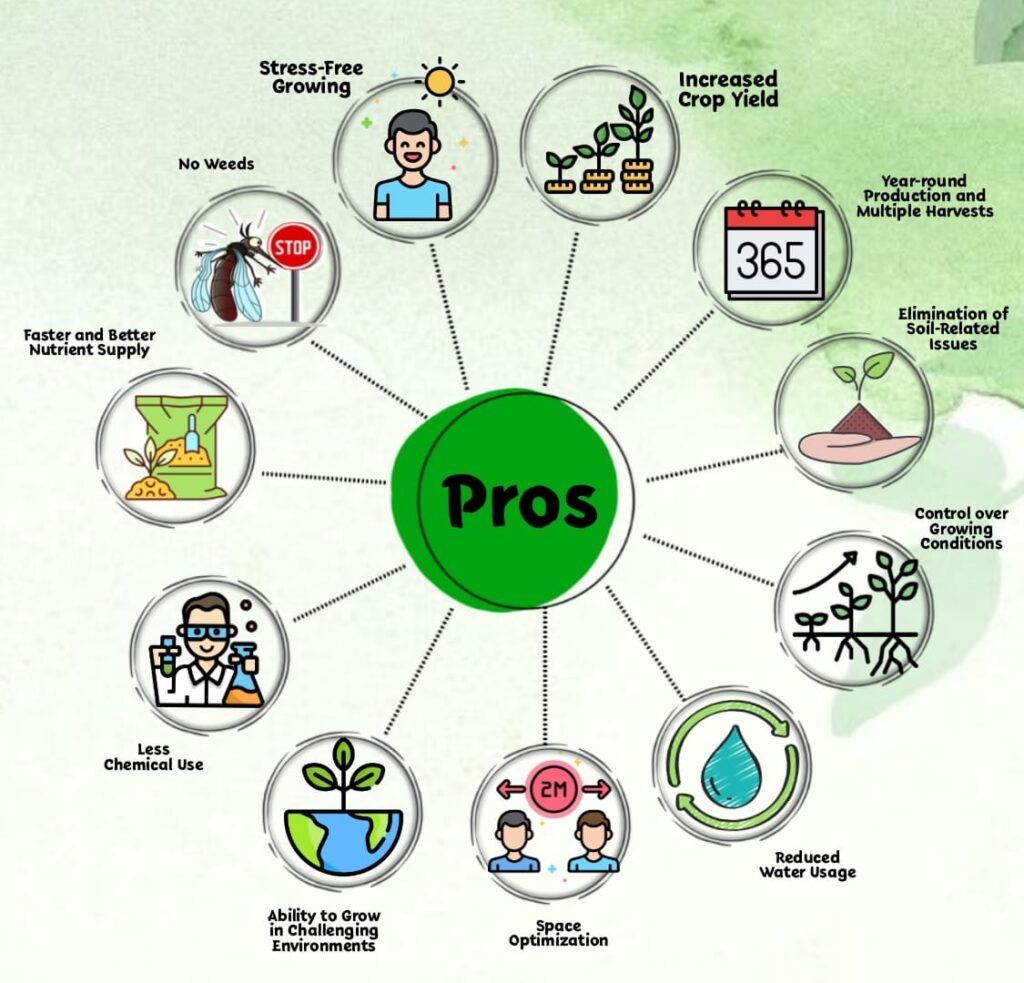
To get a comprehensive, science-backed perspective on these benefits, we will turn to a detailed review article.
[PDF] ADVANTAGES AND CHALLENGES IN SOILLESS FARMING
The paper 'Hydroponics: Advantages And Challenges in Soilless Farming' offers a thorough breakdown of the benefits. Since you appreciate understanding the 'why,' this resource provides the depth you're looking for.
Please read section 5, 'ADVANTAGES OF HYDROPONICS' (this section starts on page 100). As you read, focus on understanding how the control we discussed in the last lesson leads to benefits in four key areas: Resource Efficiency (Water and Space) Higher Yields (Faster Growth, Controlled Environment) Reduced Chemical Needs (Pest and Disease Control) Environmental Benefits (Sustainability, Lower Carbon Footprint)
To reinforce these points with a more dynamic summary, let's watch a short video segment that covers the same ground.
Hydroponics Explained: How to Grow Plants Without Soil
The 'Hydroponics Explained' video from Agriculture Academy provides a concise and professional summary of the advantages you just read about.
Watch the segment from 04:26 to 06:59. Notice how it connects these advantages directly to commercial and hobbyist appeal.
Let's distill what you've just read and watched into the most important takeaways for a potential business owner:
Key Advantages of Hydroponics
-
Increased Productivity & Yield:
- Faster Growth: Plants can grow up to 30-50% faster because nutrients are delivered directly to the roots. The plant expends less energy searching for food and more on growing biomass.
- Higher Yields per Area: By controlling the environment and using techniques like vertical stacking, you can produce significantly more food in the same physical footprint compared to soil farming.
- Year-Round Production: You are no longer bound by seasons or weather. This allows for continuous harvesting and a consistent supply for your market, which is a major business advantage.
-
Superior Resource Efficiency:
- Water Savings: Recirculating hydroponic systems use up to 90% less water than traditional agriculture. Water is not lost to ground absorption or evaporation. For a business, this means lower utility costs.
- Space Optimization: Hydroponics is ideal for urban areas or places with poor soil quality. You can set up a farm on a rooftop, in a warehouse, or even in a shipping container, bringing production closer to consumers. This "hyper-local" model reduces transportation costs and improves freshness.
-
Enhanced Control & Quality:
- Reduced Pests and Weeds: By eliminating soil, you eliminate soil-borne pests, diseases, and all weeds. This drastically reduces the need for pesticides and herbicides, which is a strong selling point for health-conscious consumers.
- Consistent Quality: A controlled environment leads to a more uniform and predictable product in terms of size, appearance, and quality.
The Limitations: What Are the Risks and Challenges?
No technology is a silver bullet. The control that provides the advantages of hydroponics also introduces a unique set of challenges and risks. Understanding these is just as important as knowing the benefits.
Let's return to our academic resource to explore the limitations.
[PDF] ADVANTAGES AND CHALLENGES IN SOILLESS FARMING
The same paper also provides an excellent, detailed look at the challenges. Pay close attention to the sections on costs and economic viability, as these are central to your business planning.
Please read section 6, 'CHALLENGES OF HYDROPONICS' (starts on page 101). As you read, focus on how these challenges represent business risks: Financial Hurdles (Initial Costs, Energy Consumption, Economic Viability) Operational Risks (Technical Expertise, Pest/Disease Management) System Constraints (Limited Crop Variety)
The video we watched earlier also briefly touches upon these limitations.
Hydroponics Explained: How to Grow Plants Without Soil
Let's watch the corresponding 'disadvantages' section from the 'Hydroponics Explained' video to summarize these points.
Watch from 06:59 to 08:29. Note the emphasis on initial investment and the risk of system failure.
Let's summarize the key challenges from a business perspective.
Key Limitations of Hydroponics
-
High Initial Investment (CapEx): Setting up a hydroponic system requires purchasing equipment like pumps, reservoirs, lighting, and environmental controls. The initial capital expenditure can be a significant barrier to entry compared to starting a small plot in a backyard.
-
Dependence on Technology and Expertise:
- Technical Knowledge: Operating a system effectively requires a good understanding of plant nutrition, pH, and system mechanics. Mistakes can be costly.
- Vulnerability to Failure: Automated systems are dependent on reliable power and water. A power outage or a pump failure can wipe out a crop in hours, as the roots have no soil to act as a buffer for moisture and nutrients. Backup systems (like generators) add to the cost.
-
Ongoing Operational Costs (OpEx):
- Energy Consumption: Indoor systems rely on artificial lighting, pumps, and potentially heating or cooling systems. Electricity is often one of the largest ongoing costs.
- Consumables: Nutrients, pH adjusters, and growing media are recurring expenses.
-
Disease Risk: While soil-borne diseases are eliminated, water-borne diseases like Pythium (root rot) can spread very quickly through a shared water system, potentially affecting the entire crop at once.
-
Limited Crop Suitability: While great for leafy greens, herbs, and some vine crops (tomatoes, cucumbers), hydroponics is not economically viable for staple root crops (potatoes, carrots) or large grains.
A Balanced View: A Tool, Not a Panacea
It's clear that hydroponics involves a series of trade-offs. It trades the low-cost, resilient, but uncontrolled nature of soil for a high-cost, fragile, but highly productive controlled system. The following table provides a concise, side-by-side comparison.
[PDF] ADVANTAGES AND CHALLENGES IN SOILLESS FARMING
The PDF resource contains a clear and useful table summarizing the comparison between hydroponics and traditional farming, which serves as a perfect summary of the trade-offs involved.
Please review 'Table 2: Comparing Hydroponics and Traditional Soil Farming' on page 103. This table neatly encapsulates the pros and cons we've discussed.
For your business, the key is not to be deterred by the limitations but to plan for them. A solid business model for hydroponics will have strategies to mitigate these risks, such as having backup power, implementing strict sanitation protocols, and accurately calculating energy costs in your pricing.
Conclusion
In this lesson, we have moved from the "what" of hydroponics to the "why"—exploring the practical advantages and limitations that stem from its core principles.
Key Takeaways:
- Advantages are primarily centered on efficiency and control: higher yields, faster growth, year-round production, and significant water/space savings.
- Limitations are primarily centered on cost and risk: high initial investment, reliance on technology and power, required expertise, and the rapid spread of waterborne diseases.
- Hydroponics is not a replacement for all traditional agriculture but a powerful tool that is especially well-suited for producing specific crops (like leafy greens) in specific environments (like urban areas).
- From a business standpoint, success depends on leveraging the advantages (e.g., marketing local, pesticide-free produce) while actively managing the risks (e.g., budgeting for electricity, having backup systems).
Now that we have a balanced understanding of the pros and cons, our next lesson will start to get more technical. We will examine the core functional components common to all hydroponic systems. Understanding these parts—the pumps, lights, reservoirs, and timers—is the next logical step toward learning how to build and operate your own system.