Hello! Welcome to the third lesson in our "Plant Biology for Hydroponics" module.
In our first two lessons, we covered the essential nutrients plants need and the process of photosynthesis they use to create their own food. We've established what they eat and how they create energy. Now, we'll connect these ideas by exploring the critical mechanism of how plants actually absorb those nutrients from the water in your hydroponic system.
This lesson addresses the learning outcome: Explain the process of ion exchange for nutrient uptake in soilless media. This is a fundamental concept in hydroponics. Understanding it is the key to managing your nutrient solution effectively, particularly its pH, which is crucial for running a successful and productive hydroponic business.
The Problem: Getting Nutrients into the Root
First, let's establish a key fact. The nutrients we discussed in lesson one—nitrogen, potassium, calcium, etc.—are not absorbed by the plant as solid particles. When you dissolve nutrient salts in water, they break apart into electrically charged atoms or molecules called ions.
- Positively charged ions are called cations (e.g., Potassium , Calcium ).
- Negatively charged ions are called anions (e.g., Nitrate , Phosphate ).
Plant roots are surrounded by these ions in the nutrient solution. The challenge is moving these ions from the solution, across the cell membrane of a root cell, and into the plant. This is where ion exchange comes in.
The Principle: Maintaining Electrical Balance
At its core, ion exchange is governed by a simple rule: plants must maintain electrical neutrality. They can't just absorb a positive ion without balancing the charge. To take in a cation, a plant must either release another cation or take in an anion at the same time. The most common way plants solve this is by "exchanging" ions with the surrounding solution.
This next video provides a fantastic explanation of this process and, crucially, links it to something you will be measuring constantly in your hydroponic system: pH.
How does nutrient uptake affect media pH? - Part one
The video 'How does nutrient uptake affect media pH?' from the Science in Hydroponics channel explains the core principle of charge balance during nutrient uptake. It demonstrates why absorbing different types of ions directly changes the pH of your nutrient solution.
Watch from 01:59 to 05:49. Focus on these two key scenarios: What does the plant release when it takes in a cation like potassium (K+)? What is the effect on pH? What does the plant release when it takes in an anion like nitrate (NO3-)? What is the effect on pH?
As you saw, the process is an elegant exchange:
- To absorb a cation (positive charge): The plant root releases a hydrogen ion () from within its cells into the solution. Since pH is a measure of the concentration of hydrogen ions, releasing more makes the solution more acidic, causing the pH to drop.
- To absorb an anion (negative charge): The plant releases a hydroxide ion () or a bicarbonate ion (). These ions neutralize the hydrogen ions in the solution, making it more alkaline and causing the pH to rise.
This is why the pH of your hydroponic reservoir will naturally drift over time. It's a direct indicator that your plants are actively feeding! The type of nutrients they are absorbing in the largest quantities will determine the direction of that drift.
The Mechanisms of Ion Exchange
So we know why exchange happens (charge balance), but how does it physically occur at the root? There are a couple of key theories that explain the mechanics.
This next animation provides a simple visual model for two of these theories. While it mentions "soil" and "clay particles," the underlying principles of how roots exchange ions apply directly to the root-and-solution interface in hydroponics.
Plant Nutrition: Mineral Absorption | Part 1
The video 'Plant Nutrition: Mineral Absorption | Part 1' by Free Animated Education illustrates two classical theories of ion exchange.
Watch the section from 02:19 to 03:42, which covers the 'Ion Exchange Theory'. Pay attention to the two mechanisms described: Contact Exchange: Ions swapping places when the root and a particle are very close. Carbonic Acid Exchange: How CO2 from root respiration creates carbonic acid, which releases H+ ions that can then be exchanged for nutrient cations.
The Carbonic Acid Exchange Theory is particularly relevant. Roots, like other living cells, respire. They release , which reacts with the water () in your nutrient solution to form carbonic acid (). This acid then releases hydrogen ions (), providing the very "currency" the plant needs to exchange for the essential cations like potassium (), calcium (), and magnesium ().
The Role of Soilless Media: Cation Exchange Capacity (CEC)
In pure hydroponics like Deep Water Culture (DWC), the exchange happens directly between the root and the water. However, many "soilless" systems use a substrate like coco coir, peat moss, or perlite. These materials are not inert; they can also participate in ion exchange.
This ability of a growing medium to hold and exchange cations is called Cation Exchange Capacity (CEC).
To understand this concept, let's turn to a short article.
What is CEC and Why Is It Important?
This article, 'What is CEC and Why Is It Important?' from PT Horticulture, clearly defines Cation Exchange Capacity and its relevance to soilless growing media. It will help you understand the role your growing medium can play.
Please read the following sections of the article: Start at the beginning with 'Understanding Cation-Exchange Capacity'. Review the table of cations and anions. Read the section 'Negative Charge of Soil and Soilless Growing Media'. Finally, read the short section 'Supply Nutrients Through Fertilization'. Focus on how negatively charged sites on media particles can hold onto positively charged nutrients.
In essence, particles of a medium like peat or coir have negatively charged surfaces. These act like weak magnets, holding onto the positively charged cations from your nutrient solution. The plant root can then exchange its ion directly with the media particle to grab that nutrient.
Think of it as a small, temporary nutrient buffer. However, as the article correctly points out, the CEC of soilless media is far less important than it is in field soil. In hydroponics, you are providing a constant and complete diet of nutrients in the solution, so you don't rely on the medium to store them.
The Journey into the Plant
Once an ion is taken up by a root hair cell through exchange, its journey has just begun. It must travel through several layers of the root to reach the xylem, which is the plant's internal plumbing system that transports water and nutrients up to the rest of the plant.
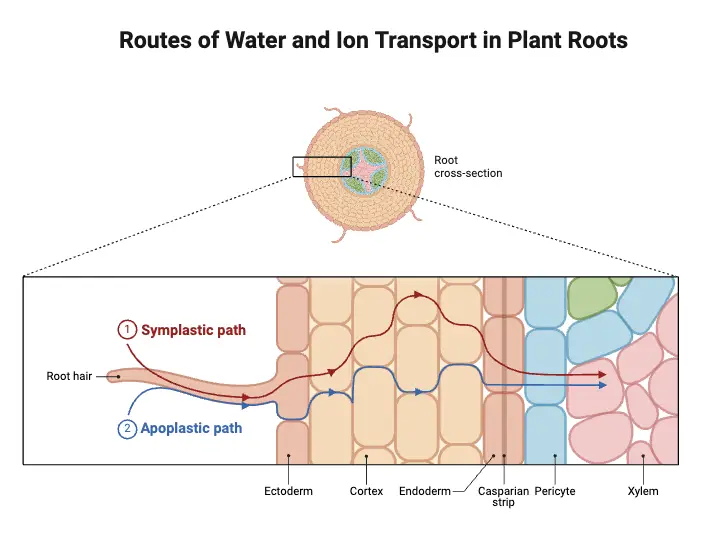
This image provides a great visual summary of the final step of the absorption process, showing how the plant carefully controls what gets into its vascular system.
Conclusion
Today you've learned the mechanism that underpins all nutrient management in hydroponics. You now understand that plants don't just passively "drink" nutrients; they actively trade for them.
Here are the key takeaways from this lesson:
- Nutrients exist as charged ions (cations and anions) in the water.
- Plants absorb these ions via ion exchange, releasing an ion of a similar charge to maintain electrical neutrality.
- The uptake of cations (, ) causes the release of ions, lowering the pH of your solution.
- The uptake of anions () causes the release of ions, raising the pH of your solution.
- Soilless media like coco coir have a Cation Exchange Capacity (CEC), allowing them to act as a minor nutrient buffer, but the nutrient solution is the primary source of nutrition.
In our next lesson, we will zoom out. Having covered nutrients, photosynthesis, and nutrient absorption, we will now look at the entire plant life cycle, from a tiny seed to a mature, harvestable plant. This will set the stage for understanding how a plant's environmental and nutritional needs change as it grows.