Introduction
Welcome to the final lesson in our module on Crop Management and Troubleshooting. In our last session, we covered the essential maintenance task of flushing and changing your nutrient reservoir. That process is fundamental to creating a healthy environment that allows your plants to reach their full potential.
Today, we will focus on the culmination of all your hard work: the harvest. This lesson directly addresses the learning outcome: Identify signs of crop maturity and describe proper harvesting techniques. We will explore not just when a plant is ready, but also how to harvest it to maximize both quality and yield.
For your goal of building a hydroponic business, this is a pivotal moment. The quality of your harvested produce and the efficiency of your harvesting methods directly impact your product's market value, your production capacity, and ultimately, your profitability. Mastering these skills is what turns a healthy plant into a saleable product.
1. The Science of Perfect Harvest Timing
Harvesting is more than just picking a plant when it looks big enough. The optimal harvest window is a specific point in the plant's life cycle when its nutritional value, flavor, and texture are at their absolute peak. Harvesting too early or too late can significantly diminish the quality of your produce.
To understand the "why" behind this, let's explore the plant's internal clock and metabolism.
Perfect Hydroponic Harvest Timing for Maximum Nutrition
This article, 'Perfect Hydroponic Harvest Timing for Maximum Nutrition,' provides an excellent scientific foundation for why timing is so critical. It explains the concept of a plant's 'nutritional peak.'
Please read the section titled 'Understanding the Science Behind Nutritional Peak Timing,' including the subsection on 'The Role of Plant Metabolism in Nutrient Development.' Focus on how a plant's energy shifts from structural growth to producing the compounds that give it nutritional and flavor value.
As the article explains, a plant's metabolism is dynamic. In its early stages, it focuses on building its structure (roots, stems, leaves). As it matures, this energy is redirected toward producing and storing valuable compounds like vitamins, antioxidants, and essential oils. Your goal as a grower is to harvest at the precise moment this concentration of desirable compounds is at its maximum.
2. Reading the Signs: How to Identify Crop Maturity
Plants communicate their readiness for harvest through a variety of signals. Learning to interpret these cues is a key skill. These signals can be general or highly specific to the type of crop you are growing.
General Cues: Visuals and Timing
Across many plant types, you can look for general indicators of maturity related to their appearance and the environment.
Perfect Hydroponic Harvest Timing for Maximum Nutrition
Let's return to the same article to learn about the general signals plants send. We will look at visual cues and how environmental timing plays a role.
Read the sections 'Visual Cues: Your Plants Are Talking to You' and 'Timing Indicators: The Internal Clock of Your Crops.' Pay attention to how color, texture, photoperiod, and even the time of day can signal peak maturity.
To summarize the key general indicators:
- Color: Look for a deep, vibrant, and uniform color characteristic of the variety. A slight yellowing on the oldest, outer leaves can sometimes indicate that the peak has been reached and the plant is beginning to decline.
- Texture & Firmness: Leaves should be crisp and firm (turgid), and fruits should feel heavy for their size.
- Time of Day: For many leafy greens and herbs, early morning is the best time to harvest. Overnight, plants rehydrate and build up sugars, leading to maximum crispness and sweetness before the day's heat and photosynthetic activity begin to change their chemistry.

Crop-Specific Signs
While general cues are helpful, precise timing requires understanding the unique signs for each type of crop. Let's look at three common categories you might grow for a small business.
Perfect Hydroponic Harvest Timing for Maximum Nutrition
The article we've been using has excellent, detailed sections for different crop types. We'll read the sections for leafy greens, tomatoes (as an example of a fruiting crop), and herbs.
Please read the following three sections: 'Leafy Greens: Mastering the Morning Harvest': Note the importance of crispness and how to distinguish a developed leaf from an overdeveloped one. 'Tomatoes: The Art of Color Transition Harvesting': Focus on the concept of the 'breaker stage.' This is a key commercial technique where tomatoes are harvested before they are fully red to maximize shelf life and nutrient development off the vine. 'Herbs: Capturing Maximum Flavor Compounds': Understand that for herbs, the 'golden moment' is just before the plant begins to flower, as this is when essential oil concentration is highest.
Here is a summary table of the key takeaways for each crop type:
| Crop Type | Key Harvest Indicator | Why? |
|---|---|---|
| Leafy Greens | Fully developed leaves, vibrant color, harvested in the morning. | Maximizes cellular water pressure (crispness) and stored sugars. |
| Fruiting (Tomato) | "Breaker stage" (first signs of color change). | Fruit has reached physiological maturity and will continue to ripen with better nutritional development and shelf life. |
| Herbs | Just before flower buds open. | Plant's energy is focused on producing a high concentration of aromatic essential oils to attract pollinators. |
3. Proper Harvesting Techniques
Once you've identified that a plant is mature, how you harvest it is the next critical step. The technique depends on the plant and your goal, which is often to maximize the total yield from your system.
A. Terminal Harvest (Whole Plant)
The most straightforward method is to harvest the entire plant at once. This is common for head-forming lettuces (like romaine or iceberg) or at the end of a crop's productive life.
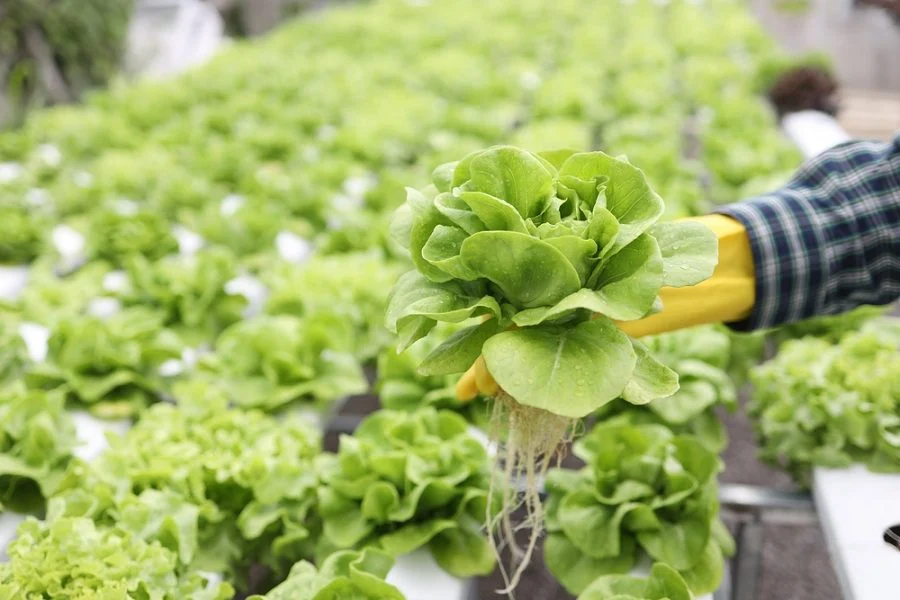
When performing a terminal harvest, you simply lift the entire plant out of its net pot. Afterwards, as noted in the Standard Operating Procedure documents from LINK, it's crucial to clean and sanitize the system components before starting a new crop to prevent any disease carryover.
B. Continuous Harvest ("Cut and Come Again")
For many leafy greens and herbs, a far more productive and profitable method is the "cut and come again" technique. This involves harvesting only the mature, outer leaves, leaving the central growing point of the plant intact to produce more leaves. This allows you to get multiple harvests from a single plant, dramatically increasing the yield per square foot of your system.
Maximize Harvesting Lettuce With The Cut and Come Again Method
This video from Epic Gardening provides an excellent demonstration of the 'cut and come again' method for lettuce.
Watch the video from the beginning to 03:20. Pay close attention to: The core principle: preserving the central growing tip (the crown). The two techniques shown: picking outer leaves by hand and using a knife for a larger bunch. The crucial business insight: you can typically get 3 to 5 cuts before the plant's quality degrades and it tries to bolt (flower).
This method is a cornerstone of efficient small-scale commercial production. It provides a steady, continuous supply of produce from a limited space, which is ideal for servicing regular customers like restaurants or farmers' market patrons.
4. Beyond the Harvest: Preserving Quality
Your job isn't quite done when the plant is cut. The period immediately following harvest is critical for preserving the quality you worked so hard to achieve. Mishandling produce can quickly degrade its nutritional value, flavor, and appearance.
Perfect Hydroponic Harvest Timing for Maximum Nutrition
Let's look at one final section from our main article on post-harvest handling. This is especially important for a business context where produce needs to stay fresh until it reaches the customer.
Read the section 'Post-Harvest Handling for Nutrition Preservation.' Focus on the importance of rapid cooling ('removing field heat') and proper storage to slow down metabolic processes that cause degradation.
For a business, this might mean having an ice water bath ready for leafy greens immediately after cutting or moving tomatoes to a cool, dark place to ripen perfectly. These steps ensure your customer receives a premium product.
As your operation grows, you could even adopt professional methods like using a refractometer to test Brix levels (sugar content), as mentioned in the article (LINK, section 7). This allows you to provide customers with objective data on the sweetness and quality of your produce, a powerful marketing tool.
Conclusion
Congratulations on completing this module! You now understand the full cycle of managing a hydroponic crop, from maintaining the nutrient solution to the final, rewarding harvest.
Key Takeaways:
- Harvest for Quality, Not Just Size: The goal is to harvest at the peak of nutritional value and flavor, which is determined by the plant's metabolic stage.
- Learn the Plant's Language: Each crop type provides specific visual and timing cues for maturity—from the color of a tomato to the firmness of a lettuce leaf.
- Harvest for Maximum Yield: Techniques like "cut and come again" allow for multiple harvests from a single plant, dramatically increasing the productivity of your system.
- Preserve Your Work: Proper post-harvest handling, especially rapid cooling, is essential to maintain the quality of your produce from your system to your customer.
In our previous lessons, we've built your technical skills in managing a hydroponic system. Now that you can successfully grow and harvest a crop, we are ready to move on to the business side of your goal. In the next module, Foundations of a Hydroponic Business, we will begin by analyzing which high-demand, fast-growing crops are best suited for a small-scale commercial operation.