Introduction
Welcome to the first lesson of our new module, Foundations of a Hydroponic Business. In the previous module, we concluded our study of the crop lifecycle by learning how to identify mature plants and apply the correct harvesting techniques. Mastering that process ensures you can produce a high-quality product.
Now, we shift our focus from cultivation to commerce. This lesson directly addresses the learning outcome: Analyze high-demand, fast-growing crops suitable for small-scale commercial hydroponics.
For your goal of launching a home-based hydroponic business, this is a critical starting point. Simply growing what you like isn't enough; you need to grow what sells and what makes economic sense for your space and resources. We will establish a clear framework for evaluating crops not just on their biology, but on their business potential.
1. What Makes a Hydroponic Crop "Profitable"?
Before we can identify profitable crops, we must first define what "profitable" means in the context of a small-scale hydroponic operation. It's a combination of several interconnected factors that go beyond the simple selling price.
To build this analytical framework, let's start with a foundational reading.
Most Profitable Hydroponic Crops: Maximising Yield
The article 'Most Profitable Hydroponic Crops' from Hyjo provides an excellent breakdown of the key business metrics for evaluating crops. It moves beyond just yield and looks at the economic realities of a hydroponic farm.
Please read the section 'What Makes a Hydroponic Crop Profitable?', including the five key factors listed. Focus on understanding how each factor contributes to the overall financial success of a crop.
As the article outlines, the profitability of a crop is determined by these five core factors:
- Growth Cycle Length: How fast can you get from seed to sale? A shorter cycle means more harvests per year and faster cash flow. This is often called "crop turnover."
- Yield per Square Metre: Space is a fixed and valuable asset in a home-based setup. Crops that produce more saleable product in a smaller footprint are more efficient and profitable.
- Market Price & Demand Stability: Is there a consistent, year-round demand for this crop? High-demand, stable-priced crops reduce financial risk compared to niche or seasonal products with fluctuating prices.
- Labour and System Complexity: How much hands-on time does the crop require (e.g., pruning, pollination)? Does it need a complex, expensive system to thrive? Lower labor and complexity reduce your operational costs.
- Risk of Crop Loss: How susceptible is the crop to diseases, pests, or environmental fluctuations? Resilient, lower-risk crops provide more predictable returns.
Keeping these five factors in mind gives you a powerful lens through which to analyze any potential crop for your business.
2. Identifying High-Demand Crops
Now that we have our evaluation criteria, let's apply them. We'll start by looking at the market to see which crops are in high demand.
This chart shows the projected size of the global hydroponics market, broken down by major crop types. It gives us a strong indication of where the commercial focus lies.
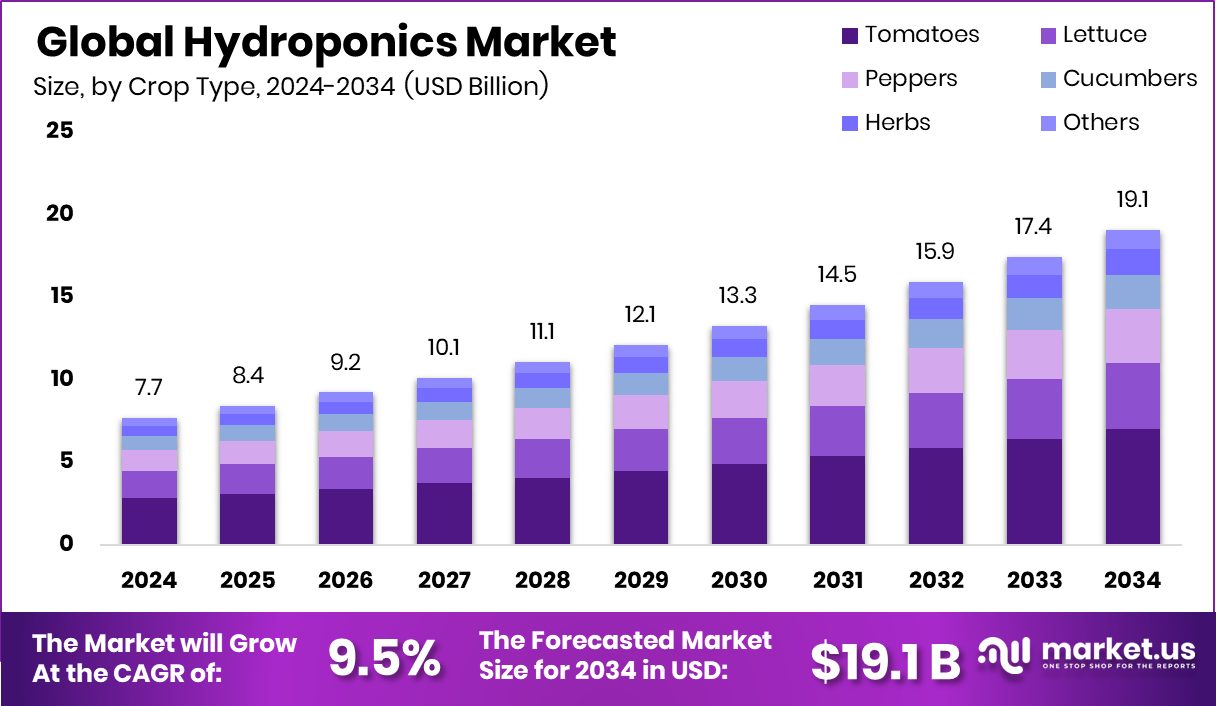
The data clearly shows that lettuce and tomatoes are market leaders, with herbs also representing a significant segment. This aligns with what we often see in local markets and restaurants. Let's dig deeper into the most suitable crops for a small-scale commercial start-up.
3. Analyzing the Best Bets for a Small-Scale Start-up
For a new home-based business, the ideal crops are those that score well across our five profitability factors, especially short growth cycles, high space efficiency, and low complexity. This is why leafy greens and herbs are often called the "cash crops" of hydroponics.
A. Fast-Turnover Crops: Leafy Greens and Herbs
These crops are the workhorses of small-scale hydroponics. They grow quickly, can be planted densely, and have consistent demand.
What are the BEST PLANTS to grow in AQUAPONICS?
This video from New Agrarian, while focused on aquaponics, provides an excellent commercial analysis of why certain crops are chosen over others. The economic principles are identical for hydroponics.
Please watch from 03:55 to 07:39. The presenter outlines the two most important commercial factors (profit per square foot and nutrient demand) and then details the benefits of growing lettuce, bok choy, Swiss chard, kale, and basil. Note the specific numbers he uses for potential profit per raft.
Let's summarize the key profitable crops from this category:
- Lettuce:
- Growth Cycle: Very short (4-8 weeks).
- Yield/Space: Excellent. Can be grown very densely, especially in NFT or DWC systems.
- Market: Extremely high, consistent demand.
- Complexity: Low. No pollination or extensive pruning needed.
- Basil (and other Herbs like Dill, Chives, Coriander):
- Growth Cycle: Short, and offers continuous harvesting ("cut and come again").
- Yield/Space: Excellent. Very compact growth.
- Market: Very high value per gram. Huge demand from restaurants and farmers' markets.
- Complexity: Low.
- Microgreens:
- Growth Cycle: Extremely short (7-21 days). The fastest turnover possible.
- Yield/Space: The most space-efficient crop you can grow.
- Market: Niche, but extremely high-value. Prized by chefs.
- Complexity: Low, but requires a very consistent and clean harvesting/packaging process.

B. Higher-Value (but more complex) Fruiting Crops
Crops like tomatoes, cucumbers, and peppers have strong market demand, as we saw in the chart. However, they introduce more complexity.
5 Crops You Can Easily Grow In Hydroponics to make money.
The video '5 Crops You Can Easily Grow In Hydroponics to make money' from Agriculture Academy discusses some of these other options.
Watch the sections on Cucumbers (03:53 - 04:48) and Beans (04:48 - 05:38). Notice the discussion of trellising (using vertical space) and the different growth habits (bush vs. vining).
Let's analyze a fruiting crop like tomatoes using our framework:
- Growth Cycle: Much longer (3+ months to first harvest).
- Yield/Space: Lower density than lettuce, but can be trained vertically.
- Market: Very high demand.
- Complexity: Higher. Requires trellising for support, often needs pollination assistance indoors, and requires more intensive pruning.
- Risk: Longer growth cycle means a longer period where things can go wrong (disease, nutrient issues).
For a beginner, it's often wise to start with fast-turnover crops to generate early cash flow and gain experience before tackling more complex fruiting varieties.
C. Crops to Avoid Commercially
It's also useful to know what not to grow. The first video you watched mentioned several crops that are generally not economical for small systems.
- Broccoli/Cauliflower: Take up a huge amount of space for a single, one-time harvest.
- Root Crops (Carrots, Potatoes): Difficult to grow well in most hydroponic systems (except media beds, which have their own challenges) and have a relatively low market price.
- Heavy Vining Crops (Melons): Require massive amounts of space, support, and nutrients for a low number of fruits.
4. Matching Your Crop to Your System
Finally, your crop choice is directly linked to the type of hydroponic system you plan to use—a concept we've covered in previous modules. Certain crops perform significantly better in specific systems.
Hydroponic Production of Edible Crops - VCE Publications
This research paper from Virginia Tech, 'Hydroponic Production of Edible Crops,' provides data on how different crops perform in various systems. This adds a scientific layer to our analysis.
Please review the section 'Overall Results' (page 9) and look closely at Table 5: Relative crop yield comparisons between system types. Focus on the conclusions drawn about which systems are best for leafy greens versus fruiting crops.
The research confirms our analysis:
- Leafy Greens (Spinach, Parsley): Produce the highest yields in NFT and DWC systems. This is because these systems provide constant access to water and nutrients for their shallow root systems.
- Fruiting Crops (Tomatoes, Peppers): Perform best in media-based systems like Dutch Buckets or Media Bags. These systems provide better physical support for the larger plant and root structure.
Since we will be focusing on building a DWC system in the next module, this analysis confirms that starting with leafy greens or herbs is the most compatible and logical choice.
Conclusion
In this lesson, you've learned how to move from a grower's mindset to a business owner's mindset by analyzing crops based on their commercial viability.
Key Takeaways:
- Profitability is multi-faceted: It's a balance of growth speed, space efficiency, market demand, labor, and risk.
- Start with "Cash Crops": For a small-scale home business, fast-turnover crops like lettuce, basil, and other herbs are ideal for generating quick, reliable revenue.
- Match Crop to System: The most profitable crop choices are those that are best suited to your specific hydroponic system. Leafy greens excel in DWC and NFT, while fruiting crops need media-based systems.
- Analyze, Don't Guess: Use a consistent framework to evaluate potential crops rather than choosing based on personal preference alone.
Now that we have a clear idea of what crops are most strategic to grow, our next step is to plan the investment. In the next lesson, we will begin to calculate the initial capital expenditure (CapEx) required to set up a small-scale DWC operation designed to grow these profitable crops.