Introduction
Welcome to our third lesson. In our previous session, we drew a clear line between traditional, rule-based software and modern, pattern-based AI. You learned that while a conventional program follows a human-written recipe, an AI system learns its own "recipe" by observing vast amounts of data. This distinction is the bedrock for understanding AI's unique power and limitations.
Today, we build on that foundation by exploring the different types of AI that exist, or are theorized to exist. Not all AI is created equal. The field is best understood as a spectrum of capability, ranging from the specialized tools we use every day to the ambitious, human-like intelligence often depicted in science fiction. This lesson will define that spectrum, clarifying the crucial difference between the AI of today and the AI of tomorrow. By the end, you'll be able to describe what people mean by "narrow AI" and "general AI," giving you a clear framework to interpret news and conversations about AI's progress.
The Three Categories of Artificial Intelligence
To make sense of the field, researchers and thinkers generally divide AI into three categories based on its breadth of intelligence and capability. Think of it as a ladder of increasing generality and power.

These three categories are:
- Artificial Narrow Intelligence (ANI): Often called Weak AI, this is AI designed to perform a single, specific task.
- Artificial General Intelligence (AGI): Often called Strong AI, this is a theoretical form of AI with the ability to understand, learn, and apply its intelligence to solve any problem a human being can.
- Artificial Superintelligence (ASI): A hypothetical AI that would not just match human intelligence, but vastly surpass it in every domain.
Let's explore each of these, starting with the one that defines our current reality.
Type 1: Narrow AI — The Specialist
Every single AI application you have ever used—from ChatGPT to the recommendation engine on Netflix, to the navigation app on your phone—is a form of Narrow AI.
The term "narrow" isn't a criticism of its power; it's a description of its scope. A narrow AI can be superhumanly effective at its specific task, like a chess engine that can defeat any grandmaster. However, that same chess engine has zero ability to write an email, recognize a face, or even play checkers. It operates within a tightly defined, pre-programmed domain. It's a specialist.
The following resource provides an excellent, detailed breakdown of Narrow AI and its place in the world.
Types of AI Explained: Narrow, General & Super AI Guide | AI Insights Blog
This article from AI Insights Blog clearly defines Narrow AI and provides many real-world examples that will help you recognize its presence in your daily life.
Please read the section titled Type 1: Narrow AI (Weak AI). As you read, focus on two key points: The confirmation that Narrow AI is the only type that exists today. The core limitation: it has no "common sense" or ability to operate outside its specific training.
As the article notes, the paradox of Narrow AI is that it can be brilliant and clueless at the same time. It has expertise without understanding. This is why a language model like ChatGPT can write a sophisticated essay on quantum physics but can't "know" it shouldn't give dangerous advice without specific safety rules being programmed into it.
This image offers another great way to visualize the distinction we are about to explore.
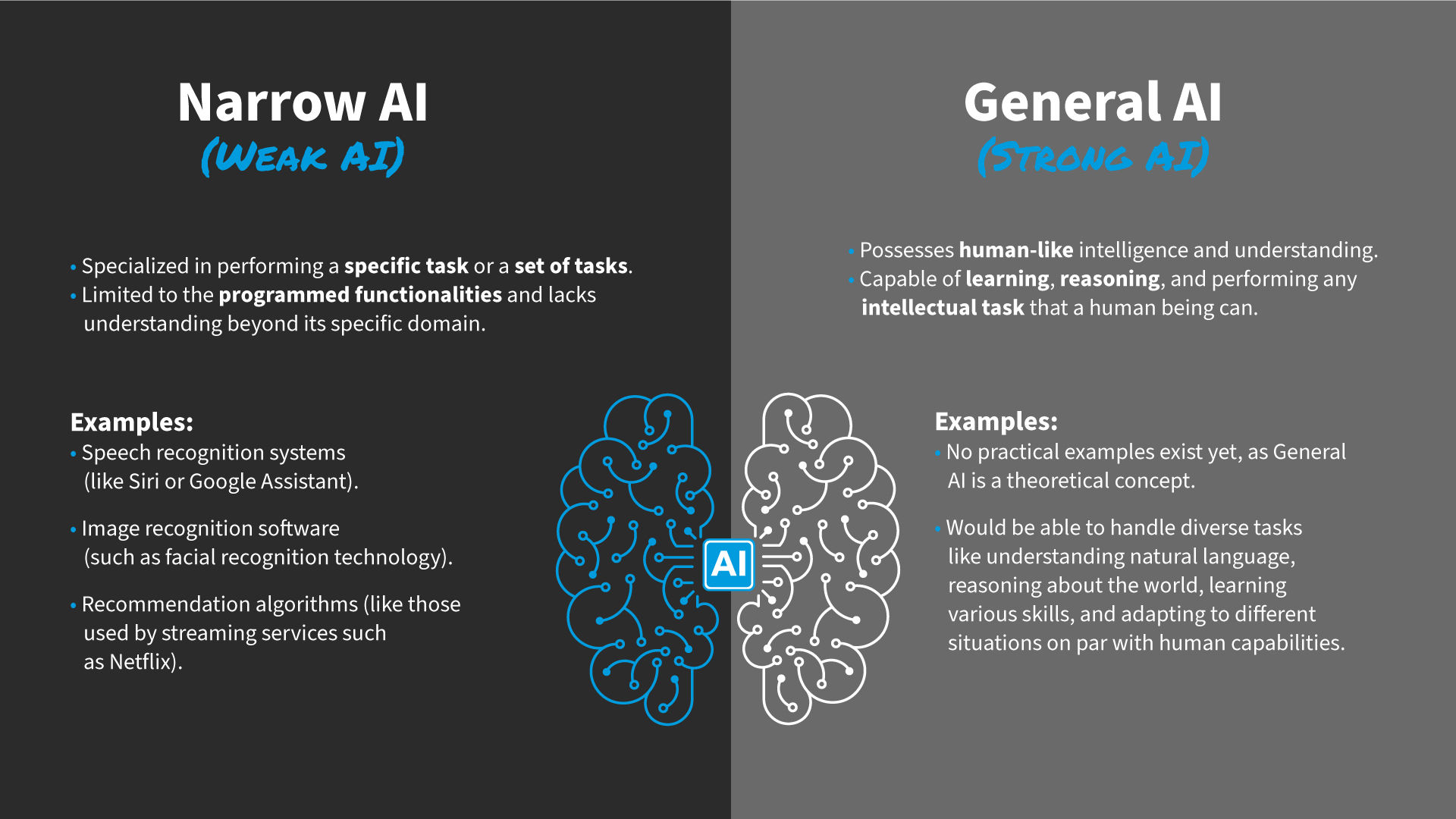
Type 2: General AI — The Polymath
If Narrow AI is the specialist, Artificial General Intelligence (AGI) is the ultimate generalist, or polymath—a goal that resonates with your own intellectual aspirations. An AGI would be a single system capable of performing any intellectual task a human can. It could learn to be a physicist, then a musician, then a chef, applying knowledge learned in one area to problems in another. It would possess creativity, strategic thinking, and common sense.
Crucially, AGI does not exist yet. It remains the "holy grail" of AI research, a theoretical concept that drives much of the industry's ambition and debate.
To grasp the conceptual leap from today's AI to AGI, the following short video offers some powerful analogies.
What is artificial general intelligence? | Ian Bremmer Explains
This video from GZERO Media uses vivid examples to illustrate the profound difference in capability between today's narrow systems and a hypothetical AGI.
Please watch from the beginning until the end of the Uzbekistan example. Pay close attention to how AGI doesn't just provide an answer, but takes autonomous action to solve a complex, open-ended problem.
The video's examples—turning an apple into a fully prepared meal or creating an economic reform plan—highlight the key difference: AGI isn't just a better information tool; it's envisioned as an autonomous problem-solving agent.
So, how do researchers think about a concrete milestone for AGI? Sam Altman, CEO of OpenAI, has offered a very practical, non-technical definition.
What the Heck Is AGI? A Beginner’s Guide to the Next Big Thing
This clip from the "AI For Humans" channel provides a straightforward definition of AGI that is widely used in the field.
First, watch the introductory analogy from the simple definition of AGI. Then, skip ahead to hear Sam Altman's definition of AGI as the equivalent of a "median human coworker."
This idea of an AI that could reliably do the job of a remote human coworker is a useful, grounded way to think about the goal of AGI. It’s not about creating a god-like oracle, but a machine with the general cognitive flexibility of a human.
A Glimpse of the Horizon: Superintelligence (ASI)
Logically, if we can create an AI with the general intelligence of a human (AGI), it's conceivable that this AI could then improve itself or design an even more intelligent successor. This leads to the third category on our spectrum: Artificial Superintelligence (ASI), a hypothetical form of intelligence that would be vastly smarter than the most brilliant human in every field.
ASI is a theoretical concept that fuels the most serious long-term discussions about AI safety and existential risk, topics we will explore in detail later in this course. For now, it's enough to know its place on the spectrum as the ultimate, and most speculative, endpoint.
Bringing It All Together
The distinction between Narrow, General, and Super AI is the single most important framework for understanding the AI landscape. To cement this, let's turn back to our main reading, which summarizes the concepts side-by-side and answers some common questions.
Types of AI Explained: Narrow, General & Super AI Guide | AI Insights Blog
This resource will now help us define AGI and ASI more formally and compare all three types directly.
Please read the rest of the article, starting from the section Type 2: General AI. Pay special attention to: The comparison table under the "Side by Side" heading. The "Simple Way to Remember the Difference" analogy (specialist vs. polymath). The "Frequently Asked Questions," especially the answers to "Is ChatGPT a General AI?" and "Why do people call Narrow AI 'Weak AI'?".
Conclusion
In this lesson, we've mapped the spectrum of artificial intelligence, giving you the vocabulary and conceptual clarity to distinguish between the reality of today and the ambitions for tomorrow.
Key Takeaways:
- AI is not a single entity but a spectrum of capabilities: Narrow, General, and Superintelligence.
- Narrow AI (Weak AI) is specialized for specific tasks. It can be superhumanly powerful within its domain but lacks general understanding. All AI systems in existence today fall into this category.
- Artificial General Intelligence (AGI / Strong AI) is a theoretical AI with the flexible, adaptive, and cross-domain intelligence of a human being. It is the primary goal of many leading AI labs but does not yet exist.
- Artificial Superintelligence (ASI) is the hypothetical next step: an AI that would vastly exceed all human cognitive abilities.
- Understanding this spectrum is essential for cutting through media hype and participating thoughtfully in conversations about AI's potential and its risks.
Preview of the Next Lesson:
Now that you can differentiate the types of AI, we will conclude our introductory module by looking at concrete examples of narrow AI you likely encounter every day. We will identify where AI is working behind the scenes in common applications like search engines, recommendation systems, and voice assistants, making its impact on your life more tangible.