Introduction
In our first lesson, we established a foundational understanding of artificial intelligence through analogy, comparing it to a learning toddler or a skilled chef who develops intuition from experience. The core takeaway was that AI learns from patterns in data rather than simply executing a pre-written recipe.
Today, we will formalize that distinction. This lesson is dedicated to explaining precisely how modern AI differs from the conventional, rule-based software that has powered computers for decades. By the end, you'll be able to articulate why AI represents a fundamental paradigm shift in computing, moving from a logic of explicit instructions to one of pattern recognition. This is a crucial step in building the "AI literacy" you seek.
The Fundamental Shift: From Logic to Learning
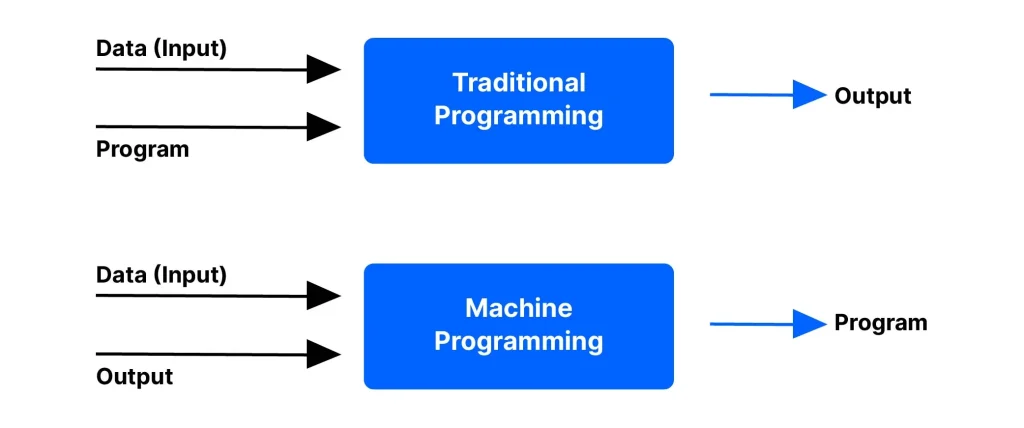
At its heart, the difference between traditional programming and artificial intelligence comes down to a reversal of inputs.
- Traditional Programming: A human programmer writes explicit rules (the program). You feed data into this program, and it produces a predictable output.
- Machine Learning (AI): You feed the system vast amounts of data and the desired outputs (e.g., pictures of cats labeled "cat"). The system then works backward to create its own program—a model capable of producing similar outputs on its own.
This diagram visualizes the shift perfectly:
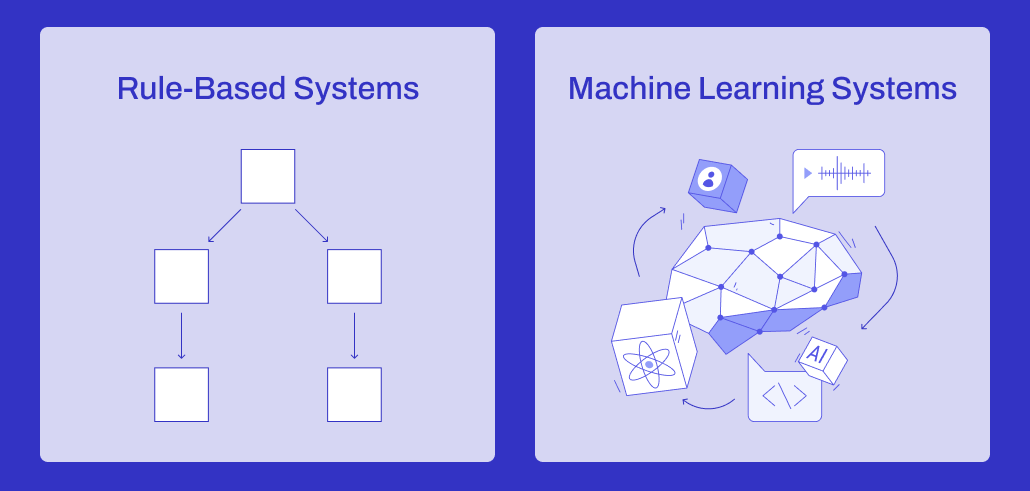
Another way to visualize this is to contrast the structure. A rule-based system is like a rigid flowchart, with clear "if-then" paths designed by a human. A machine learning system is more like a brain, a complex network that learns and adapts by observing the world (the data).
A Deeper Comparison: The Recipe vs. The System that Learns
To solidify this distinction, let's explore the specific differences in how these two approaches are built and how they behave.
Traditional Programming vs AI: The Shift from Rules to ...
This document provides a concise and clear breakdown of the two paradigms. It uses simple language to define each approach and compares them directly.
Please read the following sections: Start with the section What Is Traditional Programming? to understand the rule-based approach. Next, read What Is AI / Machine Learning? to see the contrast. Study the table under Key Differences. This is the most important part, as it summarizes the comparison across four key aspects. Finally, read the Real-World Analogy at the end of the document, which offers a simple, memorable way to frame the difference.
As the document highlights, the key differences lie in four areas:
- Logic: One is written by humans; the other is learned from data.
- Input: One requires rules and data; the other primarily needs data.
- Output: One produces a fixed, predictable result; the other makes predictions or recognizes patterns, which can have a degree of uncertainty.
- Flexibility: A traditional program is rigid and must be re-coded to change. An AI model can adapt and improve as it receives new data.
Where the Difference Matters: Chatbots and Self-Driving Cars
These differences may seem abstract, but they have profound real-world consequences. Certain problems are simply too complex or unpredictable to be solved with hand-written rules.
The following resource provides two excellent examples: chatbots and self-driving cars. As someone who has used ChatGPT, the chatbot comparison should feel particularly relevant.
What is Artificial Intelligence? AI vs Traditional Software
This article from Belitsoft dives into practical applications where the distinction between AI and traditional software becomes clear.
Please read two sections from the article: First, read the section that starts with the bold heading "You can't write the code for a car...". It powerfully illustrates a scenario where rules fail. Next, read the section comparing chatbots. Pay attention to how it contrasts the scripted, limited nature of a rule-based bot with the adaptive, learning-based nature of an AI bot.
The self-driving car example is especially powerful. A programmer cannot possibly write an if-then-else statement for every conceivable event at a traffic circle—a child running, an animal crossing, another car driving the wrong way. A rule-based system would be impossibly brittle. An AI, however, can learn a general, flexible "intuition" for driving by observing millions of hours of human driving data, allowing it to handle situations it has never seen before.
Understanding the Trade-Offs
This doesn't mean AI is always "better" than traditional programming. Each approach has distinct advantages and disadvantages. Choosing the right tool depends on the job. The following video from IBM Technology provides a balanced overview of these trade-offs.
AI Systems vs Traditional Coding
This video, "AI Systems vs Traditional Coding," clearly explains the pros and cons of each approach across three key dimensions.
Please watch the following three segments: The comparison of Stability and Scalability. The discussion on Control and Transparency, which revisits the "black box" idea we touched on in the last lesson. The final contrast on Learning and Data Handling.
To summarize the video's key points:
- Stability vs. Scalability: Traditional code is highly stable and predictable, but it scales poorly for complex, "human-like" tasks. AI is less stable (you don't always know exactly what it will output) but can scale to handle enormous complexity.
- Control vs. "Black Box": With traditional code, developers have full control and can trace any error back to its source. Complex AI models can be "black boxes"—we know they work, but we don't always know how they arrive at a specific answer. This lack of transparency is a major area of research.
- Data Handling: Traditional programs need clean, structured data and must be manually updated to learn. AI systems thrive on messy, unstructured data (images, sound, natural language) and can improve over time as they process more of it.
A Hybrid World
In reality, the world of software is not a binary choice between one or the other. Most sophisticated applications you use today are a hybrid, combining the strengths of both paradigms.
Think of a voice assistant on your phone.
- The user interface—the buttons you tap, the screen layouts, the settings menu—is built with traditional programming. It's predictable, stable, and follows clear rules.
- The part that listens to your voice, understands the meaning of your words, and formulates a relevant answer is powered by AI. It's adaptive, handles the infinite variety of human speech, and learns over time.
Traditional code provides the sturdy skeleton, while AI provides the intelligent, adaptive brain.
Conclusion
In this lesson, we have moved beyond simple analogy to establish a clear, structured understanding of the difference between AI and conventional software.
Key Takeaways:
- Traditional programming is rule-based: humans write explicit instructions that the computer follows to produce a predictable output.
- Modern AI is pattern-based: humans provide data, and the system learns its own rules to recognize patterns or make predictions.
- This fundamental difference creates trade-offs in stability, scalability, control, and adaptability.
- Neither approach is universally superior; they are different tools for different problems, and they are often used together in hybrid systems.
Preview of the Next Lesson:
Now that you can clearly distinguish AI from other software, we'll begin to explore the different types of AI. In the next lesson, we will look at the spectrum of AI capabilities, from the "narrow AI" that exists everywhere today to the still-hypothetical concept of "Artificial General Intelligence" (AGI).