Introduction
Welcome to the start of your journey into the world of Artificial Intelligence. Your goal is to build a clear, conceptual understanding of AI, not just to follow the latest headlines, but to grasp the core ideas so you can explain them confidently and think critically about them. This course is designed to help you do just that, starting from the ground up without any need for technical expertise.
This first lesson focuses on the most fundamental question: What is artificial intelligence? By the end of our session, you will be able to define AI in your own words using a simple yet powerful analogy. This skill—turning complex ideas into relatable concepts—is the cornerstone of the "AI literacy" you're aiming to build. We'll begin by exploring what makes AI different from other computer programs and see why analogies are our best tool for understanding this fascinating field.
Why Jargon Fails and Analogies Succeed
You've expressed a desire to explain complex AI concepts in simple terms. This is not just a practical skill; it's a sign of true understanding. Often, technical fields hide behind jargon, which can make them seem inaccessible. But a good explanation replaces confusing terminology with a clear and relatable analogy.

To begin, let's establish a baseline definition of "intelligence" before we make it "artificial."
SIMPLEST Explanation of How Artificial Intelligence Works? No Jargon | What is AI? How AI works?
The video "SIMPLEST Explanation of How Artificial Intelligence Works?" by Science Simplified 4 All provides a great starting point. We'll watch a short clip to get a clear definition of intelligence in both humans and machines.
Please watch the section from the definition of intelligence to when the narrator defines artificial intelligence. This sets the stage for everything that follows.
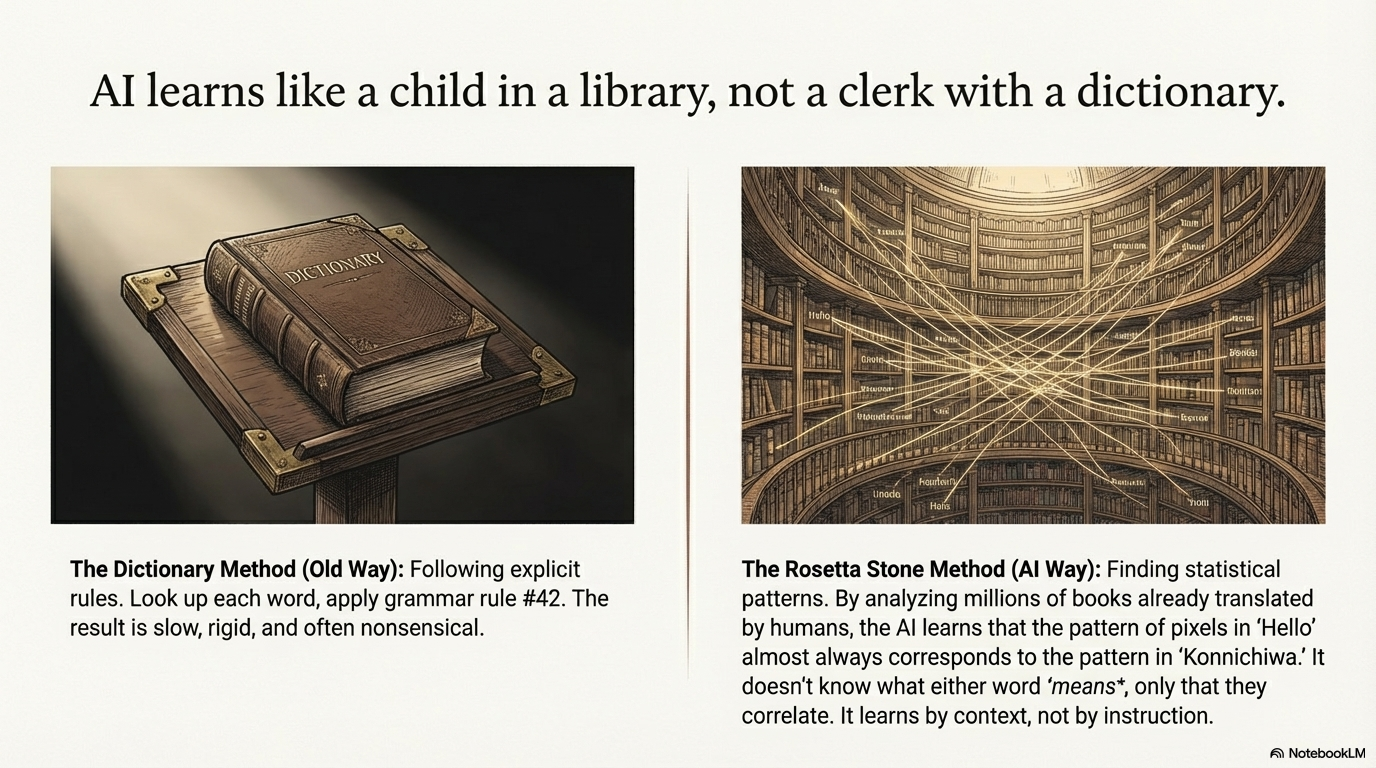
As the video explains, we consider a machine to have artificial intelligence when it can learn, make decisions, and solve problems. But what does "learning" actually mean for a machine? This is where AI diverges from every other computer program you have ever used. A traditional program follows a strict set of instructions written by a human. AI, on the other hand, creates its own understanding by looking for patterns in data.
To make this idea concrete, let's explore our first core analogy.
The AI as a Chef
One of the best ways to understand how AI works is to compare it to a skilled chef. A chef doesn't just memorize recipes; they develop an intuition for how ingredients and techniques combine. This analogy helps demystify the process of AI "training" and "thinking."
How AI Works: A Simple Analogy | Barry Hillier posted on the topic
In his post, Barry Hillier explains AI using the analogy of a chef in a kitchen. This comparison will help you build your first mental model of how an AI system functions.
Please read the transcript of the video, which begins with the question "What is AI?" As you read, focus on how the analogy maps to AI concepts: Culinary School/Kitchen Experience: This is the AI's "training phase." Ingredients, Flavors, Techniques: This represents the vast amounts of "data" the AI learns from. The Chef's Intuition: This is the AI's "model"—the complex network of patterns it has learned. Cooking on a Remote Island: This illustrates how a trained AI can function "offline" (what we call inference), using its internal knowledge without needing to access the internet.
The chef analogy is powerful because it captures the essence of AI: it's not about following a rigid, step-by-step recipe (like traditional code), but about developing a flexible, intuitive understanding from broad experience.
The AI as a Toddler
Another helpful analogy is to think of an AI learning like a young child. A child doesn't learn to recognize a cat by being given a list of rules. They learn by seeing many examples.
How AI Really Works (No Math, Just Logic)
The video "How AI Really Works (No Math, Just Logic)" from the Simple Things channel offers a clear and concise explanation that contrasts the "old way" of programming with the "new way" of AI.
Watch the segment from the beginning of the explanation. Pay close attention to the distinction between writing rules for a "cat" and simply showing the AI thousands of examples of cats. This is the single most important conceptual shift in understanding modern AI.
This idea of learning from examples, rather than being programmed with explicit rules, is what separates AI from conventional software.
Putting It All Together: Your Own Definition
Now it's your turn. Your goal is to be able to explain AI in your own words. Using the chef and toddler analogies as inspiration, try to craft a one- or two-sentence definition of artificial intelligence.
Don't worry about getting it "perfect." The aim is to create a definition that is meaningful to you and that you could use in a conversation. You might use a structure like this:
"Artificial intelligence is like a [chef/toddler/other analogy] that learns by [observing millions of examples/tasting many ingredients] instead of following strict rules, allowing it to [recognize new things/create new recipes]."
Take a few minutes to write down your own definition. This exercise will solidify your understanding and give you a personal touchstone for the concepts we'll explore next.
Diving Deeper: The Language We Use for AI
As someone interested in the connections between different fields, you might find it fascinating that the very words we choose to describe AI shape our understanding of it. The analogies we've used—chef, toddler—are not just simple explanations; they are part of a larger web of metaphors we live by.
Critically examining these metaphors is an advanced step, but it's one that aligns with your goal of developing a deep, polymathic understanding.
AI Metaphors We Live By: The Language of Artificial Intelligence
In this article, educator Leon Furze analyzes the various metaphors used to describe AI. Reading this will give you a meta-level view of how language shapes our perception of technology.
First, read the introduction, starting from the beginning down to the end of the third paragraph. Next, jump to the section "AI as a Physical Object or Entity" and read about two key metaphors: The Black Box and The Iceberg. As you read, think about: Why is AI often called a "black box"? How does the "iceberg" analogy help us understand that there's more to AI than what we see on the surface? We will revisit these ideas later in the course, but seeing them now will enrich your conceptual toolkit.
Conclusion
In this introductory lesson, we've laid the essential groundwork for your understanding of AI. We've deliberately avoided technical jargon in favor of clear, powerful analogies that get to the heart of what makes AI unique.
Key Takeaways:
- Artificial intelligence refers to a machine's ability to learn, make decisions, and solve problems.
- The defining characteristic of modern AI is that it learns from patterns in data, rather than being explicitly programmed with rigid rules.
- Analogies like the skilled chef or the learning toddler are effective tools for explaining this new paradigm of computing.
- Our choice of language and metaphors, such as the "black box" or the "iceberg," shapes how we think about AI's capabilities and limitations.
Preview of the Next Lesson:
Now that you have a core definition of AI grounded in analogy, we will formalize the distinction we've begun to explore. In the next lesson, we will directly compare modern, pattern-based AI with conventional, rule-based software, clarifying exactly why AI represents such a fundamental shift in technology.