Introduction
In our last lesson, we established a crucial framework for understanding the AI landscape by distinguishing between Narrow, General, and Superintelligence. You learned that all AI systems in existence today are forms of Narrow AI—powerful specialists designed for a single task. The idea of a human-like general intelligence, or AGI, remains a theoretical goal.
With this framework in mind, this lesson brings the concept of AI out of the abstract and into your daily life. We will identify the often-invisible AI systems that power many of the services you use every day. The goal is to make the idea of "Narrow AI" tangible by spotting it "in the wild." By the end of our session, you will be able to pinpoint at least three distinct examples of AI in common applications, solidifying your understanding of how deeply this technology is already integrated into the modern world.
The Invisible Assistant
One of the reasons many people are surprised to learn how much they interact with AI is that when it's working well, it's virtually invisible. It operates quietly in the background, smoothing out our digital experiences, personalizing our content, and simplifying complex tasks. It's less like a flashy robot from a movie and more like an unseen assistant, constantly learning and adapting.
The image below gives a high-level overview of some of the most common areas where this "assistant" is at work. Think of it as a map of the territory we are about to explore.

Today, we'll focus on some of the most personal and frequent of these interactions: the AI in your phone, your home, and your online services.
AI in Your Pocket and in Your Home
You don't need to look far to find your first examples of AI. The smartphone is a hub of AI-powered features, and streaming services have become masters of using AI to keep you engaged.
The following short video from the "History of Simple Things" channel gives a perfect, rapid-fire summary of these everyday encounters.
What Exactly Is Artificial Intelligence? (And How Does It Really Work?) [ID2207]
This clip provides quick, clear examples of AI you've likely used today without even thinking about it.
Please watch the segment from "we don't even notice". Notice how it connects specific actions, like unlocking your phone or getting a movie suggestion, directly to AI.
As the video points out, these aren't just simple programmed functions. Let's break down three of the most common examples.
-
Voice Assistants (Siri, Alexa, Google Assistant): When you ask your phone for the weather or tell your smart speaker to play a song, you're using a sophisticated AI. It has to perform several tasks: recognize your speech and convert it to text, understand the intent of your request (not just the words), find the right information or action, and then generate a natural-sounding spoken response. It learns from millions of users to get better at understanding accents and context.
-
Recommendation Engines (Netflix, YouTube, Spotify): When Netflix suggests a show you might like, it isn't based on a simple rule like "people who watched Movie A also watched Movie B." It's a complex AI that analyzes your viewing history, what you've rated, what you've abandoned, the time of day you watch, and compares these patterns to those of millions of other users. It's constantly learning your unique taste to create a personalized feed.
-
Navigation Apps (Google Maps, Waze): To predict traffic and estimate your arrival time, these apps use AI to analyze real-time location data from countless phones on the road. It recognizes patterns—like a slowdown that occurs every weekday at 5 PM on a specific highway exit—and combines that historical knowledge with current conditions to recommend the fastest route. This is a learning system, not a static map.
To solidify these examples and add a few more, the following reading offers a clear, non-technical breakdown.
What Is AI? A Simple, Non-Technical Guide
This section from the "What Is AI?" guide provides simple, direct examples of AI in devices and services you're already familiar with.
Please read the section titled Examples of AI. As you read, notice how each example involves the system learning from your behavior or vast amounts of data to provide a personalized or intelligent outcome.
Connecting the Dots: Examples and AI Fields
We've now seen AI in action in our phones, shopping carts, and living rooms. To deepen your understanding and connect back to your goal of seeing the bigger picture, let's categorize these examples using the "Application Domains" from the infographic we saw in a previous lesson. This helps clarify what kind of AI is being used for each task.
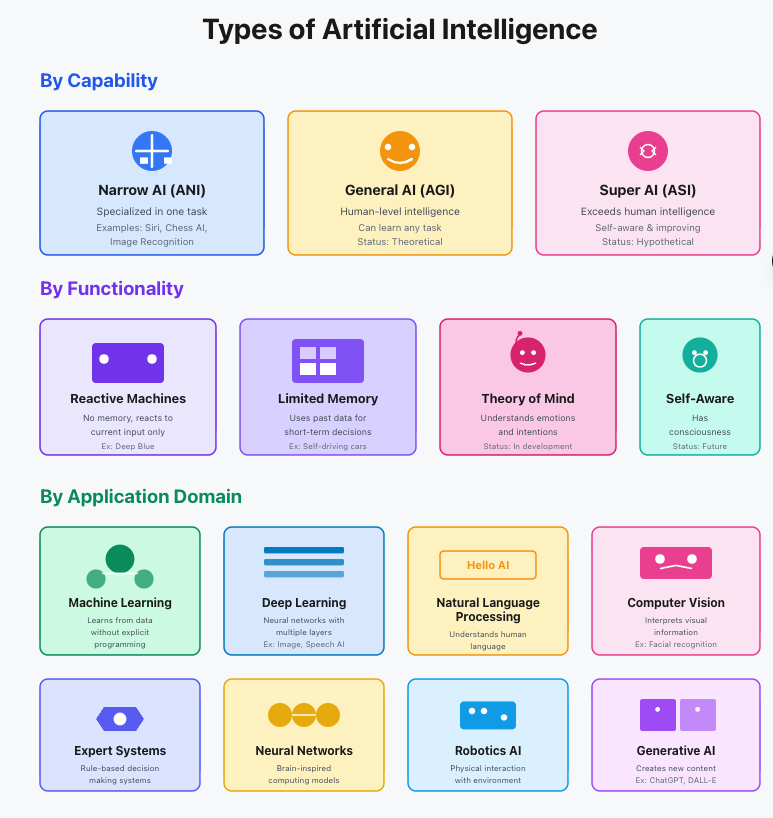
Let's map our examples to the domains shown in the bottom section of this chart:
- Facial Recognition (like Face ID on your phone) is an application of Computer Vision. The AI learns to recognize the unique patterns of your face.
- Voice Assistants (like Siri and Alexa) are prime examples of Natural Language Processing (NLP). The AI learns to understand and generate human language.
- Recommendation Engines (on Netflix or Amazon) are powered by Machine Learning. The AI learns your preferences by analyzing massive datasets of user behavior.
- ChatGPT, which you've used, is a form of Generative AI. It uses deep learning and neural networks to create new, original text.
- Self-driving cars, mentioned in some of our resources, are an advanced application of Robotics AI, which combines computer vision, machine learning, and other fields to interact with the physical world.
By making these connections, you can start to see that "AI" isn't a single technology. It's a collection of specialized fields, each contributing to the tools that have become part of our daily fabric.
Conclusion
In this lesson, we demystified the presence of AI in our daily lives, moving it from a far-off concept to a tangible reality. You learned to identify the invisible work of narrow AI systems in the tools you use constantly.
Key Takeaways:
- AI is not just a futuristic technology; it is already deeply integrated into many everyday applications, often working invisibly in the background.
- Voice assistants like Siri use Natural Language Processing to understand and respond to spoken commands.
- Recommendation engines on platforms like Netflix and Spotify use Machine Learning to analyze your behavior and personalize content suggestions.
- Navigation apps like Google Maps use AI to analyze real-time data and predict traffic patterns to find the best route.
- Other common examples include facial recognition, smart home devices, automated photo improvements, and social media feeds. Each is a form of specialized Narrow AI.
Preview of the Next Lesson:
This lesson concludes our foundational module on "What is Artificial Intelligence?". You now have a solid conceptual grasp of what AI is, how it differs from traditional software, the spectrum of its capabilities, and where to find it in your world.
Now that we understand the "what," we're going to travel back in time to explore the "why" and "how." In our next module, we will begin tracing the history of AI, starting with one of its intellectual fathers, Alan Turing, and his groundbreaking ideas about whether a machine can think.