Hello and welcome back.
In our last lesson, we built a toolkit for managing conversational stalls and awkward silences. You learned how to use bridge phrases and topic pivots to keep an interaction flowing. That was about sustaining the conversation when it hits a snag.
Today, we move from sustaining to calibrating. This lesson is about developing the crucial ability to read social signals in real-time and adjust your communication accordingly. This directly addresses your goal of preventing the disengagement you've noticed in past interactions. We're going to connect the internal grounding techniques from our earlier lessons with keen external observation, turning you from a participant into a perceptive conversational partner.
The learning outcome for this lesson is to adjust communication in real-time based on signals of engagement or disengagement from others. By the end, you'll have a framework for reading nonverbal cues and a set of strategies for responding effectively to either build on connection or steer the conversation back on track.
1. The 'Read': Decoding Engagement and Disengagement
Think of a conversation not as a monologue you perform, but as a feedback loop. You send out a signal (your words, tone, body language), and the other person sends signals back. Your ability to read those return signals is what allows you to calibrate your approach.
We can group these signals into two main buckets: cues of engagement (green lights) and cues of disengagement (yellow or red lights).
How to read people: Decode 7 body language cues
To start building your signal-reading vocabulary, let's turn to Vanessa Van Edwards. In this video, she outlines several clear, actionable cues to look for. Pay close attention to the distinction she makes between a genuine cue and an isolated action, like an itch.
Watch the video from 00:29 to 05:11, and then from 05:59 to 07:08. As you watch, mentally sort the cues into 'Engagement' and 'Disengagement' categories. Notice her advice on looking for clusters of cues.
Based on the video and other research, here is a quick reference guide.
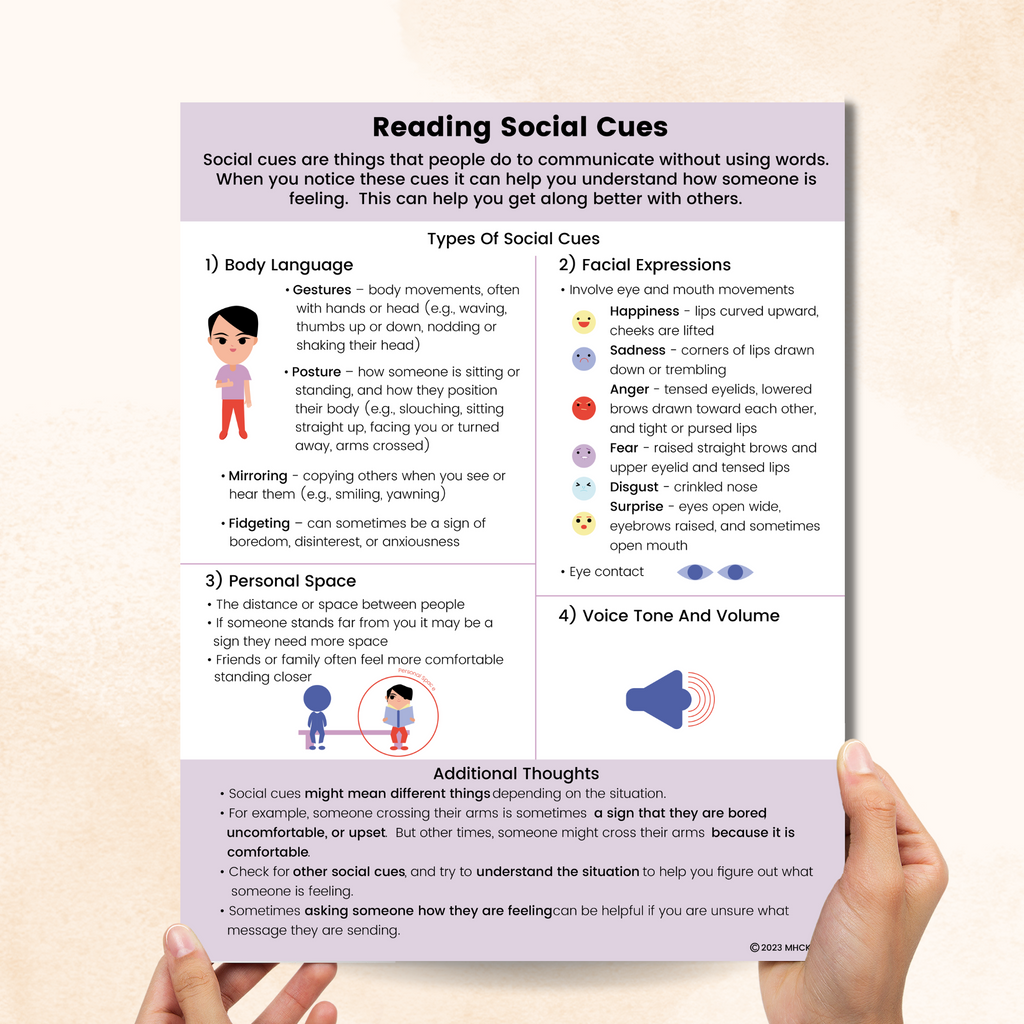
Let's organize these signals into our two categories:
🟢 Engagement Cues (Green Lights): These signal "I'm interested, keep going."
- Head Tilt: As Van Edwards explains, this is a universal sign of curiosity and listening.
- Eyebrow Raise: A quick flash of the eyebrows signals interest or curiosity.
- Slow Triple Nod: This indicates understanding and encourages you to continue. It says, "I hear you, I get it, tell me more."
- Open Body Language: Torso and feet angled toward you ("fronting"), arms uncrossed, showing comfortable space between their arms and torso.
- Leaning In: Reduces the distance between you, signaling a desire for more connection.
- Mirroring: Subtly matching your posture or gestures is a subconscious sign of rapport and alignment.
🟡 Disengagement Cues (Yellow/Red Lights): These signal discomfort, disagreement, or boredom.
- Blocking: Crossing arms, holding a drink or phone in front of their torso. This creates a physical barrier.
- Shame/Discomfort Touches: A light touch to the forehead or covering the mouth can indicate embarrassment or holding something back.
- Fast, Repetitive Nodding: Unlike the slow nod, a fast nod often signals impatience, as if to say, "Hurry up, get to the point."
- Looking Away: Breaking eye contact to scan the room is a classic sign they're looking for an exit.
- 'Turtling': Shoulders creeping up towards the ears and head sinking down. This is a defensive, space-minimizing posture that signals anxiety or discomfort.
Crucially, remember to look for clusters. One crossed arm might mean the room is cold. But crossed arms, angled away from you, with minimal eye contact? That's a clear cluster of disengagement cues.
2. The 'Adjust': Calibrating Your Response
Once you've 'read' a signal, the next step is to 'adjust'. Your adjustment will depend on whether you received a green light or a yellow one.
Responding to Green Lights (Engagement)
This is the easy part! If you're getting engagement cues, what you're doing is working. The adjustment here is to double down.
- Acknowledge and Continue: Keep the topic going.
- Subtly Mirror: If they lean in, you can lean in slightly too. This amplifies the rapport.
- Ask a Deeper Question: Use the momentum to go one level deeper on the current topic.
Responding to Yellow Lights (Disengagement)
This is the critical moment that often leads to the conversational failures you've described. Instead of panicking or freezing, see this as valuable data. The other person is telling you that a course correction is needed. Here are two powerful frameworks for making that adjustment.
Framework 1: Match the Conversation Type
Sometimes, the content is the problem. Disengagement can occur when you and your conversational partner are trying to have two different types of conversations.
The science behind dramatically better conversations | Charles Duhigg | TEDxManchester
Author Charles Duhigg explains this brilliantly in his TEDx talk. He breaks discussions down into three types. Understanding this framework gives you a powerful tool for adjustment.
Please watch from 02:04 to 09:44. Focus on the three types of conversations (practical, emotional, social) and how the surgeon in the story adjusted his approach by asking a 'deep question' when he sensed a mismatch.
As Duhigg explains, conversations can be:
- Practical: About the facts, plans, or solutions.
- Emotional: About how we feel.
- Social: About our identities and how we relate to each other.
If you are talking about the practical details of a financial model and you see their eyes glaze over, you may have a mismatch. They might be looking for a social or emotional connection, not just a data download.
The Adjustment: Ask a "deep question" to shift the conversation's focus.
- Instead of: "The P/E ratio is X, which is above the industry average." (Practical)
- Try: "What's the most counter-intuitive thing you've discovered analyzing this sector?" (Shifts to emotional/social, inviting opinion and experience).
Framework 2: Calibrate with Micro-Communication Skills
Sometimes, the issue isn't the content but the delivery. The way you say something is often more important than what you say.
Not just 'what you say' but 'how you say it'
This academic paper, though set in a medical context, offers a superb overview of the 'how' of communication. It details the specific micro-skills you can use to adjust your delivery in real-time.
Please read the sections titled 'The ‘body’ can ‘talk louder’ than the voice,' 'Empathic communication during simulation,' and 'Timing, pauses and pace in communication.' Finally, review 'Table 1' at the end, which provides an excellent summary of these skills. Focus on how you could use these skills to respond to disengagement.
Here are some adjustments you can make, inspired by this resource:
- Adjust Your Pace: If you sense anxiety or impatience (fast nodding), consciously slow down your own speech. This is called "emotional co-regulation." A calm, steady tempo can help soothe the other person's nervous system and re-engage them.
- Perform a "Temperature Check": If you're unsure what the disengagement signal means, you can ask! A simple, low-pressure check-in can work wonders.
- "I feel like I'm rambling a bit. What are your thoughts on this?"
- "Does that make sense, or am I getting too into the weeds?"
- Use Your Body Language: Respond to their physical cues with your own. If they are leaning back, don't invade their space by leaning far forward. Instead, ensure your own posture is open and non-threatening. A slight lean or a "nonverbal bridge" like gesturing can test the waters to re-establish connection without being intrusive.
Test your understanding!
You're at a networking mixer, explaining a complex financial concept to a potential contact. You notice they've crossed their arms, broken eye contact, and are looking around the room. What is the most effective first adjustment to make?
- Speak louder and faster to recapture their attention with your expertise.
- Immediately pivot to a completely new topic like the weather.
- Pause, take a breath, and perform a "temperature check" by saying, "Sorry, I can get a bit passionate about this stuff. Am I losing you in the details?"
- Mirror their body language by crossing your own arms to make them feel more comfortable.
Show answer
Option 3 is the most effective first step. It shows self-awareness, acknowledges their signals without being accusatory, and invites them to give you data on how to adjust. It shifts you from "lecturing" to "connecting."
Option 1 would likely increase their disengagement. Option 2 is a valid strategy (from our last lesson), but it's an abrupt escape rather than an attempt to salvage the current topic. Option 4 is a misunderstanding of mirroring; you should mirror engagement cues, not disengagement cues, as that could signal mutual disconnect.
3. A Meta-Framework: The Warmth-Competence Model
In your field of finance, it's common to heavily index on proving competence. You want to show you're smart, knowledgeable, and credible. However, research by Dr. Susan Fiske shows that we evaluate others on two primary axes: Warmth and Competence.

Competence without warmth can be perceived as arrogant or intimidating, leading to suspicion and disengagement. Warmth without competence can be seen as friendly but ineffective. The goal is to project both.
The Adjustment Strategy: If you're at a financial markets mixer and sense disengagement, ask yourself: "Am I over-projecting competence and under-projecting warmth?"
- Competence Cues: Using data, structured arguments, clear intonation.
- Warmth Cues: Smiling, nodding, asking questions about them, using phatic "chit-chat," mirroring.
If the answer is yes, consciously inject a warmth cue. Pause your data-driven explanation, smile, and ask an emotional/social question: "That's the data, anyway. But how does all this volatility feel from your side of the desk?" This simple shift can re-engage a person who was tuning out.
Conclusion
Adjusting your communication in real-time is one of the highest-level social skills. It's not about being fake; it's about being responsive. By learning to read the nonverbal and verbal feedback loop, you can stop guessing and start calibrating, ensuring your conversation partner feels seen, heard, and engaged.
Key Takeaways:
- Read the Signals: Learn to identify clusters of engagement (head tilt, open posture) and disengagement (blocking, looking away) cues.
- Adjust Your Content: If you sense disengagement, consider if there's a mismatch between Practical, Emotional, and Social conversation types. Use a "deep question" to shift gears.
- Adjust Your Delivery: Use micro-communication skills like slowing your pace, performing a "temperature check," or using open body language to re-establish connection.
- Balance Warmth and Competence: Especially in professional settings, ensure you're not just signaling competence. Intentionally add warmth cues to build trust and prevent disengagement.
Daily Drill (15 minutes):
- Passive Observation (5 mins): Find a place where people are interacting (a cafe, a park, or even a muted reality TV show). Your only job is to spot the cues. Look for clusters. See if you can guess the state of the conversation (engaged, bored, tense) just from body language.
- Active Observation (During one conversation): In your next low-stakes conversation, your goal is to spot one clear signal of either engagement or disengagement from the other person. Just notice it and label it in your mind ("Ah, that was a head tilt" or "Okay, they just crossed their arms and looked away").
- Post-Conversation Reflection (5 mins): After the conversation, reflect on the signal you noticed. What was happening right before it? If it was an engagement cue, what were you doing right? If it was a disengagement cue, what adjustment could you have made? (e.g., "I could have asked a deep question," or "I could have slowed down my speaking pace.").
Preview of the Next Lesson:
You now have the tools to read and adjust in a one-on-one setting. This is the foundation for navigating more complex social dynamics. In our next lesson, we will apply these signal-reading skills to a group setting, learning how to find entry points in multi-person conversations without interrupting the flow.