Welcome back! In our last lesson, we focused on integrating your verbal, vocal, and nonverbal skills to create a congruent and confident message. We moved from practicing individual skills to conducting the whole orchestra.
Today, we're focusing on the content of that message. The learning outcome is to build rapport through a balance of strategic self-disclosure and active listening. This is the heart of moving a conversation from a superficial exchange to a genuine connection. You’ll learn that rapport isn't a magical spark; it's a dynamic process of give and take, of sharing parts of your story and creating space for others to share theirs. We will explore simple frameworks to start this process and an advanced model for navigating it in professional settings.
1. The Foundation of Connection: The Self-Disclosure Loop
At its core, building rapport is about creating a cycle of mutual understanding and trust. This cycle is fueled by two key activities: self-disclosure and active listening. Research has consistently shown that we tend to like people who disclose personal information to us, and in turn, we tend to disclose more to people we like. This creates a powerful, positive feedback loop.
A helpful way to think about this is the Social Penetration Theory, which uses the metaphor of an onion.
The One Trick to Building Deep Connections
The Explearning article, 'The One Trick to Building Deep Connections,' provides an excellent, easy-to-understand overview of the core theories behind self-disclosure. We'll start here to build our foundation.
Please read two parts of this article: Start at 'Part 3: The Dance of Intimacy...' and read until the line '...each one revealing something deeper than the last.' This section explains Social Penetration Theory and the 'onion' metaphor. Then, read the section titled 'The Heartfelt Connection. How Self Disclosure Fuels Affection.' This part explains the research linking disclosure to liking.
As the article explains, relationships deepen in layers, much like an onion:
- Superficial Layer: Small talk about the weather, movies, or current events. It's safe and low-risk.
- Semi-Private Layers: Sharing personal anecdotes, aspirations, or opinions. This is where bonds begin to form.
- Intimate Core: Revealing deeply held beliefs, fears, and cherished memories.
The key is that you don't jump to the core. You "peel the onion" gradually. Strategic self-disclosure is the act of sharing a piece of information from a slightly deeper layer to invite the other person to do the same. This reciprocal exchange is what builds trust and moves the relationship inward.
2. The Other Half of the Loop: Active Listening
Self-disclosure is only half of the equation. If you share something and the other person doesn't feel heard, the connection breaks. This is where active listening comes in. It's more than just being silent while someone else talks; it's about showing through your words and body language that you are present, engaged, and understanding.
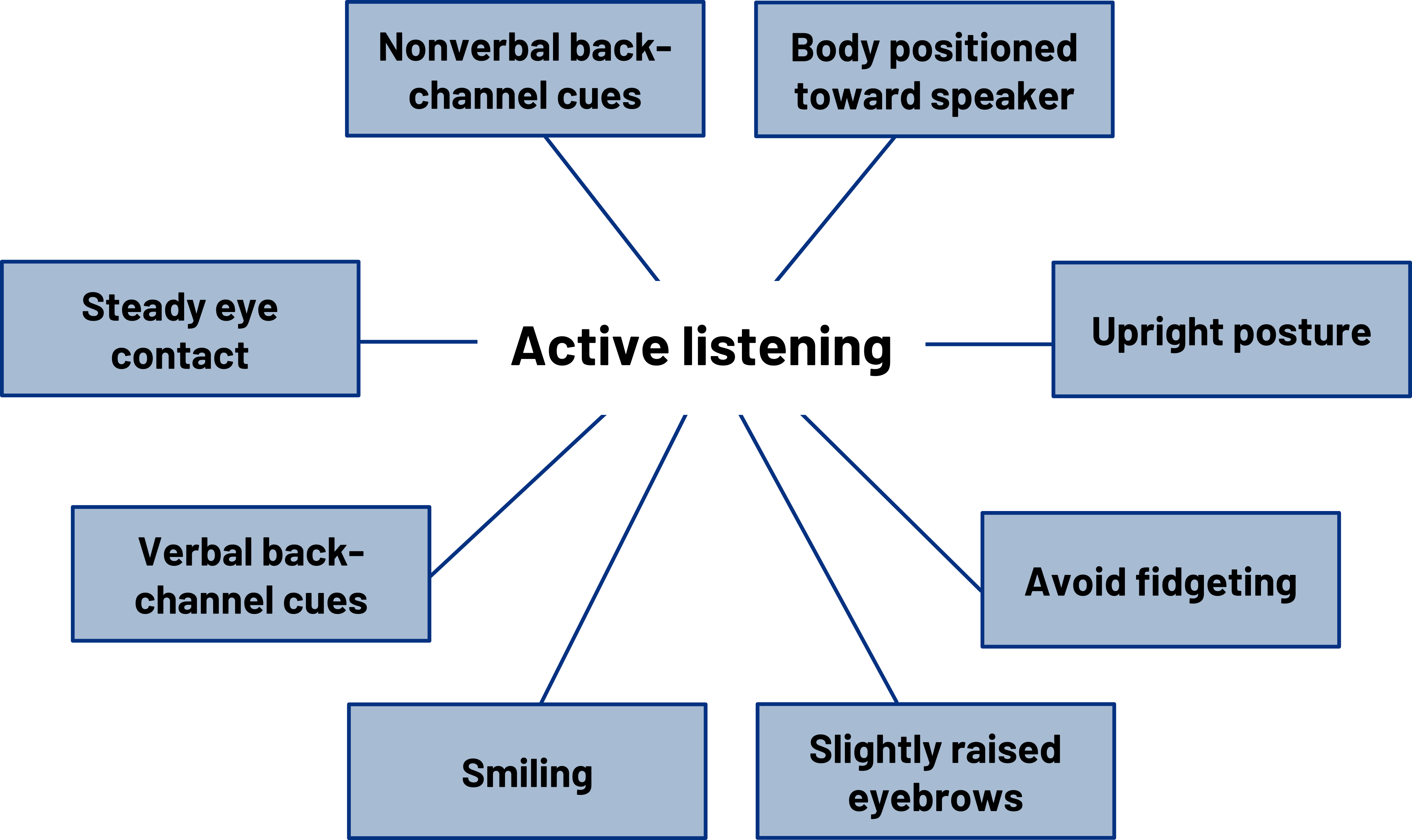
This diagram breaks down the key behaviors of active listening:
Let's connect these behaviors to skills you've already worked on:
- Body Positioned Toward Speaker & Upright Posture: This is "Fronting" and maintaining an "Open Posture" (Module 5). It signals respect and interest.
- Steady Eye Contact: You practiced this with the "triangle technique" (Module 5). It shows you're focused on them.
- Nonverbal & Verbal Back-channel Cues: These are small signals like nodding, smiling, or saying "uh-huh," "I see," or "right." They act as encouragement for the speaker to continue.
- Avoid Fidgeting: This relates to managing nervous habits (Module 5). Holding a drink or keeping your hands in a neutral position can help.
Active listening creates the psychological safety necessary for the other person to reciprocate your self-disclosure. When you truly listen, you are non-verbally communicating, "What you're sharing is important, and I am here to receive it."
3. Practical Frameworks for Building the Loop
Knowing the theory is one thing; applying it in a real conversation is another. Here are two practical frameworks for initiating and sustaining a self-disclosure loop.
Framework 1: Topic -> Options -> Share (Low-Risk)
This simple, three-step formula is perfect for turning everyday small talk into a more personal exchange.
Never Struggle with Small Talk Again | Easy Tips for Better Conversations
Jefferson Fisher provides a wonderfully practical and low-risk formula for conversation in his video 'Never Struggle with Small Talk Again'. This is a great starting point for practicing strategic disclosure.
Watch from 04:01 to 06:48. Pay close attention to the three-part formula he explains: 1. Pick a topic, 2. Give options, 3. Share your personal preference and ask 'what about you?'. Notice his explanation of the 'mutual contract' this creates.
To recap the formula:
- Pick a Topic: Anything from the weather to the event you're at.
- Offer Options: Frame a question with two choices (e.g., "Are you more of a summer or winter person?"). This is easier to answer than a completely open question.
- Share & Inquire: After they answer, share your own preference and why. Then, turn it back to them ("What about you?"). The "why" is a small self-disclosure that invites them to share their own "why."
Framework 2: High -> Low -> Buffalo (High-Impact)
For situations where you want to build a connection more quickly, you can use a more direct approach. Communication coach Vinh Giang calls this the "High Low Buffalo" game.
How To Build Rapport FAST And Skip The Boring Small Talk
Vinh Giang's 'High Low Buffalo' technique is a more structured way to accelerate rapport. It's essentially a packaged set of self-disclosure prompts.
Watch from 01:14 to 04:13. Observe how the 'High Low Buffalo' game works. Most importantly, notice what Vinh does after the other person shares. He doesn't just move on; he 'pulls on a thread' from her 'Low' to deepen the conversation. This is the critical link between disclosure and active listening.
The structure is:
- High: Share something that's going great for you.
- Low: Share something that's a bit of a challenge.
- Buffalo: Share something random or interesting about yourself.
After you (or they) share, the most important step is to pull on a thread. Listen actively for the most interesting part of their answer and ask a curious, open-ended question about it. This demonstrates you were listening and validates their disclosure, making them feel comfortable sharing more.
4. An Advanced Layer: Strategic Disclosure and Status Distance
In professional contexts, especially in a field like finance, conversations often happen between people of different levels of seniority or status. Deciding what to share in these situations requires another layer of strategy.
Academic research provides a useful model for this, centered on the idea of "status distance." When there's a large perceived gap in status (e.g., between a student and a managing director), people can be hesitant to disclose personal information for fear of being misinterpreted. The type of information you choose to share can either increase or decrease this perceived distance.
TO DISCLOSE OR NOT TO DISCLOSE? STATUS DISTANCE ...
This academic paper by Phillips, Rothbard, and Dumas offers a sophisticated framework for understanding disclosure in professional settings. We won't read the whole paper, but we will focus on its most practical concept.
Please read the section titled 'TYPE OF STATUS-RELEVANT PERSONAL INFORMATION DISCLOSED AND SUBSEQUENT STATUS DISTANCE' (it begins after Proposition 2). Focus on understanding the definitions of: Status-confirming information: Information consistent with stereotypes about a person's group or status. Status-disconfirming information: Information that challenges those stereotypes.
Here is the key takeaway for your goals:
- Revealing Status-Confirming Information tends to increase status distance.
- Example: A senior partner talking exclusively about his yachting club memberships with a junior analyst might reinforce the "old boys' network" stereotype and make the analyst feel more distant.
- Revealing Status-Disconfirming Information tends to decrease status distance.
- Example: As a student networking with professionals, you might feel a large status gap. If you share a well-researched, non-obvious insight about a niche market trend, you are disclosing status-disconfirming information. It challenges the stereotype of a student as inexperienced and positions you as a peer, thereby reducing the status distance and fostering a more engaging conversation.
Thinking about disclosure in this way allows you to be highly strategic in networking events. Your goal is often to find common ground or showcase competence by sharing status-disconfirming information that bridges the gap.
Test your understanding!
You are at a networking event for your finance program. You're speaking with a senior executive from a top investment bank. Which of the following is the best example of using strategic self-disclosure to build rapport?
- Share a "High" about getting a good grade on a recent exam to show you are a good student.
- Ask them what they think about the market, listen to their answer, and then share a detailed, data-backed opinion on a specific sector that you've been following closely, which might be new to them.
- Tell them a "Low" about how stressful your job search is, hoping to get their sympathy and advice.
Show answer
Option 2 is the best choice. It balances active listening (asking their opinion first) with strategic, status-disconfirming self-disclosure. By sharing a nuanced, well-researched opinion, you are revealing competence that may be unexpected from a student, thereby decreasing the status distance and positioning yourself as a knowledgeable future colleague.
Option 1 is status-confirming (students are expected to get good grades) and doesn't do much to bridge the status gap. Option 3 is a risky disclosure that could be perceived as unprofessional or just complaining, potentially increasing the distance.
Conclusion
Building rapport is a skill, not an accident. It's a dance that requires you to lead by sharing a piece of yourself, and then follow by actively listening to and validating what the other person shares in return.
Key Takeaways:
- Rapport is a Loop: It's built on a reciprocal cycle of self-disclosure and active listening.
- Peel the Onion: Deepen connections gradually by moving from superficial to more personal topics as trust is built.
- Use Practical Frameworks: Start with low-risk formulas like "Topic-Options-Share" or use the "High-Low-Buffalo" game to accelerate connection, always remembering to "pull on a thread."
- Be Strategic in Professional Settings: Use status-disconfirming information to bridge status gaps and demonstrate competence, transforming a hierarchical exchange into a conversation between peers.
Daily Drill (10-15 minutes):
- Choose Your Framework: Decide whether you'll practice the "Topic-Options-Share" or "High-Low-Buffalo" framework today.
- Initiate a Loop: In one conversation (with a classmate, at a coffee shop, or with a friend), use your chosen framework to initiate a self-disclosure.
- Listen and Pull a Thread: Once they respond, your primary goal is to listen actively. Identify one interesting detail in their response and ask a single, open-ended follow-up question about it. Pay attention to how this shifts the dynamic of the conversation.
Preview of the Next Lesson:
You now have tools to sustain a conversation. But what happens when the thread runs out and the conversation stalls? In our next lesson, we will focus on how to manage awkward silences by using prepared bridge phrases or topic pivots, ensuring you can navigate those moments with poise and keep the interaction flowing smoothly.