Hello! Welcome to the eighth module of our course.
In the last module, we focused on the crucial skills of active listening and rapport building. You learned to avoid common conversational traps like interrupting and one-upping by shifting your focus from being interesting to being interested. This foundation of attentive listening is surprisingly the bedrock for what we'll tackle next.
You've mentioned that one of your key challenges is navigating playful moments, banter, and humor. This module is dedicated to demystifying those skills. We'll begin today by focusing on our first learning outcome: to identify major humor styles to understand your own and others' preferences.
Many people believe humor is an innate talent—you either have it or you don't. This is a myth. Humor is a social skill that can be understood, practiced, and developed. Today's lesson is the essential diagnostic step: mapping the landscape of humor so you can identify what you naturally enjoy and what styles are most effective for building the connections you want.
1. Why Humor Works: The Social Connection
Before we dive into different styles, let's establish why humor is such a powerful tool for rapport. At its core, humor signals social intelligence, confidence, and warmth. When you make someone laugh, you create a shared positive experience, a small moment of connection that builds trust.
However, as you know, a joke that lands perfectly in one context can fall flat or even cause offense in another. Understanding the audience is key.
How to be Funny in Any Conversation
The video 'How to be Funny in Any Conversation' provides a great overview of why humor is a 'social calling card' and the importance of adapting it.
Please watch the first 44 seconds of the video (00:00 - 00:44). Pay attention to the core concept of humor as combining unexpected ideas and the critical importance of tailoring it to your audience and situation.
This idea of adapting your humor is central to our goal. To adapt, you first need a vocabulary to describe the different forms humor can take.
2. A Framework for Understanding Humor's Impact
To bring some structure to this topic, we can use a psychologically-grounded framework developed by researchers. It categorizes humor into four main styles based on its target (is it directed at the self or others?) and its effect (is it benign or detrimental?).
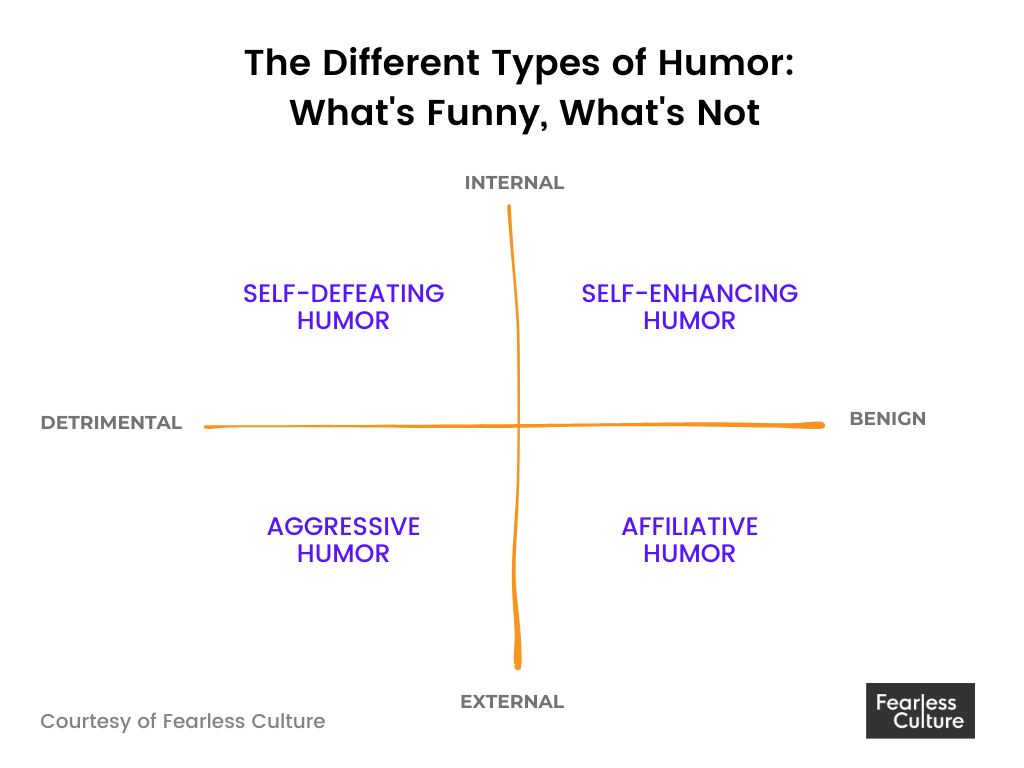
This framework helps us understand the function and impact of humor in our interactions. Let's look at the definitions.
The 'Humor Styles Questionnaire' page provides a clear interpretation of these four styles. Understanding this framework will help you analyze your own tendencies and the humor of people you interact with.
First, read the introductory paragraph under the main heading to understand the four styles: Affiliative, Self-Enhancing, Aggressive, and Self-Defeating. Then, scroll down to the 'Interpretation' section and read the descriptions for each subscale in the table. This will be our core framework.
Here's a quick summary of the four styles:
- Affiliative (Benign, External): This is the humor of connection. It involves telling jokes, engaging in witty banter, and saying funny things to amuse others and put them at ease. It's prosocial and aims to strengthen relationships. Goal: "Let's laugh together."
- Self-Enhancing (Benign, Internal): This is a coping humor. It's about finding amusement in life's absurdities and maintaining a positive perspective, even in the face of stress. It’s about cheering yourself up. Goal: "I can find the funny side of this."
- Aggressive (Detrimental, External): This humor uses sarcasm, teasing, ridicule, or putting others down. While it can be funny within a trusted group that understands the intent, it risks alienating or hurting others. Goal: "I'm laughing at you."
- Self-Defeating (Detrimental, Internal): This is excessively self-disparaging humor used to gain approval or letting others laugh at your expense. It can sometimes backfire, making others uncomfortable or lowering their perception of you. Goal: "Laugh at me so you'll like me."
Your goal is to strengthen your Affiliative and Self-Enhancing styles, as these are most strongly linked to positive social outcomes and psychological well-being.
3. A Practical Vocabulary of Humor Types
Building on that four-quadrant framework, we can now explore a more granular list of common humor techniques or types. Think of these as the specific tools in a comedian's toolkit. Knowing them will help you spot what's happening in a funny conversation.
The resources below describe several distinct types. We'll focus on a few key ones that are particularly useful for building rapport.
How to Effortlessly Develop a Sense of Humor (& Humor Types)
The article 'How to Effortlessly Develop a Sense of Humor' from Science of People offers a fantastic breakdown of 12 different humor types, with celebrity examples.
Read 'Step 2. Understand the 12 Types of Humor Below'. Skim through the descriptions for all 12 types to get a broad overview. Pay special attention to: Self-deprecating, Self-enhancing, Anecdotal, Callback, and Surprise & Incongruity.
How to be Funny in Any Conversation
Let's return to the 'How to be Funny' video, which gives practical examples of a few of these styles.
Watch the following three segments to see these styles in action: Misdirection (Surprise & Incongruity): 00:54 - 01:43 Self-Deprecating Humor: 01:43 - 02:59 Affiliative Humor: 03:46 - 04:50
Let's consolidate the most important styles for your goal:
| Humor Style | Description | When to Use |
|---|---|---|
| Affiliative / Anecdotal | Sharing funny personal stories or observations about shared experiences. | Excellent for building bonds. The "us against the world" feeling ("If we pass this exam...") is pure affiliative humor. |
| Self-Deprecating | Lightly making fun of your own minor flaws or relatable mistakes (e.g., clumsiness, forgetfulness). | Great for appearing humble and relatable. Crucial distinction: this is different from Self-Defeating humor. Joke about things you are genuinely okay with, not deep insecurities. |
| Self-Enhancing | Turning a potential criticism into a point of pride, often with a playful, confident tone. (e.g., "Jealous of my accent?"). | A powerful tool for handling teasing or light jabs without getting defensive. Shows high confidence. |
| Callback | Referencing a joke or a funny moment from earlier in the same conversation. | Highly effective. It shows you were listening attentively (connecting to our last module!) and creates an "inside joke." |
| Surprise / Incongruity | Leading someone to expect one thing and then delivering something completely different. The foundation of most jokes. | The core mechanic to practice for constructing witty remarks. |
| Deadpan / Dry | Delivering a funny or absurd line with a completely straight face and neutral tone. | Very effective for smart, subtle humor. The contrast between content and delivery creates the comedy. |
Test your understanding!
At a networking event, you trip slightly while walking. You recover and a colleague you're with says, "Woah, smooth moves!"
How could you respond using Self-Deprecating humor? How could you respond using Self-Enhancing humor?
Show answer
- Self-Deprecating Response: "Thanks! If grace were an Olympic sport, I'd be a spectator." (This is light, acknowledges the stumble, and shows you don't take yourself too seriously).
- Self-Enhancing Response: "I know, right? I call that my signature 'gravity check.' Just making sure it's still working." (This playfully reframes the stumble as intentional and confident).
4. Activity: Diagnose Your Humor Profile
Now it's time to put this all together and create your own humor profile. The goal is to identify the gap between the humor you appreciate and the humor you currently use. This awareness is the key to intentional practice.
Part 1: Observe Others (5 minutes)
- Think of two people you find genuinely funny—they could be comedians, friends, or public figures (like the financial market speakers you mentioned, Aseem Dhru or Abhijit Bhave, if you've seen them use humor).
- Using the list of humor styles above, what types do they primarily use? Are they anecdotal storytellers? Dry and deadpan? Do they use a lot of self-deprecating humor? Jot down your observations.
Part 2: Self-Assessment (15 minutes)
This part has two steps.
Step A: Qualitative Feel
Go back to the Humor Styles Questionnaire resource (ID: LINK). You don't need to score it formally. Simply read through the 32 questions under the "Questions" section. As you read each statement, ask yourself: "How much does this sound like me?" Make a mental note of the questions that strongly resonate or feel completely alien. This will give you a gut feeling for your dominant styles within the four-quadrant model.
Step B: Create Your Visual Profile
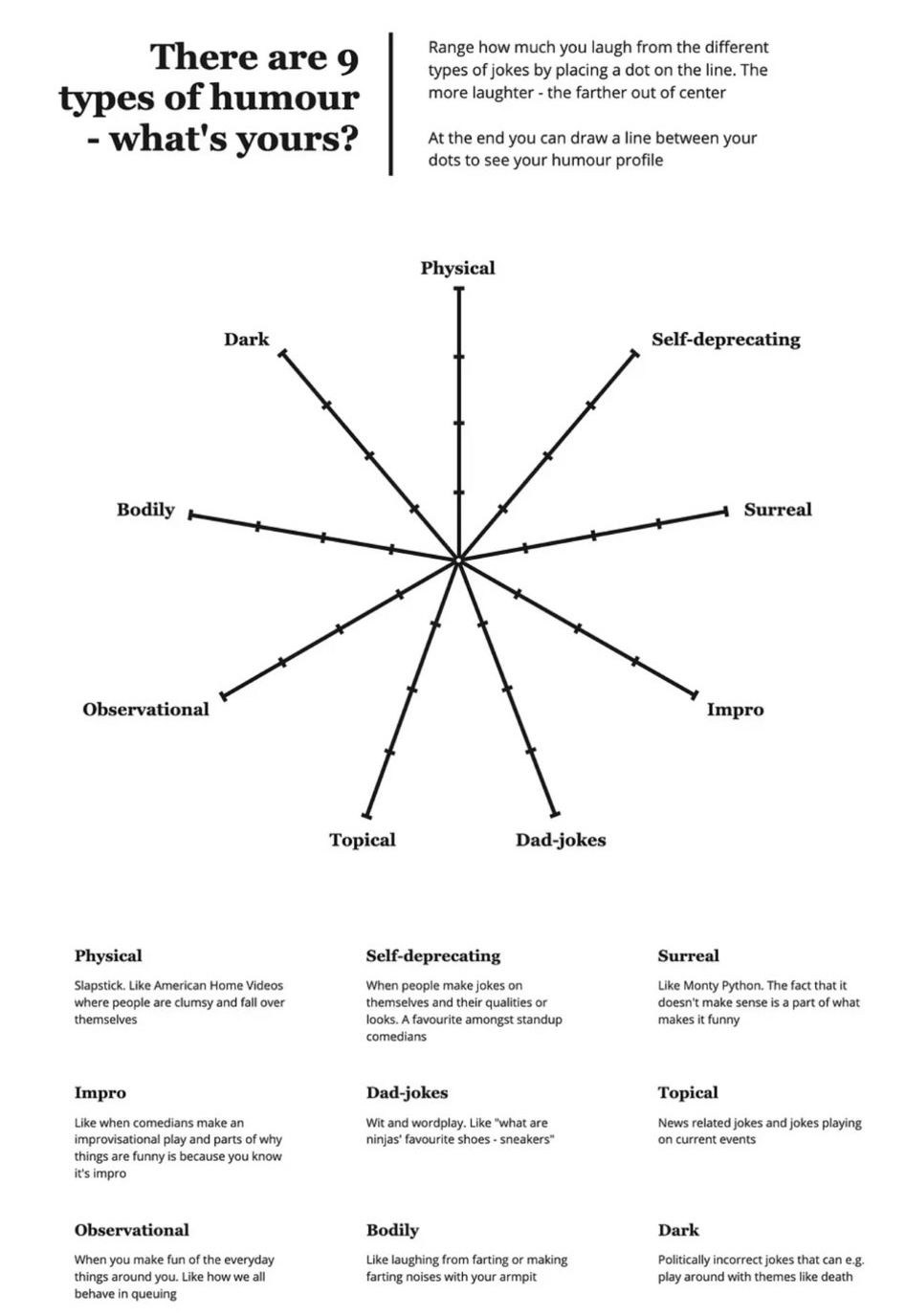
On a piece of paper or in a note-taking app, recreate a simplified version of this radar chart. List the following humor styles as the spokes:
- Affiliative / Anecdotal (Sharing stories)
- Self-Deprecating (Laughing at my small flaws)
- Self-Enhancing (Playful bragging)
- Aggressive (Sarcasm/teasing others)
- Observational / Topical (Joking about the situation/news)
- Deadpan / Dry (Understated delivery)
- Callback (Referencing past jokes)
Now, for each style, place two marks on the spoke:
- A Blue Mark (Appreciation): On a scale of 0 (not at all) to 10 (love it), how much do you enjoy or appreciate this type of humor when you see it in others?
- A Red Mark (Application): On a scale of 0 (never) to 10 (all the time), how often do you currently attempt to use this type of humor yourself?
After you've marked all the spokes, connect the dots for each color. You will have two shapes: your "Appreciation Profile" and your "Application Profile." The gaps between the two shapes are your biggest opportunities for growth. For example, you might love deadpan humor (Blue mark at 9) but never try it (Red mark at 1). This tells you exactly where you might want to start experimenting.
Conclusion
In this lesson, we moved humor from an intimidating art form to an observable science. You've learned to categorize humor and, most importantly, to diagnose your own preferences and habits.
Key Takeaways:
- Humor is a learnable skill that builds social connection.
- The four psychological styles—Affiliative, Self-Enhancing, Aggressive, and Self-Defeating—help you understand the impact of a joke. Your goal should be to cultivate the first two.
- The various practical types (anecdotal, deadpan, callback, etc.) give you a vocabulary to identify the technique being used.
- By comparing the humor you appreciate with the humor you use, you can identify specific, actionable areas for practice.
Preview of the Next Lesson:
Identifying styles is the "what." Next, we'll focus on the "why." Our next lesson will be: Analyze why specific jokes or remarks fail to land (timing, context, delivery). We'll explore the common reasons humor misfires, which will give you the tools to increase your success rate and, just as importantly, to recover gracefully when a joke doesn't work out.