Hello! Welcome back to our course.
In our last lesson, we focused on the power of comfortable silence, reframing it from a conversational void to a strategic tool for creating connection. You learned that by intentionally pausing, you invite others to share deeper, more meaningful thoughts.
Today, we'll build directly on that foundation. We'll address three of the most common rapport-breaking habits: interrupting, one-upping, and premature advice-giving. This lesson will help you achieve today's learning outcome: to avoid common rapport-breaking habits: interrupting, one-upping, and premature advice-giving.
You'll notice that the skill of comfortable silence you just practiced is the single most effective antidote to all three. These habits often aren't malicious; they're reflexive and stem from good intentions—excitement, a desire to relate, or an urge to help. However, their impact is often the opposite of what's intended, creating distance instead of connection. Our goal is to replace these reflexes with more conscious, effective behaviors.
1. The Interruption Reflex
Interrupting is perhaps the most common conversational foul. We do it when we're excited, when we're afraid we'll forget our point, or simply because our minds are racing ahead. The result, however, is that it communicates to the other person, "What I have to say is more important than what you're saying." It can make them feel disrespected and unheard.
Let's explore why this is so damaging to rapport and what to do about it.
4 Signs You Are A Bad Communicator (And How To Fix This Immediately)
The video '4 Signs You Are A Bad Communicator' by Clayton Olson frames this perfectly. He describes these habits as 'violating the relationship space'.
Please watch from 01:29 to 03:42. Pay attention to how he describes the negative conclusions people draw when you interrupt them (e.g., you lack self-awareness or containment). His antidote, the 'pregnant pause', should sound very familiar from our last lesson.
Breaking this habit requires a combination of self-awareness and practical techniques.
How to Stop Interrupting: Practical Tips for Better Listening
The article 'How to Stop Interrupting' by Kevin Eikenberry offers a fantastic set of actionable strategies. It moves from awareness to concrete action.
Please read the following sections: '1. Realize You’re Interrupting': This is the crucial first step of diagnosis. '2. Match the Pace of the Other Person': This is a powerful technique. When you consciously slow down to match a slower speaker, you physically inhibit your ability to interrupt. '3. Use a Reminder Gesture': This is a practical fix for the fear of forgetting your point. A simple, discreet physical cue can 'hold' the thought for you. '6. Stop and Apologize When You Do Interrupt': A simple, graceful recovery method.
The core strategy here is to expand the space between their last word and your first. The 3-second pause you practiced in our last lesson is your primary tool for this.
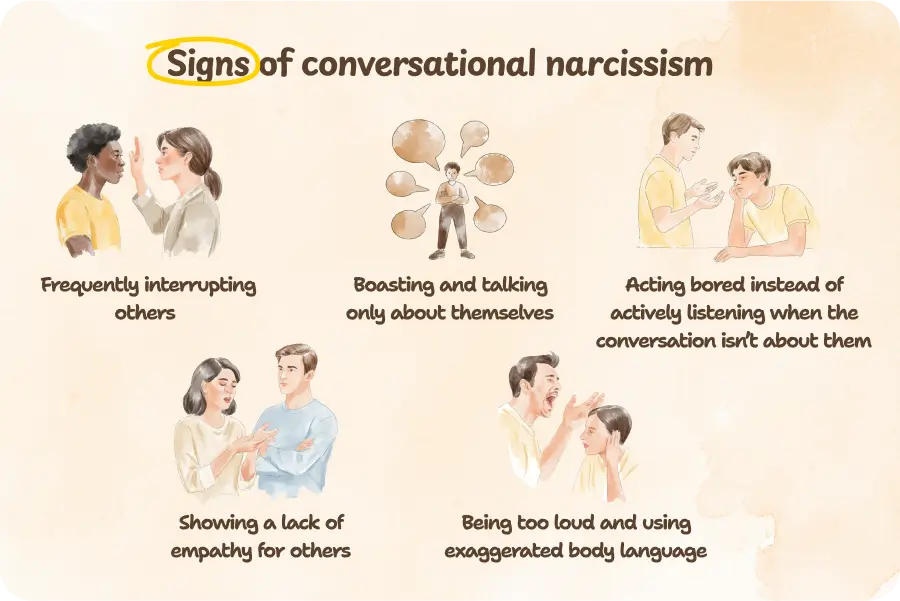
2. The One-Up and Conversational Narcissism
Have you ever shared a story, only to have someone immediately jump in with, "That's nothing, one time I..."? That's a classic one-up.
A subtler, more common version is the shift-response. You share something, and the other person says, "That reminds me of..." and proceeds to tell their own story. While often intended to show empathy, it effectively shifts the conversational spotlight away from you and onto them. When this becomes a pattern, it's a behavior sociologist Charles Derber termed "conversational narcissism."
Let's look at a clear framework for understanding this.
How To Have Better Conversations - Upwords
This article from Upwords, 'How To Have Better Conversations,' introduces a simple but powerful distinction between 'shift responses' and 'support responses'.
Please read from the beginning down to the heading 'The three-second rule'. Focus on: The clear example of a 'shift' vs. a 'support' response. How even well-intentioned attempts to show empathy by sharing our own stories can be perceived as 'one-upping' or making it about ourselves. The alternative: using support responses like 'umm-hmm' or 'tell me more'.
So, if sharing our own story isn't the best way to connect, what is? The most effective strategy is to stay in their story a little longer.
what to say to someone who always tries to one-up you
Jefferson Fisher provides an incredibly simple and powerful antidote to one-upping in his video 'what to say to someone who always tries to one-up you'.
First, watch from 00:37 to 01:57 for a clear definition of one-upping. Then, jump to 10:08 and watch until 13:01. The key takeaway here is the strategy of asking one follow-up question before sharing your own story. Pay close attention to the example question, 'What was your favorite part?'
This technique—asking one curious question—is transformative. It proves you were listening and that you're more interested in their experience than in sharing your own. After you've explored their story, you can then ask, "Would you mind if I shared a similar experience?" This turns your story into a contribution, not a competition.
Test your understanding!
A colleague at a networking event mentions, "I just closed a really tough deal in the commodities market; it was exhausting." Your immediate internal reaction is, "Oh, I had a deal just like that last year that was even more complex!"
Based on what you've just learned, what is a better response than immediately sharing your story? Provide a specific example of what you could say.
Show answer
Instead of sharing your own story (a 'shift response'), you should offer a 'support response' by asking a curious follow-up question.
Example responses:
- "Wow, that sounds intense. What made that particular deal so tough?"
- "Congratulations on getting it done. What was the most challenging part of the process?"
- "I can only imagine. What's one thing you learned from it?"
By asking a question, you validate their experience and invite them to elaborate, which builds much stronger rapport than one-upping them.
3. The Unsolicited Advice-Giver
When someone shares a problem or a frustration, our instinct is often to jump in and fix it. We offer solutions, suggestions, and advice because we want to help or because their negative emotion makes us uncomfortable. But in doing so, we often miss the point. Most of the time, people aren't looking for a consultant; they're looking for a witness to their experience.
Giving unsolicited advice can imply that you think they're incapable of solving their own problems. It shuts down the emotional processing of the issue and replaces it with a logical (and often unwelcome) one.
4 Signs You Are A Bad Communicator (And How To Fix This Immediately)
Let's return to Clayton Olson's video, where he covers the trap of giving unsolicited advice.
Please watch from 08:04 to 10:20. His key insight is that giving advice is often a way to save ourselves from the discomfort of feeling what the other person is feeling. The antidote he offers is crucial: meet them where they are emotionally and ask permission before offering solutions.
The alternative to giving advice is to use the active listening skills we've already covered:
- Label their emotion: "It sounds like you're feeling really undervalued."
- Paraphrase their situation: "So, if I'm hearing you right, the core issue is the lack of communication from the other team."
- Use silence: Give them space to process their own thoughts aloud.
If you genuinely have a solution you believe could help, simply ask for permission first. A phrase like, "I have a few thoughts on that, but no pressure at all. Would you be open to hearing them?" respects their autonomy and makes them much more receptive to what you have to say.
Daily Drills: Replacing Old Habits
Awareness is the first step. For the next week, focus on noticing these habits in yourself and others. Then, start practicing the alternatives in low-stakes conversations.
-
The Interruption Audit (Daily, Observational): In your conversations, simply try to notice the impulse to interrupt. Don't stop it at first, just notice it. When does it happen? With whom? What's the trigger? This self-awareness is the foundation for change.
-
The "Question First" Drill (Once a Day, Active): The next time someone tells you a story and it reminds you of one of your own, resist sharing it. Instead, ask one follow-up question as we discussed (e.g., "What was the most surprising part of that?"). Hold your story. See how the conversation changes.
-
The "Permission Gateway" Drill (Once a Day, Active): The next time someone shares a problem or vent, your only goal is to listen. Use labels and paraphrasing. If you feel an overwhelming urge to give advice, use the gateway: "Are you looking for suggestions, or do you just need to vent?" This question alone can dramatically improve the quality of your interactions.
Conclusion
Today, we've deconstructed three of the most common rapport-breaking habits. You've learned that interrupting, one-upping, and giving unsolicited advice, while often unintentional, derail connection by making the conversation about you.
Key Takeaways:
- Interrupting makes people feel disrespected. The antidote is to pause and match their pace.
- One-upping (or shift-responding) dismisses their experience. The antidote is to ask a curious question first before sharing your own story.
- Unsolicited advice invalidates their feelings. The antidote is to listen to understand, not to solve, and to ask permission before offering solutions.
The common thread through all these solutions is a fundamental mindset shift: from trying to be interesting to trying to be interested. By focusing on understanding the other person's world, you naturally avoid these traps and build the genuine rapport you're seeking.
Preview of the Next Lesson:
With this module on active listening and rapport now complete, you have a solid foundation of how to create connection and make people feel heard. Now, we can begin to build more advanced skills on top of that foundation. In our next module, we will tackle a topic you've specifically mentioned as a pain point: Humor, Wit, and Playful Banter. You'll find that being a great listener is the secret to being quick-witted, as the best humor comes from paying close attention to what's already been said.