Hello! Welcome to your next lesson in the "Foundations of Clinical Research and Biostatistics" module.
In our previous lesson, we focused on formulating a clear, testable research question using the PICO framework. You learned how to translate a clinical uncertainty, such as the potential interaction between Guggulu and Warfarin, into a precise question that science can answer.
Once you have a well-formed question, the next step is to determine the best way to answer it. Not all research is created equal; different study designs provide different levels of certainty. This lesson directly addresses that concept. Our learning outcome is to: Distinguish between observational and experimental study designs and describe the hierarchy of evidence.
Understanding this will empower you to critically evaluate the scientific literature you read, a crucial skill for your goal of integrating Ayurvedic principles with modern evidence-based medicine.
The Two Major Branches of Clinical Research
At the most fundamental level, clinical research studies are divided into two main categories: observational and experimental. The difference is simple but profound.
- Observational Studies: The researchers act as "observers." They watch, measure, and analyze what happens to subjects in a real-world setting without actively changing anything or assigning a treatment. They are looking for relationships and associations.
- Experimental Studies (or Interventional Studies): The researchers actively "intervene." They assign a specific treatment or exposure to a group of subjects and compare them to a control group to measure the effect of the intervention.
This distinction is critical because it determines what conclusions we can draw. A core principle in science is that correlation does not equal causation. Observational studies are excellent for finding correlations, but only well-designed experimental studies can provide strong evidence for a cause-and-effect relationship.
Let's watch a short video that clarifies this key difference.
Study Design - Case-control study, Cross-sectional study, Cohort study (Prospective, Retrospective)
The video 'Study Design' by Medicosis Perfectionalis starts by clearly defining the crucial difference between observational studies, which look for correlation, and interventional studies, which are needed to establish causation.
Watch from 02:48 to 04:12. Focus on the core distinction between merely observing and actively intervening.
The Hierarchy of Evidence
Because different study designs have different strengths and weaknesses, researchers have organized them into a "hierarchy of evidence." This is often visualized as a pyramid. The studies at the bottom are more prone to error and bias, making their conclusions less certain. They are often best for generating ideas or hypotheses. As you move up the pyramid, the study designs become more rigorous and the evidence they produce is considered more reliable.
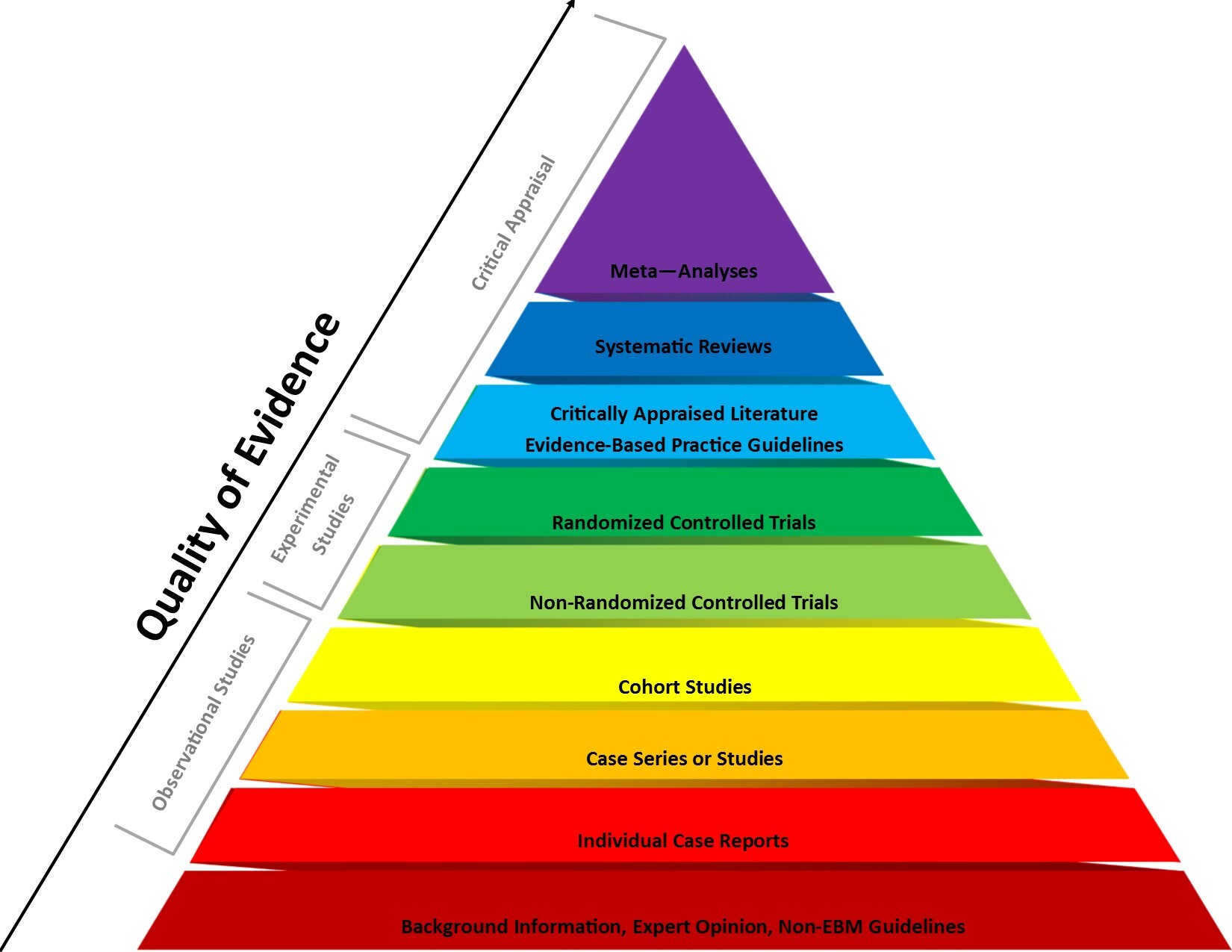
Let's explore the levels of this pyramid, starting from the bottom. The following video provides an excellent overview using a single research question—"Does drinking pop cause type 2 diabetes?"—to illustrate each type of study.
How to Study Studies, Explained by a Nutrition Scientist | Hierarchy of Evidence Series Episode 1
The video 'How to Study Studies' by Nourishable will be our guide through the hierarchy. We'll start with the video's introduction to the pyramid itself.
Watch from the beginning to 02:45. This will introduce the research question used as an example and the concept of the evidence pyramid.
Observational Study Designs
Now, let's delve into the specific types of observational studies you'll encounter. For a quick text-based summary of these designs, you can refer to the article "Observational vs. experimental studies" (Resource ID LINK) under the "Observational studies" section.
1. Case Studies and Case Reports
At the base of the evidence pyramid for human studies are case reports or case series. These are detailed accounts of one or a few patients. In Ayurveda, a vrutta (case report) detailing a successful treatment is a form of this. While they can't prove a treatment works (we don't know if the patient would have gotten better anyway, or what other factors were involved), they are extremely valuable for generating new research questions and for reporting rare or unexpected events.
How to Study Studies, Explained by a Nutrition Scientist | Hierarchy of Evidence Series Episode 1
Let's continue with the 'How to Study Studies' video to see how case studies fit into the hierarchy.
Watch from 03:59 to 05:03. Notice the discussion on why case studies are full of bias and cannot establish causation, even if the story is compelling.
2. Cross-Sectional Studies
Moving up slightly, we have cross-sectional studies. These are like a "snapshot" in time. Researchers collect data on a group of people at a single point, measuring both exposures and outcomes simultaneously. For example, surveying a village to determine the prevalence of Sandhivata (osteoarthritis) and, in the same survey, asking about their dietary habits.
These studies can identify potential associations but cannot determine the temporal relationship (i.e., did the exposure come before the outcome?).
How to Study Studies, Explained by a Nutrition Scientist | Hierarchy of Evidence Series Episode 1
The 'How to Study Studies' video explains cross-sectional studies as 'snapshots in time.'
Watch from 05:03 to 07:09. Pay attention to why the 'snapshot' nature of this design makes it impossible to determine cause and effect.
3. Case-Control Studies
These studies work backward. Researchers start by identifying a group of people who already have a disease or outcome ("cases") and a similar group who do not ("controls"). Then, they look back in time (e.g., through interviews or medical records) to compare the past exposures between the two groups. This design is efficient for studying rare diseases. However, its major weakness is recall bias—people with a disease may remember their past exposures differently than those who are healthy.
How to Study Studies, Explained by a Nutrition Scientist | Hierarchy of Evidence Series Episode 1
Next, let's see how case-control studies look backward from outcome to exposure.
Watch from 07:09 to 10:04. Understand the concept of 'recall bias' and why it weakens the evidence from this type of study.
4. Cohort Studies
Cohort studies are generally the most powerful type of observational study. They work forward. Researchers identify a group of people (a "cohort") and measure their exposure to a certain factor. The key is that at the start, no one in the cohort has the outcome of interest. The researchers then follow this cohort over time to see who develops the outcome.
Because they measure the exposure before the outcome develops, cohort studies provide stronger evidence for a potential causal link than case-control studies.
How to Study Studies, Explained by a Nutrition Scientist | Hierarchy of Evidence Series Episode 1
Cohort studies are a big step up in the observational hierarchy. Let's see how they work.
Watch from 10:04 to 13:02. Grasp why following a group forward in time provides stronger evidence than looking backward.
This flowchart can help you visualize how to differentiate between these study designs.

Test your understanding!
Read the following research scenarios and identify the study design for each (Case series, Cross-sectional, Case-control, or Cohort).
- Researchers identify 200 women recently diagnosed with post-partum depression and 200 women who recently gave birth without depression. They ask all of them about their use of traditional Ayurvedic postnatal care (Sutika Paricharya).
- Researchers survey 5,000 adults in a city. The survey asks about their weekly consumption of fried food and also measures their current blood pressure.
- Researchers recruit 10,000 healthy middle-aged men. They assess each man's Prakriti (Vata, Pitta, Kapha). They then track these men for 20 years to record who develops heart disease.
- An Ayurvedic physician documents the treatment and progress of 10 consecutive patients with Gridhrasi (sciatica) who were treated with Basti Karma.
Show answer
- Case-control study. It starts with the outcome (depression) and looks backward at a past exposure (Sutika Paricharya).
- Cross-sectional study. It measures an exposure (fried food) and an outcome (blood pressure) at the same single point in time.
- Cohort study. It starts with a healthy population, assesses an exposure (Prakriti), and follows them forward in time to see who develops the outcome (heart disease).
- Case series. It's a descriptive report of a group of patients with the same condition receiving the same treatment, with no comparison group.
Experimental Study Designs: The Gold Standard
To get the strongest evidence for a cause-and-effect relationship, we must move up the pyramid to experimental studies.
Randomized Controlled Trial (RCT)
The Randomized Controlled Trial (RCT) is considered the "gold standard" of clinical research. Its key features are:
- Intervention: The researchers actively give a treatment (e.g., an Ayurvedic herb) to one group.
- Control: This group receives an alternative, such as a placebo (a dummy pill) or the current standard treatment.
- Randomization: Subjects are assigned to the intervention or control group by chance, like flipping a coin. This is the most important feature, as it helps ensure the groups are as similar as possible in every way except for the intervention being studied. This minimizes bias.
Many RCTs are also "double-blind," meaning neither the participant nor the researcher knows who is receiving the real treatment and who is receiving the placebo. This prevents expectations from influencing the results.
How to Study Studies, Explained by a Nutrition Scientist | Hierarchy of Evidence Series Episode 1
Now we arrive at the top of the pyramid for single studies: the Randomized Controlled Trial. Let's see why it's considered the 'gold standard.'
Watch from 13:02 to 16:30. Focus on the concepts of randomization, placebo control, and blinding, and how they work together to reduce bias and allow for causal inference.
The Apex of the Pyramid: Synthesizing Evidence
Even a single, well-conducted RCT isn't the final word. The highest level of evidence comes from studies that synthesize the results of all relevant previous studies on a topic.
- Systematic Review: A rigorous process of finding, evaluating, and summarizing all the research on a specific PICO question.
- Meta-Analysis: A statistical technique used within a systematic review to combine the numerical data from multiple studies (e.g., several RCTs) to calculate an overall "pooled" effect.
By looking at the entire body of evidence, these studies provide the most comprehensive and reliable picture we have.
How to Study Studies, Explained by a Nutrition Scientist | Hierarchy of Evidence Series Episode 1
Finally, let's explore the very top of the evidence pyramid.
Watch from 16:30 to 18:37. Understand why a meta-analysis, or a 'study of studies,' provides a more powerful and reliable conclusion than any single study alone.
Conclusion
Today, we journeyed through the hierarchy of evidence, from individual case reports to powerful meta-analyses. Understanding this framework is not about dismissing lower-level evidence—after all, case reports and observational studies are often the source of brilliant hypotheses that lead to groundbreaking RCTs. Rather, it's about appreciating the level of confidence we can have in the conclusions from different types of research.
Key Takeaways:
- Clinical research is divided into observational (observing associations) and experimental (testing for causation) studies.
- Observational designs include case reports, cross-sectional studies, case-control studies (looking backward), and cohort studies (looking forward).
- The Randomized Controlled Trial (RCT) is the gold standard experimental design for determining cause and effect, thanks to randomization and the use of a control group.
- The Hierarchy of Evidence ranks study designs based on their ability to minimize bias, with case reports at the bottom and systematic reviews/meta-analyses at the top.
- For Ayurvedic research, much traditional knowledge exists as expert opinion and case series. To build a stronger evidence base, we need to design and conduct high-quality observational studies and RCTs.
Preview of the Next Lesson:
We've mentioned that the hierarchy of evidence is all about minimizing "bias." But what exactly is bias? And what is "confounding," a related concept that can lead to incorrect conclusions in observational studies? In our next lesson, we will explain the concepts of bias and confounding and describe methods to control for them in study design and analysis. This will give you an even deeper understanding of what makes a research study truly trustworthy.