Hello! Welcome to the first lesson in our module, "Foundations of Clinical Research and Biostatistics."
In our last session, we analyzed a case study involving a potential interaction between Guggulu and Warfarin, which highlighted a critical clinical uncertainty. This naturally leads to the question: "How can we scientifically determine if this interaction is real and clinically significant?" Answering such questions is the foundation of evidence-based practice and is central to your goal of bridging Ayurveda and modern science.
This lesson introduces the essential first step in any scientific investigation. Our learning outcome is to: Formulate a clear, testable research question using the PICO (Population, Intervention, Comparison, Outcome) framework. Mastering this skill will allow you to translate clinical observations and traditional knowledge into a language that modern research can address.
From General Curiosity to Specific Questions
In clinical practice and research, we ask two main types of questions. It's crucial to understand the difference.
-
Background Questions: These are broad, general knowledge questions. You've answered thousands of these during your BAMS studies. Examples include:
- "What are the classical uses of Ashwagandha?"
- "What is the pathophysiology of osteoarthritis (Sandhivata)?"
- "What are the steps of Vamana Karma?"
These questions are typically answered using textbooks, classical Ayurvedic samhitas, and review articles.
-
Foreground Questions: These are specific, focused questions about managing a particular patient or population. They compare different options to find the best course of action. It is for these questions that we use the PICO framework.
To explore this distinction further, let's watch the beginning of a tutorial on clinical research questions.
PICO Question tutorial: Understanding and framing clinical research questions made easy!
This video, 'PICO Question tutorial,' clearly explains the difference between general background questions and the specific foreground questions that drive clinical research.
Watch from 00:42 to 05:18. Focus on understanding why an experienced clinician's questions become more specific and how these 'foreground' questions require a different type of evidence than 'background' questions.
As you progress toward becoming a research-informed practitioner, your focus will shift from asking background questions to formulating precise foreground questions. The PICO framework is the tool that enables this precision.
The PICO Framework: Deconstructing a Research Question
PICO is an acronym that provides a structure for building a good foreground question. It ensures you include all the key elements needed to make the question answerable and to guide a search for evidence.
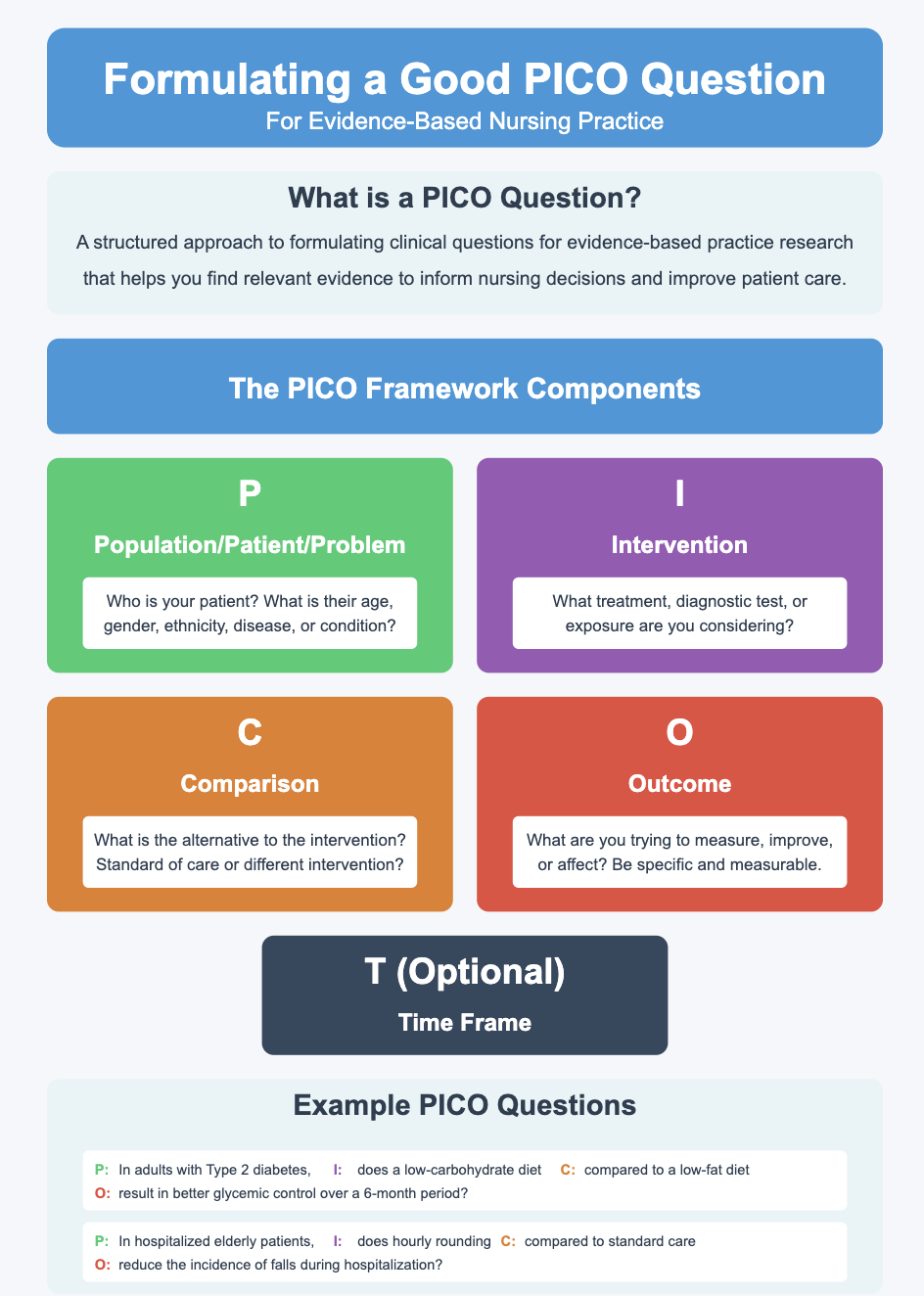
Let's break down each component:
- P – Patient, Population, or Problem: Who are you interested in? Describe the group as specifically as possible. This can include their primary condition, age, gender, or other important characteristics.
- I – Intervention or Exposure: What is the treatment, diagnostic test, or other action you want to investigate? This is the main factor you are studying.
- C – Comparison or Control: What is the alternative to your intervention? This could be a placebo, the current standard of care (allopathic or Ayurvedic), or no intervention at all. A comparison is essential to determine if the intervention is what's truly causing the effect.
- O – Outcome: What do you want to accomplish or measure? This must be a specific, measurable result that is important to the patient and clinician (e.g., pain reduction, change in a blood marker, improved quality of life).
Let's watch a detailed breakdown of each of these components.
PICO Question tutorial: Understanding and framing clinical research questions made easy!
The same 'PICO Question tutorial' video provides a clear explanation of each letter in the PICO acronym.
Please watch from 05:18 to 08:57. Pay attention to the examples provided for each component, such as the difference between an 'intervention' and an 'exposure'.
Now, let's see how these components come together to form a question based on a real published study.
PICO - Using PubMed in Evidence-Based Practice
The National Institutes of Health (NIH) provides a simple webpage demonstrating how to deconstruct a clinical scenario into PICO elements and then form a question.
Please read the section 'Using PICO to Frame Clinical Questions.' Focus on the scenario about exercise for older patients. Observe how they identify the P, I, C, and O, and then synthesize them into a single, clear question.
The example shows the process clearly:
- Scenario: Wondering if patient education helps older patients with high blood pressure to exercise more.
- P: Patients age 65+ with high blood pressure.
- I: Patient education program.
- C: No patient education.
- O: Patient participation in exercise.
- Question: "Are patient education programs effective (compared to no intervention) in increasing patient exercise in the population of patients age 65 and older with high blood pressure?”
Test your understanding!
A clinician is working with patients who have type 2 diabetes. She has heard that daily yoga practice might help control blood sugar. She wants to find evidence for this.
Break this scenario down into its PICO components.
Show answer
- P - Population: Patients with type 2 diabetes.
- I - Intervention: Daily yoga practice.
- C - Comparison: No yoga practice (or standard care alone).
- O - Outcome: Better blood sugar control (which could be measured by HbA1c levels).
Resulting Question: In patients with type 2 diabetes (P), does daily yoga practice (I) compared to no yoga practice (C) result in improved blood sugar control (O)?
Applying PICO to Ayurvedic Research: The Art of Translation
Using PICO for Ayurvedic research presents unique and interesting challenges. It requires a thoughtful translation of Ayurvedic concepts into a framework that modern science can measure. This is a core skill for bridging the two systems.
The following resource is an excellent guide, as it discusses exactly how to structure literature searches for Ayurveda using the PICO framework.
Literature searches on Ayurveda: An update
The article 'Literature searches on Ayurveda: An update' from the AAYU journal provides specific, practical advice on defining PICO elements in an Ayurvedic context.
First, read the section titled 'Search question' to see how PICO was used for a study on psoriasis (Kusta). Then, read the section in the 'Discussion' that begins 'Well-structured research question...'. Focus on the guidance given for defining the Population, Intervention, and Outcome in Ayurvedic terms.
This article provides critical insights for your work:
-
Population (P): You must be a "translator." Define your population using both the Ayurvedic term (e.g., Kitibha Kusta) and its closest modern biomedical equivalent (e.g., chronic plaque psoriasis). You should also consider different spellings and synonyms to be comprehensive.
-
Intervention (I): The intervention can be a single herb (dravya), a classical formulation, or a complex procedure like Panchakarma. It's crucial to be specific. Instead of "an herbal treatment," define it as "a standardized extract of Curcuma longa at 500 mg twice daily." For formulations, list the botanical names of the ingredients.
-
Outcome (O): This is where the integration is most apparent. You can and should use both Ayurvedic and modern biomedical outcomes.
- Ayurvedic Outcomes: These could be based on Phalashruti (the expected benefit described in classical texts), or changes in symptom scores based on Ayurvedic parameters (e.g., reduction in Ruksha Guna in skin).
- Biomedical Outcomes: These include validated clinical scales (e.g., Psoriasis Area and Severity Index - PASI), biomarker levels (e.g., C-Reactive Protein for inflammation), or validated Quality of Life questionnaires.
Let's Build an Ayurvedic PICO Question Together
Let's return to the clinical question that ended our last module: Does Guggulu increase bleeding risk in patients taking Warfarin?
This is a good start, but it's not yet a testable PICO question. Let's refine it.
- P - Population: Who are we most concerned about? Not just anyone taking Warfarin, but specifically "Patients on stable, long-term Warfarin therapy." We could add more details like "for atrial fibrillation" to be even more specific.
- I - Intervention: "Taking Guggulu" is vague. A better definition is "Daily administration of a standardized Commiphora mukul (Guggulu) extract."
- C - Comparison: To know if Guggulu is the cause, we need a control group. The best comparison would be a "Placebo."
- O - Outcome: How do we measure "bleeding risk"? We can use a direct clinical outcome like "incidence of minor or major bleeding events." More importantly, we can use a validated surrogate marker: "change in International Normalized Ratio (INR)."
Now, let's assemble these components into a well-formed research question:
In patients on stable, long-term Warfarin therapy (P), does the daily administration of a standardized Commiphora mukul extract (I) compared to a placebo (C) result in a clinically significant increase in INR or a higher incidence of bleeding events (O)?
This question is now clear, specific, and, most importantly, testable through a clinical study.
Conclusion
Today, you have learned to use the PICO framework, a foundational tool for evidence-based medicine and clinical research. By structuring your clinical questions this way, you create the necessary bridge between a practical problem and a scientific investigation.
Key Takeaways:
- Research addresses specific foreground questions, not just general background knowledge.
- The PICO framework (Population, Intervention, Comparison, Outcome) is the standard for structuring these questions.
- Applying PICO to Ayurveda requires a thoughtful translation of concepts, especially for the Population (disease names), Intervention (herb/formula standardization), and Outcome (using both Ayurvedic and biomedical measures).
- A well-formed PICO question is the first and most critical step in designing a study or searching for existing evidence.
Preview of the Next Lesson:
Now that you can formulate a testable question, the next logical step is to ask, "How do we answer it?" In our next lesson, we will explore the different ways research studies are designed. You will learn to distinguish between observational and experimental study designs and describe the hierarchy of evidence, which will help you understand which types of studies provide the most reliable answers to your PICO questions.