Hello! Welcome to the next lesson in our journey to bridge Ayurveda and modern science.
In our last session, we focused on how to monitor a patient's progress by selecting and integrating traditional Ayurvedic parameters and modern biomedical markers. We established that this process provides you with crucial, patient-specific evidence about whether a treatment is working.
Today, we'll address the next logical step: how do you talk about evidence with your patients? This includes not only the evidence you gather from them but also the vast body of scientific research that informs our clinical decisions. By the end of this lesson, you will be able to explain the principles of evidence-based practice and levels of evidence to a patient in clear, non-technical language.
This is a cornerstone skill for any integrative practitioner. It allows you to build trust, respect your patient's autonomy, and collaboratively decide on the best course of action, whether you are recommending an ancient herbal formula or a modern medication.
1. What is "Evidence-Based Practice"? More Than Just Research
Patients today are often told to look for "evidence-based" treatments. But what does this term actually mean? It's often misunderstood as simply "doing what the research says." The reality is more holistic and patient-centered.
Evidence-Based Practice (EBP) is best understood as a three-legged stool. For a clinical decision to be stable and sound, it needs all three legs.
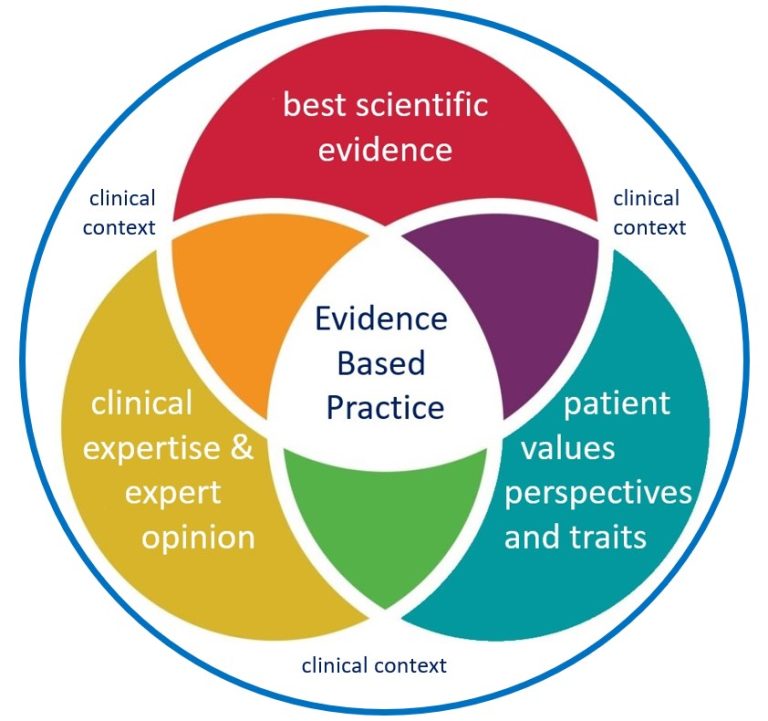
Let's break down these three essential parts in a way you can explain to a patient:
- The Best Scientific Evidence: This is what high-quality research studies tell us about a treatment's safety and effectiveness. It's the most objective part of the decision. You might explain it as, "We look at the results from many studies done around the world to see how well this treatment has worked for thousands of people."
- Your Clinical Expertise: This is the knowledge and judgment you've gained through your training and experience. As a BAMS graduate, this includes your deep understanding of Ayurvedic principles, diagnostics, and therapeutics. You could say, "Based on my experience treating patients with similar conditions and constitutions, I've found this approach to be helpful."
- The Patient's Values and Preferences: This is what matters most to the individual patient—their goals, beliefs, lifestyle, and what they are willing and able to do. This ensures the treatment plan is not just scientifically sound but also personally acceptable. You can ask, "What are your goals for this treatment? What feels right for you, considering your daily life and personal beliefs?"
To see how these ideas are presented simply, let's watch a short video.
“Evidence-based” Treatment: What Does It Mean?
The video '“Evidence-based” Treatment: What Does It Mean?' from the Veterans Health Administration provides a clear, patient-friendly introduction to this concept.
Please watch from the beginning to 01:59. Notice how it emphasizes that EBP relies on the number and quality of studies, as well as agreement from experts, which together form the 'best evidence' leg of our stool.
As the video highlights, EBP gives the patient the best chance of a good outcome because it combines what the science says, what the clinician knows, and what the patient wants. It's a partnership.
2. Levels of Evidence: Not All Evidence is Created Equal
Now let's focus on that first leg of the stool: "the best scientific evidence." When a patient comes to you with an article they read online or a story they heard from a friend, how do you help them understand the strength of that information?
This is where the "hierarchy" or "levels of evidence" comes in. It's a way of ranking different types of studies based on how much we can trust their results. A useful analogy is building a legal case: a single eyewitness account is a starting point, but video footage, DNA evidence, and multiple corroborating witnesses make the case much stronger.
To explore this, we'll watch a fantastic video that breaks down the levels of evidence using the example of sugary drinks and diabetes.
How to Study Studies, Explained by a Nutrition Scientist | Hierarchy of Evidence Series Episode 1
The video 'How to Study Studies, Explained by a Nutrition Scientist' from the channel Nourishable presents the hierarchy of evidence as a pyramid. It clearly explains each level, from the weakest at the bottom to the strongest at the top.
Please watch from 01:36 to 18:22. As you watch, focus on understanding the key difference between each level and why a study type is placed higher or lower on the pyramid. You don't need to memorize the technical names, but rather grasp the concept of increasing strength and reliability.
Let's summarize those levels using patient-friendly language, which you can use in your practice.

Here's how you can explain the key levels to a patient:
-
Bottom of the Pyramid (Anecdotes, Case Reports, Expert Opinions):
- What it is: A story about one person's experience ("My cousin took this herb and his arthritis vanished!") or an expert's idea.
- How to explain it: "This is a great starting point and can give us some interesting clues. But because it's just one person's story, we can't be sure if the same thing will happen for others, or if something else caused the improvement. It's weak evidence."
-
Middle of the Pyramid (Observational Studies like Cohort Studies):
- What it is: Studies that watch large groups of people over many years to see if there are links between a behavior (like diet) and a health outcome (like heart disease).
- How to explain it: "This is much stronger. It's like observing thousands of people and noticing that those who eat a certain diet tend to be healthier. It shows a link or association, but it can't prove that the diet caused the good health. Maybe those people also exercised more."
-
Near the Top (Randomized Controlled Trials - RCTs):
- What it is: The "gold standard" for testing a treatment. Researchers create two identical groups; one gets the real treatment, and the other gets a placebo (a fake treatment).
- How to explain it: "This is our best way to know if a treatment really works. By comparing two groups, where the only difference is the treatment itself, we can be much more confident that any improvement we see is actually due to the treatment. This is how most modern medicines are tested."
-
The Very Top (Systematic Reviews & Meta-Analyses):
- What it is: Experts gather all the high-quality RCTs on a single topic and combine their results statistically.
- How to explain it: "This is the strongest evidence of all. Instead of relying on just one study, it combines the results of all the best studies. This gives us the most complete and reliable picture of what the science says."
Test your understanding!
A patient with joint pain brings you a glossy brochure for a new herbal supplement. The brochure features a glowing testimonial from a single person who claims their pain disappeared in a week. How would you explain to the patient where this "evidence" fits on the pyramid, without dismissing their interest?
Show answer
You could say something like: "Thank you for bringing this to me. It's always good to explore all the options. The story in this brochure is what we call a 'case report' or an anecdote. It's at the bottom of our evidence pyramid. It's an interesting starting point, and it's great that this person felt better. However, it's just one person's experience, so it's hard to know if the supplement was the true cause or if it would work for you. For us to be more confident, we'd want to see 'randomized controlled trials'—those are the studies higher up the pyramid where they compare the supplement to a placebo in hundreds of people. Let's see if we can find any of those stronger studies for this supplement."
3. Having the Conversation: Integrating Evidence into Practice
Knowing the theory is one thing; putting it into a compassionate and clear conversation is another. The goal is not to lecture the patient but to empower them to be a partner in their own care.
Here are some practical tips for that conversation, drawing on best practices in health communication.
To communicate these ideas effectively, we can use established techniques. The guide 'Help patients understand' from the American Medical Association Foundation provides excellent, practical advice.
Please review the sections on 'Six steps to improving interpersonal communication with patients', 'Use plain, nonmedical language', the 'teach-back' technique, and the 'Ask-Me-3' program. These are your tools for the conversation.
A Framework for Your Conversation
- Start with the Patient's Question: Often, the conversation begins because a patient asks, "Should I take this?" or "Is this treatment any good?"
- Use Plain Language: Avoid jargon. Use the analogies we discussed (e.g., the legal case).
- Frame with "Ask-Me-3": Structure your explanation around these three simple questions:
- "What is my main problem?" (Confirm the diagnosis and goals).
- "What do I need to do?" (Present the treatment options).
- "Why is it important for me to do this?" (This is where you explain the evidence, integrating all three legs of the EBP stool).
- Put the Evidence in Context: This is the most crucial step. A high-level study isn't a command. You must use your clinical judgment and involve the patient.
The Oxford Centre for Evidence-Based Medicine provides a brilliant guide on this. It reminds us that even the best evidence from a study requires careful thought before being applied.
Levels of Evidence: An introduction
The document 'Levels of Evidence: An introduction' explains the nuances of applying evidence. It clarifies what the levels of evidence are NOT, which is key to avoiding a rigid, purely mechanical approach.
Please read the section 'What the OCEMB Levels is NOT'. Focus on the four questions listed under point 3 (a, b, c, d). These are the exact questions you should be thinking through with your patient.
Based on that reading, here's how you can weave those critical thinking questions into a patient conversation after presenting the evidence for a treatment:
- Patient Similarity: "The studies on this treatment were done on a certain type of person. You are quite similar, but with a few differences. Let's talk about whether we can expect the same results for you." (Connects to your Prakriti/Vikriti analysis).
- Clinical Benefit vs. Harm: "The study showed this treatment lowers blood pressure by 5 points. For some, that's a big deal. For you, is that benefit worth the potential side effects and the cost? Let's weigh the pros and cons together."
- Alternative Treatments: "The strongest evidence points to this modern drug. However, there is also some good evidence for an Ayurvedic approach involving diet and herbs. It might work more slowly, but has fewer side effects. Which approach feels more aligned with your preferences?"
- Patient Values: "Ultimately, the decision is yours. Given your personal values and what you're hoping to achieve, what path forward feels best to you right now?"
- Use the "Teach-Back" Technique: After your discussion, check for understanding. Say, "I know that was a lot of information. To make sure I did a good job explaining, could you tell me in your own words what we decided and why?"
Conclusion
Today, we've broken down the essential skill of communicating about evidence with patients. This is how you translate the complex world of scientific research into a meaningful, collaborative conversation that respects both ancient wisdom and modern investigation.
Key Takeaways:
- Evidence-Based Practice (EBP) is a partnership that balances three parts: the best scientific research, your clinical expertise, and the patient's values and goals.
- The Hierarchy of Evidence is a tool to rank the strength of different types of research, from single anecdotes (weakest) to large systematic reviews (strongest).
- Your role is not just to state the evidence but to help the patient interpret it in the context of their own life, their own body (Prakriti), and their own preferences.
- Using simple communication tools like plain language, analogies, the "Ask-Me-3" framework, and the "teach-back" technique transforms a lecture into a dialogue.
Preview of the Next Lesson:
Today's lesson has given you the tools to explain the 'what' and 'why' of treatment options. In our next session, we will put this directly into practice. You will "Apply the shared decision-making model to a provided integrative medicine case study to select a course of action," using the communication skills you've learned today to navigate a real-world clinical scenario.