Hello! Welcome back to our course on bridging Ayurveda and modern science.
In our last lesson, we learned how to explain the principles of Evidence-Based Practice (EBP) and the levels of evidence to a patient. We established that EBP is a partnership, balancing the best scientific evidence, your clinical expertise, and the patient's unique values and preferences.
Today, we will put that partnership into action. We will focus on the "how"—the structured conversation that allows you and your patient to make a healthcare choice together. By the end of this lesson, you will be able to apply the shared decision-making model to a provided integrative medicine case study to select a course of action.
Shared Decision-Making (SDM) is the process that brings the three legs of the EBP stool together. It's where evidence meets empathy, and clinical judgment meets patient autonomy. Mastering this skill is fundamental to a successful and ethical integrative practice, allowing you to build deep trust with your patients as you navigate choices between Ayurvedic and modern medical systems.
1. Understanding Shared Decision-Making (SDM)
At its core, SDM is a collaborative process. It moves away from the traditional model where the clinician simply tells the patient what to do, and towards a model where the clinician and patient work as a team to select tests, treatments, and care plans.
There are several models to guide this conversation. We'll start with a simple one to grasp the core concept, and then move to a more detailed, practical framework.
Let's begin with a clear, patient-friendly overview of what shared decision-making is. This video from Osmosis introduces the concept and a straightforward 'three-talk model' which we will build upon.
Watch the first two minutes and thirty-nine seconds (00:00 to 02:39). Pay attention to how the clinician initiates the conversation ('team talk'), explores the patient's goals and fears while discussing options ('option talk'), and then facilitates a choice based on the patient's preferences ('decision talk').
The "three-talk model" gives us a good sense of the flow:
- Team Talk: Establish that a decision needs to be made and that you will make it together.
- Option Talk: Discuss the available choices, including their pros and cons. This is where your ability to explain evidence clearly is critical.
- Decision Talk: Help the patient weigh the options based on what matters most to them.
2. The SHARE Approach: A 5-Step Framework for Integrative Practice
To make this process more concrete and easy to apply, we will use a well-established framework called the SHARE Approach. It breaks SDM down into five memorable steps.
The SHARE Approach Steps of Shared Decision Making
The SHARE Approach was developed by the U.S. Agency for Healthcare Research and Quality (AHRQ) to provide a clear roadmap for these conversations. This guide details the five steps and provides practical tips.
Please read pages 2 through 5 of this guide, which cover the introduction and the five essential steps. As you read, think about how you would adapt the tips for each step to a conversation involving both Ayurvedic and modern medical options.
Let's break down these five steps with a focus on their application in an integrative setting.
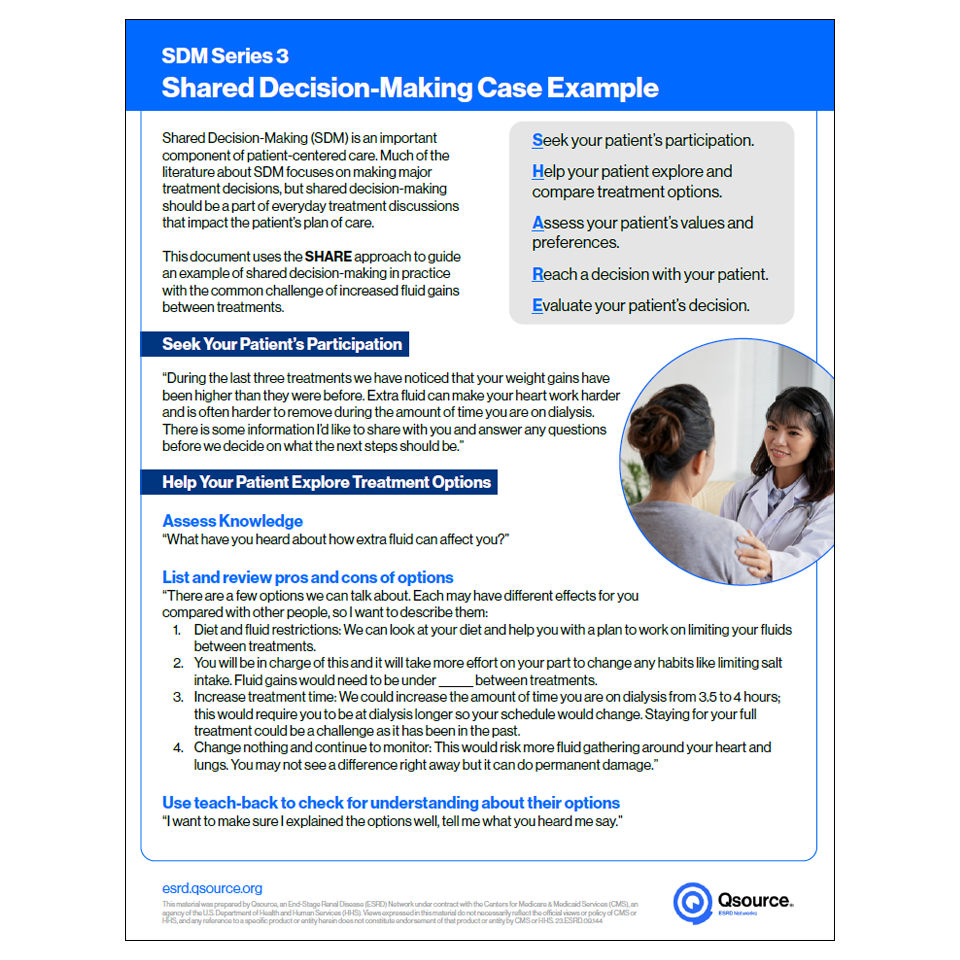
Step 1: Seek your patient’s participation.
- Action: Explicitly invite the patient to partner with you.
- Integrative Context: This is especially important when a patient might feel hesitant to discuss traditional practices with a modern-trained practitioner, or vice-versa. You can say, "There are a few ways we can approach this, drawing from both modern medicine and Ayurvedic principles. I'd like to discuss them with you so we can decide together what feels right."
Step 2: Help your patient explore and compare options.
- Action: Clearly explain the options, including their benefits and risks. Use the communication skills we learned in the last lesson.
- Integrative Context: This is the most complex step in an integrative setting. You'll need to present evidence for different modalities. For example, a modern drug might have strong evidence from Randomized Controlled Trials (RCTs), while an Ayurvedic herb might have evidence from traditional use, observational studies, or smaller trials. It's your job to present this honestly.
- Communicating Risk and Benefit: Discussing probabilities can be difficult. The next video offers an in-depth look at how to approach this part of the conversation.
How to Apply Evidence to a Patient (Shared Decision Making)
This video from Strong Medicine delves into the clinician's role in SDM. It connects EBM to practice and discusses various ways to talk about risks and benefits, from simple qualitative descriptions to more quantitative or visual methods.
Please watch the segment from 07:23 to 13:22. It explores different methods for discussing benefits and harms. Notice the pros and cons of using qualitative terms ('low risk'), statistics (like Number Needed to Treat), and visual aids (like the Cates plot).
Step 3: Assess your patient’s values and preferences.
- Action: Ask open-ended questions to understand what matters most to the patient.
- Integrative Context: This goes beyond medical outcomes. It includes the patient's beliefs about health, healing, and nature. What is their Prakriti and how does that influence their lifestyle? Do they prefer a "natural" approach, even if it works more slowly? Are they concerned about the "chemicals" in modern drugs? What are their fears, goals, and daily realities (cost, time, family support)?

Step 4: Reach a decision with your patient.
- Action: Check if the patient is ready to decide. The final choice should be a collaborative one.
- Integrative Context: The best decision might be a truly "integrative" one. It might not be a simple choice between Ayurveda or modern medicine, but a plan that combines elements of both.
Step 5: Evaluate your patient’s decision.
- Action: Plan a follow-up to see how the chosen path is working.
- Integrative Context: Many Ayurvedic and lifestyle-based interventions take time. It's crucial to set realistic expectations and schedule regular check-ins to monitor progress using both Ayurvedic parameters (e.g., symptom changes, digestive health) and biomedical markers (e.g., blood tests). This makes the plan dynamic and responsive.
Test your understanding!
A patient expresses interest in trying a traditional herbal remedy for their high blood pressure instead of the modern medication you suggested. According to the SHARE model, what is the first thing you should do after hearing this? What should you avoid doing?
Show answer
The first step is Seek participation. You should welcome their input and affirm their role in the decision, saying something like, "Thank you for telling me about this. I'm glad we can talk about it openly. Let's explore both of these options together to figure out the best plan for you."
You should avoid immediately shutting down their idea or jumping straight into a lecture about why the medication has better evidence (that comes later, in Step 2). The priority is to establish a collaborative partnership.
3. Case Study: Applying the SHARE Model
Now, let's apply this framework to a common scenario.
Case:
Mr. Kumar is a 62-year-old man recently diagnosed with Type 2 Diabetes during a routine check-up. His HbA1c is 7.8%. You prescribe Metformin. After two weeks, he returns and reports that while he is taking the medication, he is experiencing uncomfortable digestive side effects (gas and bloating). He also mentions that his brother-in-law has controlled his diabetes "naturally" with Ayurvedic herbs and a special diet, and he wants to stop the Metformin and try that instead.
Let's walk through the SHARE model to navigate this conversation.
-
Step 1: Seek Participation
- You: "Mr. Kumar, thank you for being so open about the side effects and your interest in Ayurveda. It's very common to have questions about the best path forward, and it's important we find a plan that works for your body and aligns with your beliefs. Shall we discuss the different approaches we could take?"
-
Step 2: Help Explore and Compare Options
- You: "As I see it, we have a few main options.
- Continue with Metformin: We can discuss ways to manage the side effects, as they often improve with time. The evidence for Metformin in controlling blood sugar and reducing long-term complications is very strong, based on many large studies.
- Use an Ayurvedic Approach: This would involve specific dietary changes and herbal preparations. Some herbs have shown promise in smaller studies for helping with blood sugar, but the evidence isn't as strong as for Metformin. The primary risk is that if it doesn't work effectively, your blood sugar could remain high, leading to complications.
- An Integrative Approach: We could try a combination. Perhaps we continue Metformin, possibly at a lower dose, while also intensively incorporating the Ayurvedic diet and lifestyle changes. This might give us the best of both worlds."
- Here, you would discuss the risks/benefits of each, using plain language and checking for understanding (teach-back).
- You: "As I see it, we have a few main options.
-
Step 3: Assess Values and Preferences
- You: "To help us decide, what is worrying you most right now? Is it the side effects of the medication, the idea of being on a modern drug long-term, or the risk of diabetes complications? What did you hear about the Ayurvedic approach that was appealing to you?"
- Listen actively. He might express a strong belief in natural healing, a fear of becoming dependent on "chemicals," or a deep trust in his family's experience. These values are the key to the decision.
-
Step 4: Reach a Decision
- Based on the conversation, you might land on a consensus. For example, if his main concern is side effects but he understands the risk of uncontrolled diabetes, you might agree on the integrative approach: "Okay, so how about this for a plan? We will try a lower dose of Metformin, which may reduce the side effects. At the same time, we'll start the Ayurvedic dietary plan you're interested in. You will monitor your blood sugar at home, and we'll re-check your HbA1c in 3 months. How does that sound?"
-
Step 5: Evaluate the Decision
- You: "Let's schedule a follow-up appointment in one month to see how you're feeling with the side effects and the new diet. Please call me if you have any trouble. This is our starting plan, and we can always adjust it based on how you're doing."
This approach respects the patient's interest in Ayurveda while maintaining clinical responsibility. To see how this plays out in a real, high-stakes clinical environment, let's look at a case report from a world-renowned cancer center.
A Unique Model for Integrating Traditional Medicine with ...
This case study from MD Anderson Cancer Center is a powerful real-world example of shared decision-making. It details how clinicians navigated a family’s interest in using Ayurvedic treatments alongside conventional chemotherapy.
Please read the sections 'Integrative approach and recommendations,' 'Discussion,' and 'A combined approach...'. Note how the clinicians acknowledged the family's wishes, provided counseling on the potential risks (herb-drug interactions), and ultimately reached a 'combined decision' to defer herbs during active chemo but incorporate safe Ayurvedic dietary strategies. This is a masterful application of SDM.
Conclusion
Today we have built upon our knowledge of evidence-based practice by learning a structured method for applying it in partnership with our patients. The Shared Decision-Making model, particularly the 5-step SHARE approach, provides a reliable framework for navigating complex choices in an integrative setting.
Key Takeaways:
- Shared Decision-Making (SDM) is a collaborative process where clinicians and patients make healthcare choices together.
- The SHARE Approach offers a five-step guide: Seek participation, Help explore options, Assess values, Reach a decision, and Evaluate the decision.
- In an integrative practice, SDM is essential for honestly discussing options from different medical systems, respecting patient beliefs, and co-creating a plan that is both safe and personally acceptable.
- The goal is not to prove one system "right" and the other "wrong," but to find the optimal path for the individual patient, which often involves a thoughtful integration of both.
Preview of the Next Lesson:
Making a collaborative decision is a crucial clinical skill. Documenting that decision is just as important. In our next and final lesson of the course, we will cover how to properly document these complex conversations and integrated treatment plans. We will explore the principles of medical-legal documentation in an integrative practice to ensure clarity, continuity of care, and professional accountability.