Hello! Welcome back.
In our last lesson, we explored how impaired Agni leads to the formation of Ama (metabolic toxins), and we correlated this with modern concepts like chronic inflammation and oxidative stress. We concluded that Ama can obstruct the body's channels, or Srotamsi. This lesson logically follows by asking: what exactly are these Srotamsi?
Your goal today is to map the Ayurvedic concept of 'Srotamsi' (channels) to physiological systems like the circulatory, lymphatic, and nervous systems. This is a fundamental step in translating Ayurvedic anatomy and physiology into the language of modern science, allowing us to understand how systemic health is maintained and how disease spreads from an integrative perspective.
1. The Concept of Srotamsi: The Body as a Network
As you know from your Ayurvedic studies, the human body is described as being composed entirely of channels: "Srotomayam hi shariram" (Charaka Samhita). The term Srotas comes from the Sanskrit root "Sru," meaning "to flow." These are the pathways responsible for transporting everything the body needs—from air and nutrients to waste products—and for facilitating communication.
This concept isn't limited to large, visible tubes. Ayurveda categorizes Srotas into:
- Sthula (Macro) Srotas: Large, visible channels like the gastrointestinal tract or blood vessels.
- Sukshma (Micro) Srotas: Subtle, microscopic channels like capillaries, cellular pores, and even functional pathways like nerve signaling tracts.

To start building our scientific correlations, let's consult a modern research paper that aims to do just that.
The paper 'Conceptual And Applied Aspects of SROTAS' provides a foundational definition and classification of Srotas before drawing correlations to modern systems.
Please read the sections titled 'Conceptual Understanding of Srotas' and 'Classification of Srotas' (on page 9640). This will refresh the classical definitions and introduce a key table that we will use throughout this lesson.
Now, let's use this framework to map specific Srotas to their modern counterparts.
2. Mapping Key Srotas to Modern Systems
We will focus on the systems mentioned in our learning outcome—circulatory, lymphatic, and nervous—while also touching on others to build a more complete picture.
Rakta Vaha Srotas and the Circulatory System
This is perhaps the most straightforward correlation.
- Rakta Vaha Srotas are the channels that carry Rakta (blood).
- This maps directly to the Cardiovascular or Circulatory System, comprising the heart, arteries, veins, and capillaries, which circulates blood throughout the body.
The Ayurvedic texts even distinguish between different types of vessels. A second research paper provides a clear structural comparison.
A Systematic Review On The Concept Of Srotas: Structural ...
The paper 'A Systematic Review On The Concept Of Srotas' contains a table that offers a direct structural comparison between Ayurvedic and modern channel terminology.
Please review 'Table 2: Structural Comparison of Ayurvedic and Modern Channels' (page d493). Note how Dhamani (pulsatile vessels) are correlated with arteries and Sira (non-pulsatile vessels) with veins.
This direct mapping shows how Ayurvedic anatomists observed and classified the body's "tubes" based on their function, much like modern anatomy does.
Rasa Vaha Srotas and the Lymphatic System
This correlation is incredibly insightful and fundamental to bridging the two sciences.
- Rasa Vaha Srotas are the channels that carry Rasa Dhatu, the body's primary nutritive fluid, which is said to nourish all other tissues.
- This concept aligns beautifully with the function of the Lymphatic System.
The lymphatic system is a network of tissues, vessels, and organs that work in parallel to the circulatory system. It's sometimes called the body's "sanitation system" or "second circulatory system." To fully appreciate this connection, it's essential to understand what the lymphatic system does.
Lymphatic System: Crash Course Anatomy & Physiology #44
The video 'Lymphatic System: Crash Course' provides an excellent and concise overview of this vital system's structure and function.
Please watch from 0:52 to 5:05. Focus on: How the lymphatic system recovers excess fluid (interstitial fluid) from tissues. The structure of lymphatic capillaries and vessels. How this fluid, now called lymph, is transported and returned to the bloodstream.
As you saw in the video, blood plasma leaks out of capillaries to deliver nutrients to cells, becoming interstitial fluid. While most is reabsorbed into the blood, about 3 liters per day are collected by the lymphatic vessels. This fluid, now called lymph, is rich in nutrients and white blood cells.
This is the modern correlate of Rasa. The lymphatic vessels are the Rasa Vaha Srotas, and the lymph is the Rasa Dhatu. This system is responsible for:
- Transporting nutritive fluid: Just as Rasa nourishes the other Dhatus.
- Immune surveillance: The lymph nodes, which filter the lymph, are key sites of immune activity. This relates to the concept of Ojas and immunity, which is supported by healthy Rasa.
- Waste removal: It cleanses the tissues, which relates to its role in clearing metabolic byproducts (Kleda).
This mapping provides a scientific basis for why impairment of Rasa Vaha Srotas in Ayurveda is said to lead to poor nourishment, weak immunity, and swelling (Shotha), which is the modern condition of lymphedema.
Majja Vaha Srotas and the Nervous System
The correlation for Majja Vaha Srotas is more nuanced and highlights the sophisticated, functional nature of the Srotas concept.
- Majja is often translated as bone marrow, but it also encompasses nervous tissue.
- Majja Vaha Srotas are therefore the channels related to the function of both marrow and the nervous system.
The paper 'A Systematic Review On The Concept Of Srotas' explicitly makes this connection. In Table 3, it maps Majjavaha Srotas to the Central Nervous System (CNS) and Peripheral Nervous System (PNS).
Here, the "channel" is not necessarily a physical tube but a functional pathway. The Majja Vaha Srotas represent the pathways of nerve impulse transmission along neurons, axons, and across synapses. Obstruction or vitiation of these Srotas would correspond to neurological deficits, such as impaired sensation, movement, or cognition.
This demonstrates that Srotas can be a system of communication and control, not just fluid transport.
Test your understanding!
An Ayurvedic text describes a condition with blockage in the Rasa Vaha Srotas, leading to swelling (Shotha) and a feeling of heaviness in the lower limbs.
- What modern physiological system is most likely affected?
- What is the modern medical term for this type of swelling?
- Based on the function of this system, why does a blockage cause swelling?
Show answer
- The lymphatic system is the modern correlate of the Rasa Vaha Srotas.
- The modern term for this condition is lymphedema.
- The lymphatic system's primary roles include draining excess interstitial fluid from the body's tissues and returning it to the bloodstream. A blockage in the lymphatic vessels prevents this drainage, causing fluid to accumulate in the tissues, which manifests as swelling.
3. A Comprehensive View
We've covered the key systems from the learning outcome. For a more complete picture, other major Srotas also have clear correlates:
- Prana Vaha Srotas (carrying Prana, life force/air) -> Respiratory System
- Anna Vaha Srotas (carrying food) -> Gastrointestinal System
- Udaka Vaha Srotas (carrying water) -> Fluid regulation systems (involving kidneys, hypothalamus)
- Mutra Vaha Srotas (carrying urine) -> Urinary System
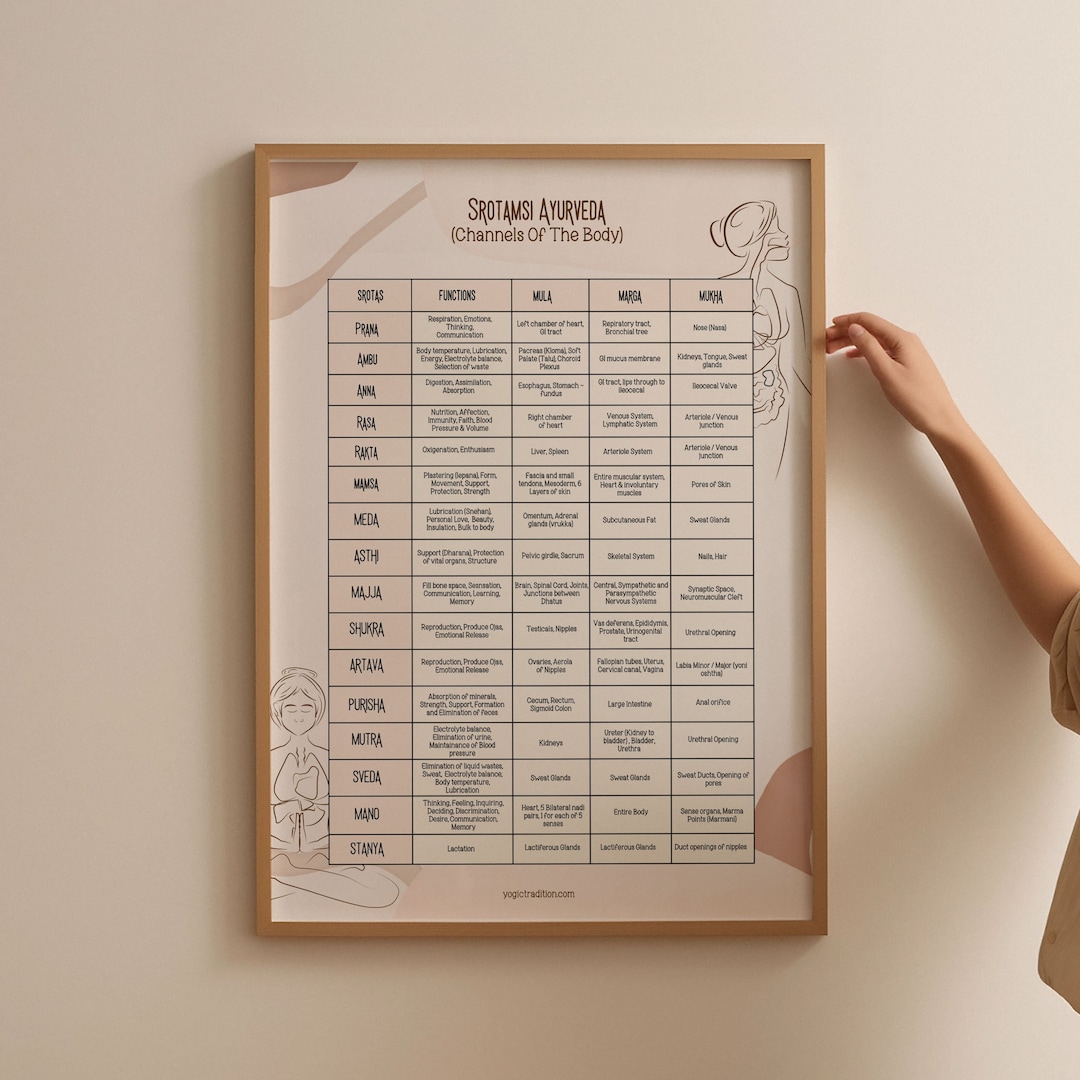
This chart provides a great visual summary of these and other correlations.
Conclusion
Today, we have demystified the Ayurvedic concept of Srotamsi by mapping it onto modern physiological systems. This process of translation is not about replacing one system with another, but about building a richer, more integrated understanding of the human body.
Key Takeaways:
- The Ayurvedic concept of Srotas refers to a vast network of channels that are both structural (macro) and functional (micro).
- We can establish strong correlations between specific Srotas and modern anatomical and physiological systems:
- Rakta Vaha Srotas map to the Circulatory System.
- Rasa Vaha Srotas map to the Lymphatic System, with Rasa itself corresponding to lymph/interstitial fluid.
- Majja Vaha Srotas map to the Nervous System, where the "channels" are functional pathways of nerve conduction.
- Other Srotas like Pranavaha and Annavaha align with the Respiratory and Digestive systems, respectively.
- This mapping provides a scientific framework for understanding Ayurvedic pathology. For example, the obstruction of Srotas by Ama can now be understood as the disruption of circulatory, lymphatic, and metabolic pathways by inflammatory mediators and metabolic waste.
Preview of the Next Lesson:
Having explored the body's building blocks (Dhatus), waste products (Ama), and transport systems (Srotamsi), we are now ready to address one of the most unique and central concepts in Ayurveda: individual constitution. In our next lesson, we will seek to translate the concept of 'Prakriti' (constitution) into the language of modern genomics, proteomics, and metabolomics. This will take our bridge-building from the level of organ systems down to the molecular basis of individuality.