Hello! Welcome to our next lesson.
In our previous session, we mapped the Ayurvedic concept of Srotamsi to modern physiological systems like the circulatory and lymphatic systems. We saw how this translation helps us understand the body as an interconnected network of channels. Today, we take this journey a level deeper—from the systems of the body to the very blueprint of the individual.
Your learning goal for this lesson is to translate the concept of 'Prakriti' (constitution) into the language of modern genomics, proteomics, and metabolomics. This is a cornerstone of our course, as it directly addresses how ancient Ayurvedic wisdom about individual uniqueness can be explored and understood using the most advanced tools of modern science.
1. The Quest for a Common Language
As an Ayurvedic practitioner, you are intimately familiar with Prakriti—the unique, inherent constitution of an individual determined at conception. It is the foundation of personalized diagnosis, treatment, and lifestyle advice in Ayurveda, categorizing individuals primarily into Vata, Pitta, and Kapha types.
Modern medicine is also moving towards a highly personalized approach. The key question for our course is: can these two systems of personalized medicine speak to each other? Can the ancient concept of Prakriti be described in the modern language of biology? The answer, increasingly, is yes.
Let's begin by watching two short clips from prominent researchers who are leading this charge. They articulate the vision behind integrating these two knowledge systems.
Evidence-Based Ayurveda: How Ancient Wisdom + Modern Biology Revolutionizes Healthcare-Prof. Shankar
First, Professor Shankar explains why Ayurveda's systemic view and modern biology's molecular view are not in conflict, but are complementary perspectives, like looking at the same garden from two different windows.
Please watch the segment from 02:44 to 15:26. Focus on the core argument: why unifying Ayurveda (a 'whole system' view) and modern biology (a 'part' or molecular view) provides a deeper, more complete understanding of human health.
Evidence-Based Ayurveda: How Ancient Medicine Meets Modern Science | Prof Bhushan Patwardhan
Next, Professor Bhushan Patwardhan introduces 'Ayurgenomics', the new scientific discipline born from the hypothesis that Dosha Prakriti has a genetic basis. This is the field that directly addresses our learning outcome today.
Now, watch from 20:47 to 22:12. Pay close attention to how he frames the research that connected Prakriti to genomics and the mention of specific findings, like the PGM1 gene.
These videos set the stage for our exploration. The goal is not to reduce Prakriti to a few genes but to build a bridge of understanding using a shared, evidence-based language. This bridge is built upon the "-omics" sciences.
2. The 'Omics' Cascade: A Modern View of Individuality
To translate Prakriti, we first need to understand the modern vocabulary for describing biological individuality. This is the world of "-omics".
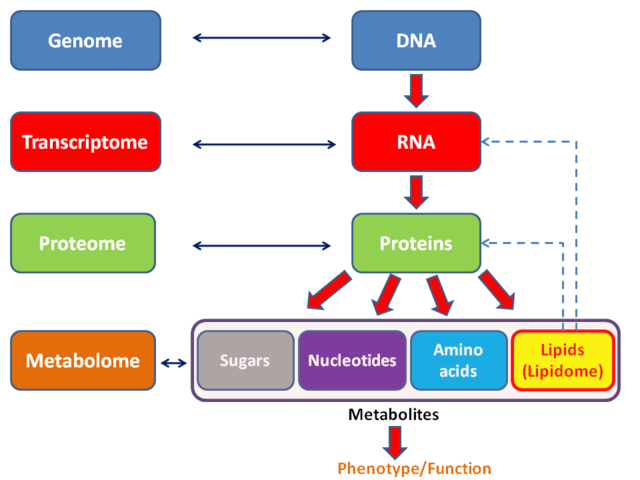
Let's break this down:
- Genomics (The Blueprint): This is the study of your complete set of DNA, or genome. It contains the instructions for building and operating your entire body. Variations in these instructions, called genetic polymorphisms (like SNPs), are a major source of individual differences.
- Transcriptomics (The Active Instructions): Not all genes in the blueprint are active at the same time. Transcriptomics studies the transcriptome—the set of all RNA molecules that are being "read" from the DNA at a given moment. This tells us which genes are currently switched on or off.
- Proteomics (The Workers): The RNA instructions are used to build proteins. Proteomics is the study of the proteome, the entire set of proteins in a cell or organism. Proteins are the "workers" that carry out most cellular functions.
- Metabolomics (The Products & Fuel): Proteins catalyze metabolic reactions, producing and using small molecules called metabolites (e.g., sugars, fats, hormones). Metabolomics studies the metabolome, the complete set of these metabolites. This gives a real-time snapshot of the body's physiological state.
In essence, your genotype (your genes) influences your phenotype (your observable traits, like Prakriti) through this complex cascade. The central idea of Ayurgenomics is that the distinct phenotypes of Vata, Pitta, and Kapha individuals might correspond to measurable, distinct patterns at each of these "omic" levels.
3. Ayurgenomics: From Principle to Evidence
The field of Ayurgenomics formally uses these "-omics" tools to explore the molecular basis of Ayurvedic concepts. The research approach is methodical and fascinating.

Let's explore the key findings that have emerged from this approach.
Ayurgenomics-based frameworks in precision and ...
This paper, 'Ayurgenomics-based frameworks in precision and ...', is a comprehensive review of the field. We will use it to understand the core concepts and findings.
Please read the 'Impact statement' and the section 'Human genetic individuality, health baselines, and disease trajectory: Modern medicine versus Ayurveda' (including Box 1). Focus on how the paper contrasts the modern approach to individuality with Ayurveda's concept of Prakriti as a health baseline.
Now that you have the conceptual framework, let's dive into the specific molecular correlates that have been discovered.
Genomic Correlates of Prakriti
Researchers have found that certain gene variants are significantly more common in individuals of a specific Prakriti.
The paper "Prakriti: A trans-disciplinary approach to integrative medicine" provides a concise summary of these genetic associations.
Prakriti: A tran-disciplinary approach to integrative medicine
This chapter provides clear, direct examples of gene variants that have been correlated with specific Prakriti types.
Please read section '4.3 Genetic Associations with Prakriti' on page 6. This section gives concrete examples of genes associated with Vata, Pitta, and Kapha.
From this reading, we get powerful examples of translation:
- Pitta Prakriti: Linked to variants in genes related to inflammation and metabolism, such as IL-6 (a key inflammatory protein), TNF-α (another inflammatory molecule), and PGM1 (a gene involved in glucose metabolism). This aligns perfectly with the Ayurvedic description of Pitta governing digestion, metabolism, and inflammatory processes.
- Kapha Prakriti: Associated with variants in genes involved in lipid metabolism and fat storage, such as FABP2 and APOE. This provides a molecular basis for the Kapha tendency towards a slower metabolism, higher BMI, and stability.
- Vata Prakriti: Linked to variants in genes like CYP2C19 (involved in drug metabolism) and DRD4 (a dopamine receptor gene), reflecting the heightened neurological sensitivity and variability characteristic of Vata.
These are not just correlations; they provide a functional link between the Ayurvedic description and modern molecular pathways.
Metabolomic and Other 'Omic' Correlates
The differences are not just in the genes. They manifest throughout the 'omics' cascade. The most comprehensive summary of this research is found in Table 1 of the "Ayurgenomics-based frameworks" paper.
Ayurgenomics-based frameworks in precision and ...
This table is the heart of our lesson. It's a dense but incredibly valuable summary of two decades of research, showing how Vata, Pitta, and Kapha individuals differ at every molecular level.
Please carefully study 'Table 1. Studies of predominant Prakriti types...' Don't worry about understanding every detail. Instead, look for patterns. For each 'Omics study' (e.g., Biochemical, GWAS, Epigenomics, Gut metagenomics), note the different findings for Vata, Pitta, and Kapha.
Let's pull out some key findings from that table to create our translation:
-
Metabolomics (Biochemical):
- Pitta: Higher baseline levels of hematological (blood) parameters.
- Kapha: Higher baseline levels of lipid profiles (e.g., triglycerides) and liver enzymes.
- This aligns with Pitta's connection to Rakta (blood) and Kapha's connection to tissues and fluid balance.
-
Epigenomics (Gene Regulation):
- The study found differences in DNA methylation (a chemical tag that turns genes on or off) between the Prakriti types.
- For example, Kapha types had higher methylation in genes related to cell growth and obesity, while Pitta types showed differences in metabolism-related genes. This shows that the environment and lifestyle can modulate gene expression differently in each Prakriti.
-
Metagenomics (Gut Microbiome):
- The types of bacteria in the gut differ between Prakriti types.
- Pitta individuals tend to have more butyrate-producing microbes, which are protective against inflammation.
- Kapha individuals show a higher prevalence of Prevotella copri, which is correlated with inflammation and insulin resistance.
- This links the concept of Agni (digestive fire), which is central to Prakriti, directly to the composition of the gut microbiome.
Test your understanding!
A research study observes that individuals of Pitta Prakriti have significantly higher expression of genes related to immune response and inflammation compared to Kapha Prakriti individuals.
- Which "omics" field does this observation primarily belong to?
- Based on the 'omics' cascade, what would be the likely corresponding finding in proteomics and metabolomics for these Pitta individuals?
- How does this finding align with the classical Ayurvedic understanding of Pitta dosha?
Show answer
- This observation belongs to Transcriptomics, as it deals with gene expression (the amount of RNA being produced from a gene).
- In proteomics, one would expect to find higher levels of the corresponding inflammatory proteins (like IL-6 or TNF-α). In metabolomics, this could manifest as higher levels of biomarkers for inflammation and oxidative stress.
- This aligns perfectly with Ayurveda's description of Pitta as the dosha governing transformation, heat, and metabolism. An overactive Pitta is classically associated with inflammatory conditions ("pitta-ja shotha"), skin rashes, and hyperacidity, all of which are manifestations of an heightened immune or inflammatory response.
Conclusion
Today we have built a substantial bridge between the ancient wisdom of Prakriti and the modern sciences of genomics, proteomics, and metabolomics. This is not about reducing a holistic concept to a set of molecules, but about creating a shared language that allows for deeper investigation, validation, and integration.
Key Takeaways:
- Ayurgenomics is the scientific field that seeks to understand the molecular basis of Ayurvedic principles, particularly Prakriti.
- The concept of Prakriti can be translated into the language of "-omics," which describes individuality at the level of genes (genomics), gene expression (transcriptomics), proteins (proteomics), and metabolites (metabolomics).
- Scientific studies have identified specific genomic markers (e.g., PGM1 in Pitta, APOE in Kapha) and metabolomic profiles (e.g., different lipid levels, gut bacteria) that correlate with the three main Prakriti types.
- These molecular findings often align remarkably well with the functional descriptions of Vata, Pitta, and Kapha found in classical Ayurvedic texts, providing a modern basis for personalized medicine.
Preview of the Next Lesson:
Having established a molecular basis for individual constitution (Prakriti), we can now explore other core concepts of vitality. In our next lesson, we will hypothesize modern scientific mechanisms for Ayurvedic concepts like 'Ojas' (vitality) and 'Bala' (strength/immunity). Understanding your Prakriti is the first step to understanding how your personal Ojas and Bala are generated and maintained, a connection we will explore in detail.