Hello! Welcome to your next lesson in our journey to bridge Ayurveda and modern science.
In our last lesson, we established the correspondences between the Sapta Dhatus and modern tissues, understanding them as the building blocks of the body. We saw how a healthy Agni (metabolic fire) is essential for the proper nourishment and formation of these tissues. Today, we will explore the pathological flip side: What happens when Agni is impaired?
This brings us to the crucial Ayurvedic concept of Ama. Your goal for this lesson is to connect the Ayurvedic concept of 'Ama' (metabolic toxins) to modern concepts like metabolic waste, oxidative stress, and chronic inflammation. Understanding Ama through a scientific lens is fundamental to explaining the Ayurvedic perspective on the root cause of many chronic diseases.
1. The Ayurvedic Concept of Ama
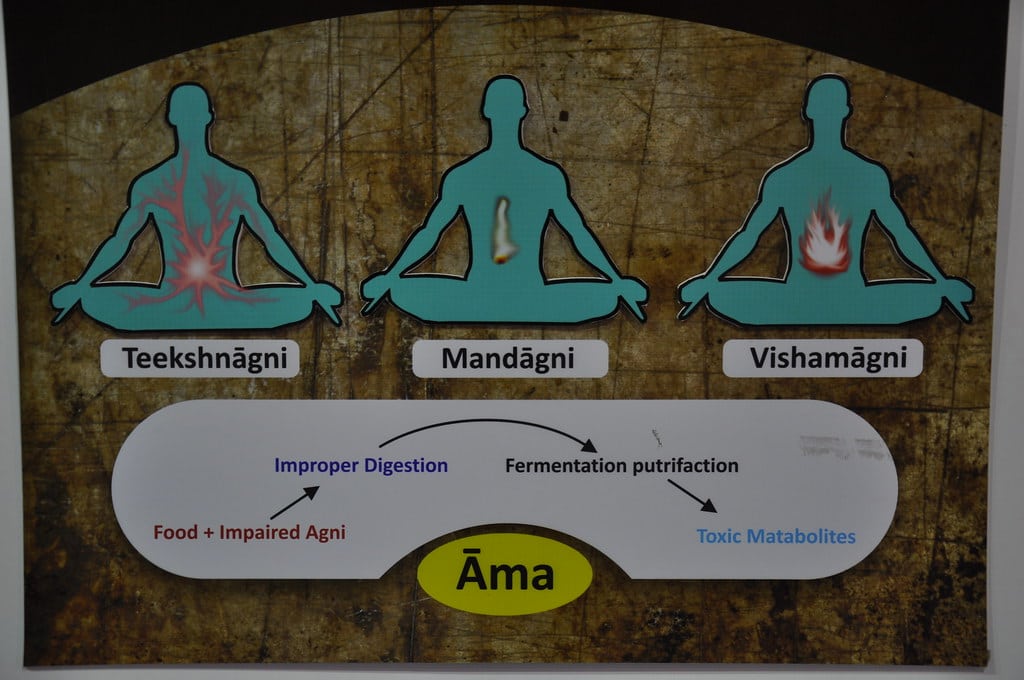
In Ayurveda, Ama is considered the root of most diseases. It is a sticky, toxic, undigested substance that forms when our digestive and metabolic capacity (Agni) is weakened. This impairment can be due to poor diet, stress, or an unhealthy lifestyle.
To begin, let's watch a short video that clearly explains how impaired Agni leads to the formation of Ama from an Ayurvedic viewpoint.
Ayurveda Made Easy ... Ama = Toxins!
The video 'Ayurveda Made Easy ... Ama = Toxins!' by Vedic Sage provides an excellent foundational explanation of how the qualities of Agni relate to digestion and how opposing qualities lead to the creation of Ama.
Please watch from the discussion on Agni's qualities (0:38) to the explanation of Ama's absorption into circulation (3:50). Focus on: The qualities of a healthy Agni. How Ama is formed when Agni is impaired. The qualities of Ama (sticky, heavy, etc.) and how it obstructs bodily processes.
As the video explains, this undigested, morbid material is not eliminated. Instead, it can be absorbed from the gastrointestinal tract into circulation, where it travels throughout the body, clogging the Srotamsi (channels) and disrupting tissue function.
For a more detailed classical definition, let's turn to a scholarly text.
EXPLORING AMA AS AN AYURVEDIC INFLAMMATORY MEDIATOR
The research paper 'EXPLORING AMA AS AN AYURVEDIC INFLAMMATORY MEDIATOR' begins by summarizing the classical definitions and formation process of Ama. This will add depth to our understanding.
Please read the section 'CLASSICAL UNDERSTANDING OF AMA' (page 485). Pay attention to the various definitions from classical texts (like Charaka and Vagbhata) and the general symptoms (Lakshanas) associated with the presence of Ama, such as Srotorodha (channel obstruction) and Gaurava (heaviness).
Now that we have a solid Ayurvedic foundation for Ama, let's build the bridges to modern science.
2. Bridge 1: Ama as Metabolic Waste and Endotoxemia
The most direct translation of Ama as "undigested food material" is metabolic waste. When digestion and metabolism are inefficient, various intermediary metabolites and byproducts can accumulate.
This concept is strongly linked to modern research on gut health, specifically intestinal permeability, or "leaky gut syndrome."
EXPLORING AMA AS AN AYURVEDIC INFLAMMATORY MEDIATOR
The paper 'EXPLORING AMA AS AN AYURVEDIC INFLAMMATORY MEDIATOR' draws a powerful analogy between Ama and the consequences of leaky gut syndrome.
Please read the section 'Gut Dysbiosis, Leaky Gut & the Ama Analogy' on page 487. This is a critical link. Focus on how microbial endotoxins like LPS (lipopolysaccharide) entering the bloodstream is conceptually similar to Ama circulating in the body.
This is a profound connection. In a state of 'leaky gut', the tight junctions between the cells of your intestinal lining loosen. This allows substances that should be contained within the gut—like partially digested food particles and bacterial components (endotoxins)—to enter the bloodstream. These circulating substances are, in essence, a modern scientific equivalent of Ama. They are "morbid materials" that don't belong in the systemic circulation and trigger a defensive response from the body.
3. Bridge 2: Ama and Oxidative Stress
The accumulation of metabolic waste and the immune response it triggers can lead to a state of oxidative stress. You can think of this as a form of biological "rusting."
- Free Radicals: These are unstable, highly reactive molecules produced during normal metabolism and in response to toxins.
- Antioxidants: These are molecules that neutralize free radicals, protecting your cells.
- Oxidative Stress: This occurs when there is an imbalance—too many free radicals and not enough antioxidants to neutralize them. These excess free radicals can damage cells, proteins, and DNA.
The link between Ama and this process is quite direct.
Ayurvedic Concepts of Ama , Oxidative Stress and Anti-oxidants
The article 'Ayurvedic Concepts of Ama, Oxidative Stress and Anti-oxidants' explicitly makes this connection for us.
Please read the first four paragraphs and then the section starting with 'In Ayurveda, oxidative stress is seen as a disturbance...'. Notice how it defines oxidative stress and directly states that Ama accumulation leads to it.
So, the formation of Ama (metabolic waste) burdens the body's detoxification systems and increases the production of free radicals, tilting the balance toward oxidative stress and setting the stage for cellular damage.
4. Bridge 3: Ama and Chronic Inflammation
This leads us to the most significant correlation: the link between Ama and chronic inflammation.
It is crucial to differentiate between two types of inflammation:
- Acute Inflammation: A short-term, robust, and helpful response to injury or infection (e.g., the redness and swelling around a cut).
- Chronic Inflammation: A long-term, low-grade, and harmful state where the immune system is persistently activated. This "smoldering" inflammation is now recognized as a key driver of many modern chronic diseases, including heart disease, diabetes, and neurodegenerative disorders.
Let's watch a segment from a panel of experts discussing this critical distinction.
The hidden link between inflammation and disease
In this video from the Harvard T.H. Chan School of Public Health, 'The hidden link between inflammation and disease,' experts discuss the difference between acute and chronic inflammation and its role in modern disease.
Please watch from 0:37 to 5:15. Focus on how Dr. Shilpa Ravella distinguishes between acute and chronic inflammation and lists the modern diseases tied to this 'hidden, low-level, chronic inflammation.'
The circulating Ama (or its modern counterparts like LPS from a leaky gut) acts as a constant, low-level trigger for the immune system. The body perceives these substances as foreign invaders and mounts a defensive response. When this happens continuously, it results in the exact state of chronic inflammation the experts described.
The research paper we've been using synthesizes this correlation beautifully. It proposes that Ama can be seen as the Ayurvedic equivalent of pro-inflammatory mediators.
EXPLORING AMA AS AN AYURVEDIC INFLAMMATORY MEDIATOR
Returning to 'EXPLORING AMA AS AN AYURVEDIC INFLAMMATORY MEDIATOR,' let's examine the section that explicitly correlates Ama and inflammation.
Please read the sections 'CORRELATION BETWEEN AMA AND INFLAMMATION' and 'DISCUSSION' (pages 488 and 493). Pay close attention to the table 'AMA VS INFLAMMATION,' which provides a side-by-side comparison of features like channel blockage (Srotorodha) and capillary leakage, or heaviness (Gaurava) and inflammatory fatigue.
The parallels are striking. The Ayurvedic description of Ama causing symptoms like fever (Jvara), heaviness (Gaurava), and body ache (Angamarda) aligns perfectly with the systemic symptoms of modern chronic inflammation.
Test your understanding!
A patient reports frequently eating heavy, cold foods late at night. They complain of persistent fatigue, generalized body aches, and a constant feeling of "heaviness."
Using the concepts from this lesson, explain the potential pathogenic process using both Ayurvedic (Agni, Ama) and modern scientific (metabolism, inflammation) terminology.
Show answer
-
Ayurvedic Explanation: The patient's diet and eating schedule (heavy, cold food late at night) are contrary to the qualities of Agni (hot, light, sharp), leading to Agnimandya (impaired digestive fire). This results in the improper digestion of food and the formation of Ama. This sticky, heavy Ama enters circulation and obstructs the Srotamsi (channels), causing Gaurava (heaviness), Alasya (fatigue), and Angamarda (body aches).
-
Modern Scientific Explanation: The same dietary habits overwhelm the metabolic system, leading to incomplete digestion. This may contribute to intestinal permeability ("leaky gut"), allowing metabolic waste and bacterial endotoxins (LPS) to enter the bloodstream. The body's immune system recognizes these substances as foreign and mounts a persistent, low-grade immune response. This chronic inflammation, driven by pro-inflammatory cytokines, is known to cause systemic symptoms of fatigue, myalgia (muscle aches), and malaise, which correspond to the patient's complaints.
Conclusion
In this lesson, we have constructed a robust scientific framework for understanding the Ayurvedic concept of Ama. We have seen that Ama is not just a vague idea of "toxins" but can be meaningfully correlated with a cascade of modern, measurable pathological processes.
Key Takeaways:
- Ama, the Ayurvedic concept of toxic metabolic waste, is formed due to impaired Agni (digestive/metabolic function).
- It can be scientifically understood as an accumulation of metabolic waste products and bacterial endotoxins that enter circulation, often due to increased intestinal permeability ("leaky gut").
- The presence of Ama in the body leads to oxidative stress, an imbalance between damaging free radicals and protective antioxidants.
- Most importantly, Ama acts as a persistent trigger for the immune system, leading to the state of low-grade chronic inflammation that is now known to be a root cause of many modern chronic diseases.
- This translation provides a scientific basis for Ayurvedic treatments that focus on clearing Ama and strengthening Agni—essentially, therapies that aim to heal the gut, reduce metabolic waste, and resolve chronic inflammation.
Preview of the Next Lesson:
We've mentioned that Ama circulates and obstructs the Srotamsi (channels). In our next lesson, we will dive deeper into this concept by mapping the Ayurvedic concept of 'Srotamsi' to physiological systems like the circulatory, lymphatic, and nervous systems. This will complete our understanding of how imbalances originating in the gut can have far-reaching systemic effects.