Hello! Welcome to the first lesson of our fourth module, "Fundamentals of Modern Pharmacology."
In the last module, we concluded by analyzing how multiple organ systems work together in a beautifully orchestrated response to maintain homeostasis, using the case of hypovolemic shock. We saw the body's innate intelligence in action—a concept that resonates deeply with the Ayurvedic principle of maintaining Svasthya (balance).
Now, we shift our focus from how the body maintains balance on its own to how we can influence these physiological processes with external substances. This is the core of pharmacology. For a practitioner aiming to bridge Ayurveda and modern science, understanding these principles is crucial, as they apply to both synthetic drugs and the complex phytochemicals in herbal preparations (Dravya).
Today's lesson is the starting point for that journey. Our learning outcome is to define pharmacokinetics and describe the four main processes: Absorption, Distribution, Metabolism, and Excretion (ADME). In simple terms, pharmacology is often divided into two main areas:
- Pharmacokinetics: What the body does to the drug.
- Pharmacodynamics: What the drug does to the body.
Today, we focus on the first part: the journey of a substance through the body.
1. What is Pharmacokinetics? The ADME Framework
Pharmacokinetics is the study of how a substance moves into, through, and out of the body. It describes the entire journey from the moment of administration until the last remnants are eliminated. This journey is universally broken down into four key stages, known by the acronym ADME:
- Absorption: How does the drug get in?
- Distribution: Where does the drug go?
- Metabolism: How is the drug broken down?
- Excretion: How does the drug get out?
This framework is fundamental to determining how often a drug should be given, in what dose, and by what route to be effective and safe.
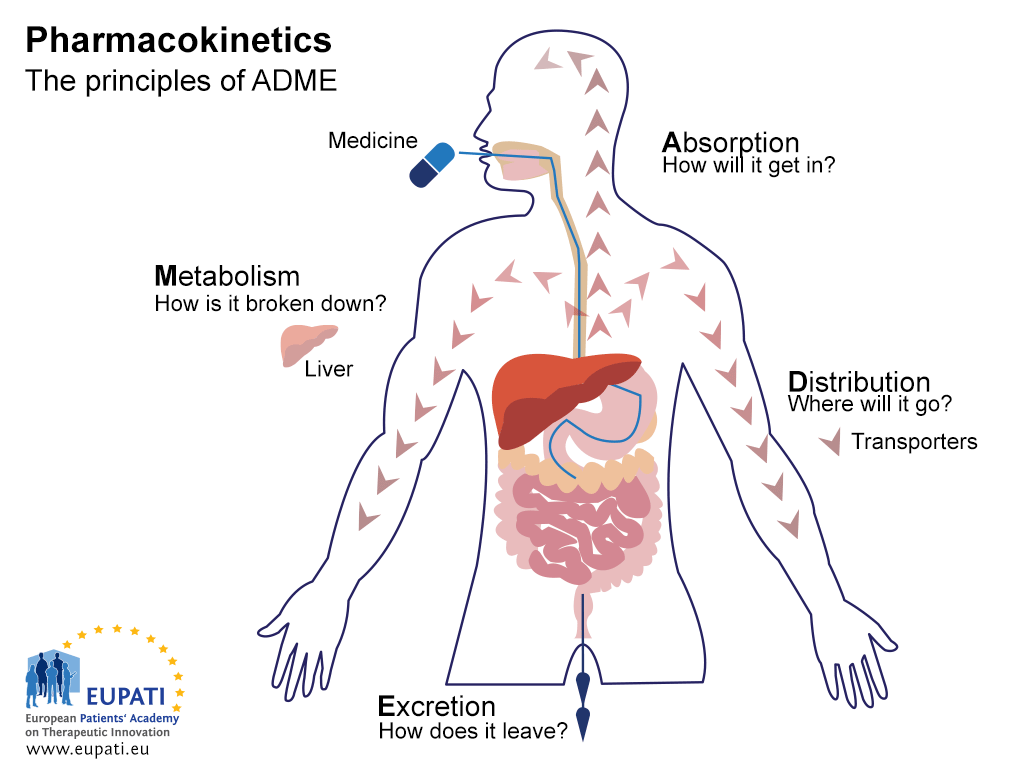
To get a quick and clear overview of these four processes, let's start with a short video.
Pharmacokinetics: How Drugs Move Through the Body
The video 'Pharmacokinetics: How Drugs Move Through the Body' from the Professor Dave Explains channel provides an excellent, concise introduction to the ADME processes.
Please watch the first part of the video, from the beginning until timestamp 01:49. This will give you a solid conceptual map of the entire journey before we dive into each step.
Now that you have a bird's-eye view, let's explore each of these stages in more detail.
2. The Four Stages of a Drug's Journey
We will now examine each of the ADME processes individually. As we go through them, you will notice strong parallels with Ayurvedic principles concerning how the body processes any substance, be it food or medicine. The body's fundamental physiological mechanisms for handling foreign substances (agyey dravya) are universal.
For a more detailed explanation of these processes, the following article will be our main textual guide.
Pharmacokinetics: Definition & Use in Drug Development
The article 'Pharmacokinetics: Definition & Use in Drug Development' from Allucent provides clear, well-structured explanations for each ADME process. We will refer to its subsections as we go.
You don't need to read this all at once. I will guide you to the specific subsections—'Absorption', 'Distribution', 'Metabolism', and 'Excretion'—as we discuss each topic.
A: Absorption
Absorption is the process by which a drug moves from its site of administration (e.g., the gut, skin, lungs) into the systemic circulation (the bloodstream). For a drug to work systemically, it must first be absorbed.
- Routes of Administration: The route greatly affects absorption. A drug given intravenously (IV) is placed directly into the bloodstream, so its absorption is immediate and 100% complete. For other routes like oral (by mouth), topical (on the skin), or inhalation, the drug must cross one or more biological membranes to reach the blood.
- Mechanisms: As you learned in cell biology, molecules cross cell membranes via mechanisms like passive diffusion (most common), facilitated diffusion, and active transport. A drug's chemical properties, such as its size and lipid solubility, determine how easily it can cross these barriers.
Please read the "Absorption" subsection in the Allucent article you opened earlier. It provides more detail on these factors and introduces the important concept of bioavailability, which we will explore further in the next lesson.
From an Ayurvedic perspective, this stage is where the initial processing by Jatharagni (the digestive fire) in the gastrointestinal tract begins. The state of the digestive tract (Koshtha) heavily influences how well a substance is absorbed, a concept modern pharmacology acknowledges when studying the effects of food or GI diseases on drug absorption.
B: Distribution
Once in the bloodstream, the drug is distributed throughout the body. Distribution is the reversible transfer of a drug from the blood to various tissues and organs.
- Blood Flow: Organs with a rich blood supply (like the brain, liver, and kidneys) receive the drug more quickly than tissues with lower blood flow (like fat and bone).
- Plasma Protein Binding: Many drugs bind to proteins in the blood, primarily albumin. This is a crucial concept: only the unbound or "free" drug is pharmacologically active. The protein-bound drug acts as a reservoir, unable to leave the bloodstream to reach its target site or be eliminated.
- Barriers: The body has protective barriers, such as the blood-brain barrier (BBB), which restricts many substances from entering the central nervous system. A drug's ability to cross such barriers is key to its site of action.
Now, read the "Distribution" subsection in the Allucent article.
This concept parallels the Ayurvedic understanding of a substance's properties (Gunas). For example, a substance with Sukshma Guna (subtle, penetrating quality) is thought to travel deep into the tissues (Dhatus), which is analogous to a modern drug's ability to distribute widely and cross cellular barriers.
C: Metabolism (Biotransformation)
Metabolism is the chemical conversion or transformation of a drug into other compounds, known as metabolites. The primary goal of metabolism is to convert lipid-soluble drugs into more water-soluble compounds that can be easily excreted.
- Primary Site: While metabolism can occur in many tissues, the liver is the main metabolic powerhouse. In Ayurveda, the liver (Yakrit) is a primary seat of Pitta and a key site for the metabolic functions of Agni.
- Enzymes: The liver contains families of enzymes, most famously the Cytochrome P450 (CYP450) system, that carry out these chemical reactions.
- First-Pass Effect: When a drug is taken orally, it is absorbed from the gut and travels directly to the liver via the hepatic portal vein before it reaches the rest of the body. The liver may metabolize a significant portion of the drug on this "first pass," reducing the amount that reaches systemic circulation. This is a critical concept in dosing oral medications.
- Metabolites: Metabolism can result in inactive metabolites (most common), active metabolites (the metabolite also has a drug effect), or even toxic metabolites.
This process is a direct modern correlate to the function of Dhatvagni and, more broadly, the transformative power of Agni. The body is biochemically altering a substance, changing its properties and preparing it for either use or elimination.
Please read the "Metabolism" subsection in the Allucent article for more details on this transformative process.

D: Excretion
Excretion is the final step: the removal of the drug and its metabolites from the body.
- Primary Route: The kidneys are the most important organ for drug excretion, eliminating water-soluble substances in the urine.
- Other Routes: Drugs can also be excreted via:
- Bile: Secreted by the liver into the intestines and eliminated in feces.
- Lungs: For volatile or gaseous substances (e.g., anesthetic gases).
- Sweat, saliva, and breast milk: To a lesser extent.
The efficiency of excretion, particularly by the kidneys, is a major factor in determining a drug's duration of action. In Ayurvedic terms, this is the final removal of processed substances as Mala (waste products) via the Mutravaha Srotas (urinary channels) and Purishavaha Srotas (fecal channels).
Finally, read the "Excretion" subsection in the Allucent article.
Test your understanding!
Imagine a patient takes a common pain reliever like paracetamol (acetaminophen) as an oral tablet. Trace its journey through the body by matching each ADME stage with the primary organ or system involved.
- Absorption:
- Metabolism (especially the "first pass"):
- Distribution:
- Excretion:
Show answer
- Absorption: The drug is absorbed from the gastrointestinal tract (stomach and small intestine) into the bloodstream.
- Metabolism (first pass): The drug travels directly to the liver, where a portion of it is metabolized before it even reaches the rest of the body.
- Distribution: The drug travels via the circulatory system (bloodstream) to various tissues, including where it needs to act to relieve pain.
- Excretion: After further metabolism in the liver, the water-soluble metabolites are filtered out by the kidneys and eliminated in the urine.
Conclusion
In this lesson, we have laid the cornerstone for understanding modern pharmacology. We defined pharmacokinetics as the study of "what the body does to a drug" and dissected its four fundamental processes.
Key Takeaways:
- Pharmacokinetics describes the journey of a drug through the body, summarized by the acronym ADME.
- Absorption is the entry of a drug into the bloodstream from its administration site.
- Distribution is the movement of the drug from the blood into the body's tissues.
- Metabolism is the chemical transformation of the drug, primarily by the liver, to prepare it for elimination. This concept strongly aligns with the transformative function of Agni.
- Excretion is the final removal of the drug and its metabolites from the body, mainly via the kidneys. This aligns with the elimination of Mala.
Understanding ADME is not just an academic exercise. It is the basis for rational drug therapy and a powerful framework for thinking about how any substance, including those from your own field of Ayurveda, is processed by the body.
Preview of the Next Lesson:
Now that we understand the qualitative journey of a drug, our next step is to learn how to quantify it. In the next lesson, we will explain key pharmacokinetic parameters including bioavailability, half-life, and the therapeutic window. These numbers are what allow clinicians to design safe and effective dosing regimens.