Hello! Welcome to our final lesson in the first module, where we've been building the foundations of modern biochemistry and cell biology.
In our last session, we explored homeostasis, the body's remarkable ability to maintain internal stability, and saw its strong parallel to the Ayurvedic principle of Samyavastha (a state of equilibrium). Today, we will examine one of the most tightly controlled aspects of this internal environment: the acid-base balance.
This lesson directly addresses the learning outcome: to describe the function of pH and buffer systems in biological processes. We will explore what pH is, why its stability is critical for life, and how the body employs sophisticated chemical and physiological systems to maintain it. This is a perfect, concrete example of the homeostatic feedback loops we discussed previously. You might find that the Ayurvedic concept of Amla Rasa (sour taste), which is associated with acidic properties, provides an intuitive starting point for understanding this topic.
Part 1: Defining Acidity and Basicity - The pH Scale
Before we can understand how the body controls its acid-base balance, we need a clear language to describe it. This language is the pH scale.
To start, let's establish the basic definitions of acids, bases, and pH.
pH Scale: Acids, bases, pH and buffers (article)
This article from Khan Academy, titled 'pH Scale: Acids, bases, pH and buffers,' provides a clear introduction to these fundamental concepts.
Please read the sections 'Introduction,' 'Autoionization of water,' 'Acids and bases,' and 'The pH scale.' Focus on understanding: The definition of an acid (donates H⁺) and a base (accepts H⁺). How pH is a measure of hydrogen ion (H⁺) concentration. The logarithmic nature of the pH scale (a change of 1 unit is a 10-fold change in acidity).
As the reading explains, pH is a logarithmic scale. This can be confusing. Why does a lower pH number mean higher acidity? The following video provides an excellent mathematical breakdown that makes this relationship very clear.
Buffers of the Body | Clinical Relevance
In this video, 'Buffers of the Body,' Dr. Matt & Dr. Mike explain the concept of pH and why its scale seems counterintuitive.
Watch the video from the beginning until 05:54. Pay close attention to the step-by-step calculation showing how the tiny concentration of hydrogen ions in the blood is converted into the familiar pH value of 7.4.
So, to summarize:
- pH is simply a more convenient way to express the concentration of hydrogen ions [H⁺] in a solution.
- The normal pH of human blood is very tightly controlled between 7.35 and 7.45.
- Because of the negative logarithm in the formula
pH = -log[H⁺], as the concentration of H⁺ ions increases, the pH value decreases.
Part 2: The Critical Importance of pH Homeostasis
Why does the body go to such great lengths to maintain its pH within such a narrow range? A slight deviation can be life-threatening. The reason lies in the structure of the body's most important functional molecules: proteins.
Let's continue with the same video to understand this crucial point.
Buffers of the Body | Clinical Relevance
Dr. Matt & Dr. Mike now explain the clinical relevance of pH balance by linking it to protein function.
Please watch from 05:54 to 09:49. The key concept here is how changes in pH disrupt the delicate three-dimensional folding of proteins, which in turn destroys their function.
As you saw, proteins—which include enzymes, receptors, and transport molecules—can only perform their functions when folded into a specific 3D shape. This shape is maintained by weak chemical bonds that are highly sensitive to the concentration of hydrogen ions. An incorrect pH causes proteins to denature (unfold), rendering them useless. This is a fundamental reason why maintaining pH balance is synonymous with maintaining life.
Part 3: The Body's Chemical Buffers
The body is constantly producing acids through metabolic processes. To prevent these acids from causing dangerous pH shifts, it uses buffers. A buffer is a chemical system that can absorb excess hydrogen ions when the solution becomes too acidic, and release them when it becomes too basic (alkaline).
The body has several major buffer systems.
1. The Bicarbonate Buffer System
This is the most important buffer system in the extracellular fluid, especially the blood. It is a powerful and elegant system that links chemical buffering directly to the function of our lungs and kidneys.
Buffers of the Body | Clinical Relevance
Let's explore the mechanics of the bicarbonate buffer system, the body's primary defense against pH changes in the blood.
Watch the video from 09:49 to 16:31. Focus on understanding the reversible chemical reaction at the heart of this system: CO₂ + H₂O ⇌ H₂CO₃ ⇌ H⁺ + HCO₃⁻ (Carbon Dioxide + Water ⇌ Carbonic Acid ⇌ Hydrogen Ion + Bicarbonate)
2. Phosphate and Protein Buffer Systems
While the bicarbonate system is dominant in the blood, other buffers play vital roles inside our cells and in our urine.
Physiologic pH and buffers - acid-base physiology
The video 'Physiologic pH and buffers' from Osmosis will introduce us to the phosphate and protein buffer systems, including a very important example: hemoglobin.
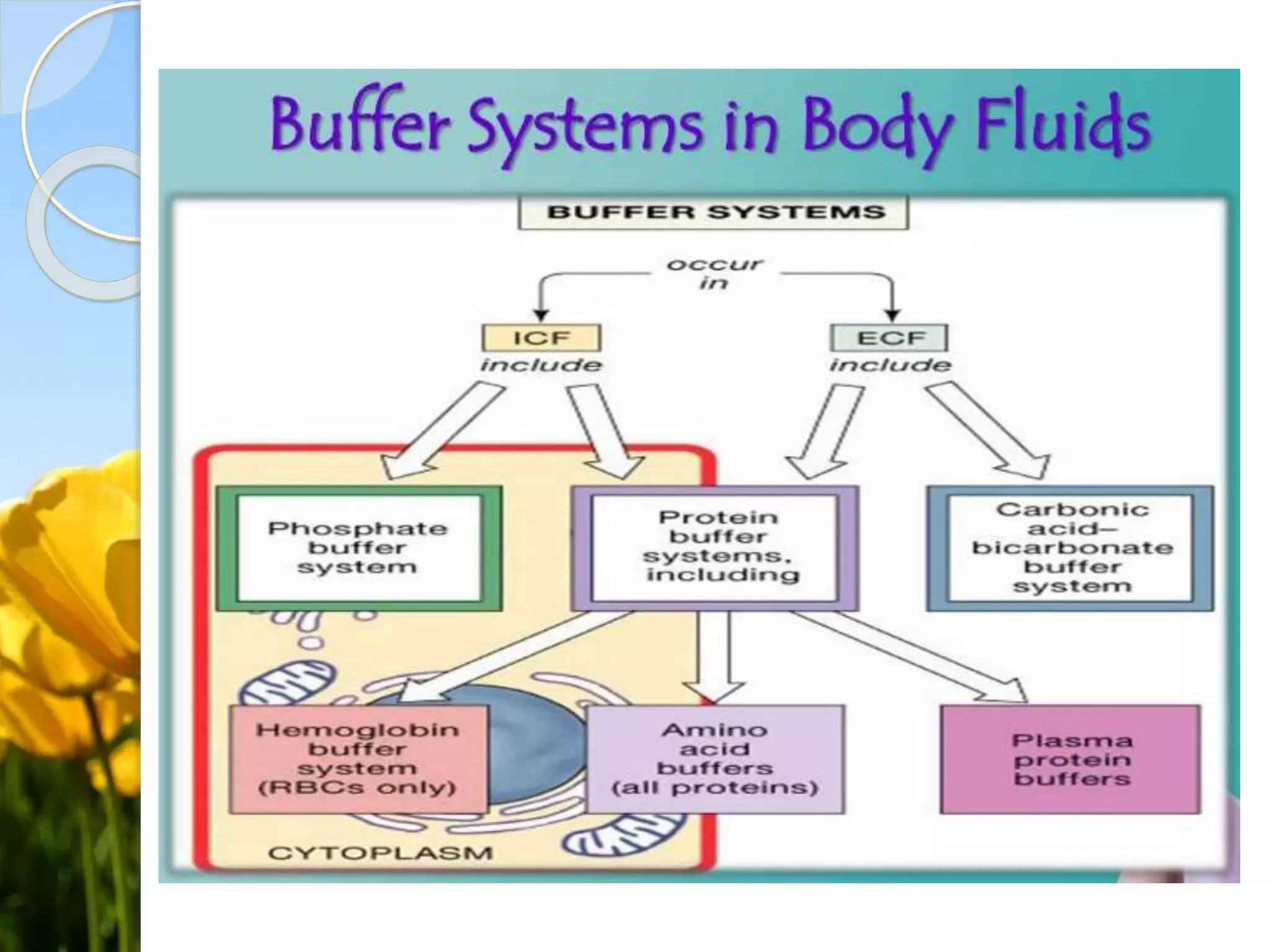
Watch from 06:03 to 09:34. Note the different locations where these buffers are most active: Phosphate buffer: Important in the urine and inside cells (intracellular fluid). Protein buffers: Act as buffers both in plasma (e.g., albumin) and inside cells. Hemoglobin: A crucial protein buffer inside red blood cells that helps manage pH changes related to CO₂ transport.
To bring all this information together, let's look at a diagram that summarizes which buffer systems operate in the different fluid compartments of the body.
Part 4: Systemic Regulation by Lungs and Kidneys
Chemical buffers are the first line of defense, acting within seconds. But for long-term stability, the body needs the help of major organ systems. The respiratory and renal (kidney) systems provide powerful, secondary control over blood pH, perfectly illustrating the concept of a homeostatic feedback loop.
Buffers of the Body | Clinical Relevance
Let's return to the Dr. Matt & Dr. Mike video to see how the lungs and kidneys work with the bicarbonate buffer system to maintain pH homeostasis.
Watch from 16:31 to 24:02. Focus on the key difference between these two systems: Respiratory System (Lungs): Provides rapid, short-term control by adjusting the breathing rate to blow off more CO₂ (raising pH) or retain CO₂ (lowering pH). Renal System (Kidneys): Provides slower, long-term control by selectively excreting H⁺ ions or reabsorbing HCO₃⁻ ions as needed.
Test your understanding!
Imagine a person is hyperventilating (breathing very rapidly and deeply) due to anxiety.
- What will happen to the level of CO₂ in their blood?
- According to the bicarbonate buffer equation (CO₂ + H₂O ⇌ H₂CO₃ ⇌ H⁺ + HCO₃⁻), how will this change in CO₂ affect the concentration of H⁺ ions?
- What will be the resulting change in their blood pH? This condition is known as respiratory alkalosis.
Show answer
- Hyperventilation causes the person to blow off CO₂ much faster than normal, so the CO₂ level in their blood will decrease.
- A decrease in CO₂ will shift the equilibrium of the buffer equation to the left. To create more CO₂, H⁺ ions will combine with HCO₃⁻. This causes the concentration of free H⁺ ions to decrease.
- A lower concentration of H⁺ ions means the blood becomes more alkaline, so the blood pH will rise above 7.45.
Part 5: An Ayurvedic Bridge: Pranayama and pH Regulation
Now, let's connect these modern physiological concepts directly to your background in Ayurveda. You are familiar with pranayama techniques and their effects on the body. Modern science is beginning to investigate the mechanisms behind these effects, and one area of interest is pH regulation.
The following reading is from a scientific review article that explores this very connection.
Scientific Review of Cooling Pranayama Techniques
This article, 'Scientific Review of Cooling Pranayama Techniques,' reviews the physiological basis of acid-base balance and connects it to respiratory practices.
Please read section 'B. Mechanisms of Blood pH Regulation' and 'C. The Role of the Respiratory System in pH Regulation and Its Connection to Pranayama.' This will serve as an excellent summary of the mechanisms we just discussed, but viewed through the lens of how a practice like pranayama could influence them.
As the article discusses, practices like Shitali and Shitkari pranayama involve slow, controlled breathing. From our lesson today, we can hypothesize a direct mechanism for their "cooling" or pacifying effect:
- By consciously controlling respiration, one directly influences the rate of CO₂ exhalation.
- Altering CO₂ levels, as we've seen, is the fastest way to influence the bicarbonate buffer system and change blood pH.
- Therefore, it is plausible that these ancient techniques exert some of their physiological effects by helping to regulate the body's acid-base homeostasis.
This is a perfect example of how we can use the tools of modern science to formulate testable hypotheses about the mechanisms behind Ayurvedic practices, a core goal of this course.
Conclusion
This lesson concludes our first module on the foundations of biochemistry and cell biology. We have seen how the body maintains a delicate acid-base balance, a critical aspect of overall homeostasis or Samyavastha.
Key Takeaways:
- pH is a logarithmic measure of hydrogen ion concentration, and human blood is kept in a narrow range of 7.35-7.45.
- This stable pH is essential for the proper structure and function of proteins, including enzymes.
- The first line of defense against pH changes are chemical buffer systems: the bicarbonate system in the blood, and phosphate and protein (e.g., hemoglobin) buffers, which are important inside cells.
- The second line of defense involves physiological regulation by the lungs (fast, short-term) and kidneys (slow, long-term).
- Practices like pranayama may influence body chemistry by modulating respiration, which directly impacts the bicarbonate buffer system and blood pH.
Preview of the Next Module:
We have now covered the major biomolecules, cellular energy production, and the fundamental principles of homeostasis. But how does a cell know how to make the specific enzymes for glycolysis or the protein buffers we discussed today? The instructions are stored in our genetic material. In our next lesson, we will begin Module 2, "Molecular Biology and Genetics," by exploring the Central Dogma of Molecular Biology, which describes the flow of genetic information from DNA to RNA to protein.