Hello! Welcome back to our journey exploring the foundations of modern biology.
In our last lesson, we discovered that enzymes are the molecular agents of Agni, the metabolic fire. We saw how they catalyze and regulate the intricate metabolic pathways that sustain life. Now, we will dive into the most central of these pathways—the one that generates the very energy your cells need to function.
Today's learning outcome is to outline the main stages of cellular respiration: glycolysis, the Krebs cycle, and oxidative phosphorylation. This process is the core of what you know as Dhatvagni—the metabolic fire that burns within every tissue, converting the essence of food into life force. By understanding cellular respiration, you'll gain a precise, molecular view of how energy is produced in the body.
Part 1: The Big Picture – The Cellular "Fire"
At its heart, cellular respiration is the process by which cells convert the chemical energy stored in nutrients, primarily glucose, into adenosine triphosphate (ATP). As we've learned, ATP is the universal energy currency of the cell.
The overall chemical reaction for aerobic cellular respiration is:
This equation shows that glucose (C₆H₁₂O₆) and oxygen (O₂) are the primary reactants (inputs), while carbon dioxide (CO₂), water (H₂O), and ATP are the main products (outputs).
Think of this like a controlled fire. When you burn wood, it reacts with oxygen and releases energy all at once as heat and light. A cell does something similar with glucose, but it "burns" it through a series of small, controlled steps. This allows the cell to capture the released energy efficiently in the chemical bonds of ATP, rather than losing it all as heat.
To get a general overview of this process, please watch the first part of the following video.
Cellular Respiration (UPDATED)
This video from Amoeba Sisters provides a great introduction to cellular respiration, explaining its purpose and introducing the main stages and molecules involved.
Watch the video from the beginning until 02:56. Focus on the overall goal of making ATP, the role of glucose and oxygen, and the comparison to photosynthesis.
As the video explains, this energy-releasing process is not a single event but a metabolic pathway with three main stages.
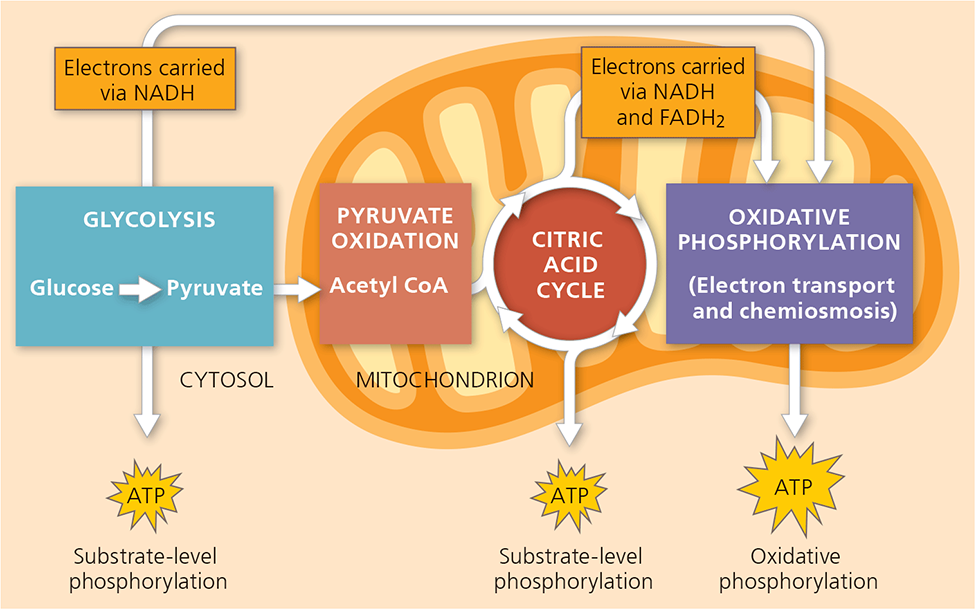
Part 2: A Step-by-Step Journey Through Cellular Respiration
Let's break down the journey of a single glucose molecule as it's converted into ATP. The CrashCourse video below provides a more detailed walkthrough of the three stages. We will go through it step-by-step.
ATP & Respiration: Crash Course Biology #7
This CrashCourse video offers a dynamic and detailed look at each stage of cellular respiration. We will use it to explore glycolysis, the Krebs cycle, and the electron transport chain.
For now, just watch from 03:26 to 06:56. This section focuses on Glycolysis, the first stage. Pay attention to what it starts with (glucose), what it produces (pyruvate, ATP, NADH), and where it happens.
Stage 1: Glycolysis ("Sugar Splitting")
As you just saw, glycolysis is the first step. It's the universal starting point for energy extraction from glucose.
- Location: Cytoplasm of the cell.
- Oxygen Required? No. This is an anaerobic process.
- Process: A single 6-carbon molecule of glucose is split into two 3-carbon molecules called pyruvate.
- Inputs: 1 Glucose, 2 ATP (an initial energy investment is required).
- Outputs: 2 Pyruvate, 4 ATP (for a net gain of 2 ATP), and 2 NADH.
What is NADH? NADH is a crucial molecule. Think of it as a rechargeable battery or an energy shuttle. It's a coenzyme that picks up high-energy electrons released during the breakdown of glucose. These "charged" NADH molecules will carry that energy to the final stage of respiration to produce a lot more ATP.
Intermediate Step: Pyruvate Oxidation
Before the Krebs cycle can begin, the pyruvate from glycolysis must be prepared.
- Location: The pyruvate molecules move from the cytoplasm into the mitochondrial matrix (the innermost compartment of the mitochondrion).
- Process: Each 3-carbon pyruvate is converted into a 2-carbon molecule called acetyl-CoA. In this process, one carbon atom is released as CO₂.
- Outputs (for two pyruvate molecules): 2 Acetyl-CoA, 2 CO₂, and 2 more NADH molecules.
Stage 2: The Krebs Cycle (also known as the Citric Acid Cycle)
Now, let's continue with the CrashCourse video to understand the Krebs Cycle.
ATP & Respiration: Crash Course Biology #7
Let's return to the CrashCourse video to see how acetyl-CoA is processed.
Watch the section on the Krebs Cycle from 06:56 to 10:56. Notice how the cycle regenerates its starting molecule and produces more energy shuttles (NADH and FADH2).
The Krebs Cycle is the central hub of cellular metabolism.
- Location: Mitochondrial matrix.
- Oxygen Required? Yes, indirectly. The cycle needs the products of the final, oxygen-dependent stage to continue. It is an aerobic process.
- Process: The 2-carbon acetyl-CoA enters a cycle of eight enzyme-catalyzed reactions. It combines with a 4-carbon molecule, goes through several transformations that release energy and CO₂, and ends up regenerating the original 4-carbon molecule, ready for the next acetyl-CoA.
- Inputs: 2 Acetyl-CoA molecules (from one glucose).
- Outputs (for two turns of the cycle): 2 ATP, 6 NADH, 2 FADH₂ (another type of electron shuttle, similar to NADH), and 4 CO₂.
So far, after glycolysis and the Krebs cycle, we have only produced a net of 4 ATP molecules. However, we have stockpiled a large amount of energy in our electron shuttles: 10 NADH and 2 FADH₂. These will power the final, most productive stage.
Stage 3: Oxidative Phosphorylation (The Big Payoff)
This is where the vast majority of ATP is made. It consists of two coupled processes: the Electron Transport Chain and Chemiosmosis.
Now watch the final part of the video, which explains this incredible process.
ATP & Respiration: Crash Course Biology #7
The final section of the CrashCourse video explains how the energy carried by NADH and FADH2 is converted into a large amount of ATP.
Watch from 10:56 to 12:28. Focus on how the flow of electrons powers proton pumps, and how the resulting gradient drives ATP synthase.
Let's break that down:
- Location: The inner membrane of the mitochondrion.
- Oxygen Required? Yes, directly. This is a strongly aerobic process.
- Process:
- Electron Transport Chain (ETC): The NADH and FADH₂ molecules "drop off" their high-energy electrons at a series of protein complexes embedded in the inner mitochondrial membrane. As electrons are passed down this chain—like a current—the energy released is used to pump protons (H⁺ ions) from the matrix into the space between the inner and outer membranes. This creates a powerful electrochemical gradient, like water building up behind a dam.
- Chemiosmosis: The accumulated protons rush back into the matrix, flowing down their gradient through a remarkable enzyme called ATP synthase. This enzyme acts like a molecular turbine. The flow of protons causes it to spin, and this rotational energy is used to attach a phosphate group to ADP, generating large amounts of ATP.
- The Role of Oxygen: Oxygen is the final electron acceptor at the end of the ETC. It picks up the "spent" electrons and combines with protons to form water (H₂O). Without oxygen, the chain would back up and halt, stopping ATP production.
- Outputs: Approximately 30-34 ATP and water.
Test your understanding!
A certain poison, cyanide, works by blocking the final step of the electron transport chain, preventing oxygen from accepting electrons. Based on what you've learned, what would be the immediate consequences for a cell exposed to cyanide? Which stages of cellular respiration would be affected and why?
Show answer
- The immediate consequence is that the electron transport chain would halt. Electrons would be unable to move down the chain because the final acceptor is blocked.
- This would stop the pumping of protons, eliminating the proton gradient.
- As a result, oxidative phosphorylation would cease, and the cell would stop producing the vast majority of its ATP (~30-34 ATP per glucose).
- With the ETC stalled, NADH and FADH₂ could not drop off their electrons and regenerate into NAD⁺ and FAD. This lack of "empty" shuttles would cause the Krebs cycle to stop as well, as it requires NAD⁺ and FAD to run.
- Only glycolysis could potentially continue for a short time, producing a tiny amount of ATP (2 net ATP per glucose) anaerobically. However, this is not enough to sustain the energy needs of human cells, leading to rapid cell death.
Part 3: Summary and Consolidation
To review and consolidate these complex steps, the following article provides a clear, structured summary.
Cellular Respiration: Steps, Process, and Stages
This article from Osmosis, 'Cellular Respiration: Steps, Process, and Stages', provides a concise and well-organized written summary of the entire process we've just discussed.
Please read the sections titled 'What are the main steps of cellular respiration?', 'Glycolysis', 'Citric Acid Cycle', 'Electron Transport Chain and Oxidative Phosphorylation', and 'Where does cellular respiration take place?'. This will reinforce the key details of each stage.
Here is a summary table of the inputs and outputs:
| Stage | Location | Oxygen Required? | Key Inputs | Key Outputs (per glucose) |
|---|---|---|---|---|
| Glycolysis | Cytoplasm | No (Anaerobic) | Glucose | 2 Pyruvate, 2 ATP (net), 2 NADH |
| Krebs Cycle | Mitochondrial Matrix | Yes (Aerobic) | 2 Acetyl-CoA | 4 CO₂, 2 ATP, 6 NADH, 2 FADH₂ |
| Oxidative Phosphorylation | Inner Mitochondrial Membrane | Yes (Aerobic) | NADH, FADH₂, O₂ | ~30-34 ATP, H₂O |
| Total Net Yield | Glucose, O₂ | ~34-38 ATP, CO₂, H₂O |
Part 4: The Ayurvedic Bridge: Cellular Respiration as Dhatvagni
This detailed biochemical pathway provides a stunningly precise model for Dhatvagni, the tissue-level metabolic fire.
- The Mitochondrion is the agni-sthana, the very seat of this cellular fire. It is where the most intense "burning" takes place.
- Glucose, the fuel, is the ahara rasa (nutrient essence) delivered to the cell.
- Oxygen is prana vayu, the vital air essential for the fire to burn brightly. Without it, the fire of oxidative phosphorylation is extinguished.
- ATP is the ojas or bala at a cellular level—the subtle essence of vitality and strength produced by the metabolic transformation.
- CO₂ and H₂O are the waste products, analogous to the "smoke" and "ash" of the metabolic fire.
A state of Mandagni (sluggish fire) at the cellular level could correlate with mitochondrial dysfunction, where this process is inefficient, leading to low energy and accumulation of metabolic byproducts (ama). Conversely, Tikshnagni (sharp/hyperactive fire) might be seen in conditions where metabolism is pathologically accelerated, consuming resources too quickly.
Conclusion
Today we have dissected the core energy-producing pathway in our cells. You have outlined the three main stages of cellular respiration and understood their location, purpose, and requirements.
Key Takeaways:
- Cellular respiration breaks down glucose in a series of steps to produce ATP.
- Glycolysis occurs in the cytoplasm, is anaerobic, and yields a small amount of ATP and pyruvate.
- The Krebs Cycle occurs in the mitochondrial matrix, is aerobic, and generates CO₂ along with more ATP and high-energy electron carriers (NADH, FADH₂).
- Oxidative Phosphorylation occurs on the inner mitochondrial membrane. It uses the energy from electrons carried by NADH and FADH₂ to create a proton gradient, which drives ATP synthase to produce the vast majority of ATP. Oxygen is the critical final electron acceptor.
- This entire process is a modern scientific description of Dhatvagni, the metabolic fire that transforms nutrients into life energy within every tissue.
Preview of the Next Lesson:
We have just seen how a cell meticulously regulates energy production. This is a prime example of a larger biological principle: homeostasis. In our next lesson, we will broaden our view to explain the concept of homeostasis and the role of feedback mechanisms in maintaining the stable internal environment that is essential for health. This will connect directly to the Ayurvedic principle of Sama, or balance.