Hello! Welcome to the first lesson in our new module, "Designing Research for Ayurvedic Interventions."
In the previous module, we successfully translated abstract Ayurvedic concepts into the language of modern science. We developed testable hypotheses connecting Prakriti to genomics, and Ojas and Bala to psychoneuroimmunology and specific immune markers like CD4+ T-cells. This raises a crucial question: how do we actually test these ideas in a rigorous, scientific way? The answer lies in creating a research protocol.
Your learning outcome for this lesson is to outline the key sections of a research protocol for an Ayurvedic intervention. A protocol is the single most important document in clinical research. It is the detailed blueprint that guides every step of a study, ensuring it is conducted safely, ethically, and effectively. Mastering its structure is the foundational first step toward your goal of conducting high-quality research on Ayurvedic treatments.
1. What is a Research Protocol?
Before diving into the sections, let's establish what a protocol is and why it's so critical. Think of it as the master recipe for a scientific study. It describes the study's objectives, design, methodology, and statistical considerations, leaving no room for ambiguity.
To get a practical feel for what a protocol contains and why it matters, let's hear from a clinical researcher.
Everything You Need To Know About Most Clinical Trial Protocols! Clinical Researcher Explains!
Watch this introductory segment from the video 'Everything You Need To Know About Most Clinical Trial Protocols!' by Dan Sfera. He provides a concise overview of the protocol and its 'cliff notes' version, the synopsis.
Watch the segment from 00:51 to 02:21. Notice the key elements he lists in the synopsis: title, phase, objectives, and study design. This gives you a quick overview of what a protocol aims to communicate upfront.
As the video explains, the protocol provides a complete roadmap. This is formally defined in the AYUSH guidelines for clinical research.
Guidelines for AYUSH Clinical Studies in COVID-19
The 'Guidelines for AYUSH Clinical Studies' document provides an excellent formal definition of a protocol and its purpose, tailored to our context.
Read the two paragraphs under the heading 'Clinical Trial Protocol – Development and Implementation' (starting with 'Protocol is a document...'). Pay attention to the multiple functions of a protocol: ensuring safety, guaranteeing data integrity, and serving as the basis for review by ethics committees and funding agencies.
In essence, a well-written protocol is your argument for why the study should be done and your detailed plan for how you will do it.
2. The Core Sections of a Research Protocol
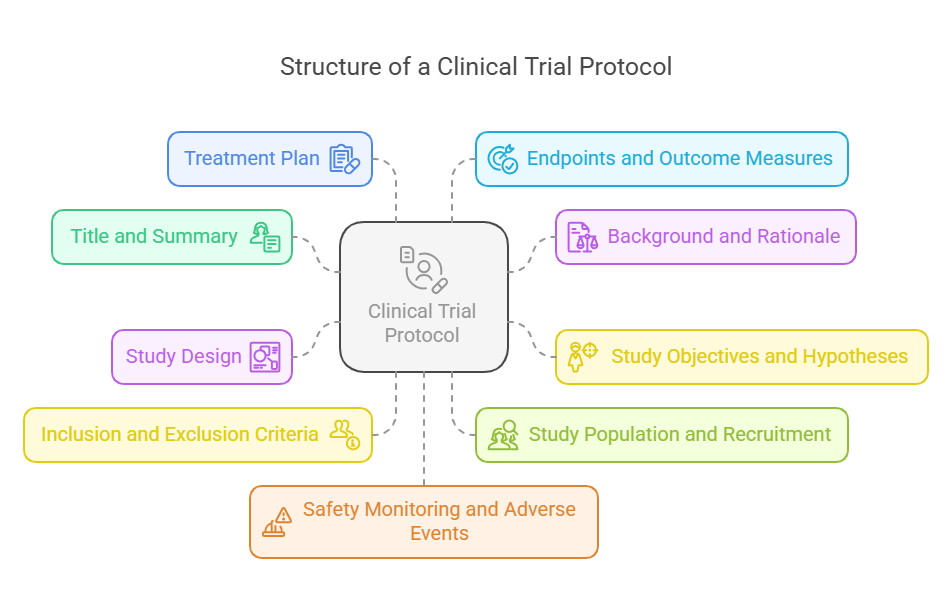
A research protocol is typically organized into several key sections. While the exact order can vary slightly, the core components are universal. We will walk through the main sections, using the structure recommended by the Ministry of AYUSH as our guide.
This diagram provides a helpful visual overview of the key components we will be discussing.
I. Title, Introduction, and Rationale
This first part sets the stage for the entire study.
- Title: Should be clear, concise, and descriptive. It should mention the intervention, the population, and the study design (e.g., "A Randomized, Controlled Study of Ashwagandha for Improving Immune Function in Healthy Adults").
- Introduction/Background: This section explains why the research is necessary. It summarizes the health problem, existing knowledge (and its limitations), and the importance of finding a solution.
- Rationale: This is where you justify your specific approach. For an Ayurvedic study, this is a critical section where you bridge traditional knowledge with modern science. You would explain the Ayurvedic basis for your chosen intervention and propose a plausible scientific mechanism. For example, based on our last lesson, you might rationalize testing a Rasayana herb by citing its traditional use for building Bala and hypothesizing that it works by enhancing CD4+ T-cell function.
II. Objectives and Outcomes (Endpoints)
This section defines what you aim to achieve and how you will measure success. It is arguably the most important part of the protocol, as it dictates the study design and sample size.
- Objectives: These are the specific scientific questions the trial aims to answer. They are often split into:
- Primary Objective: The single most important question. There should ideally be only one. (e.g., "To determine if Ashwagandha increases CD4+ T-cell count compared to placebo.")
- Secondary Objectives: Other important questions that the study can answer. (e.g., "To assess the safety of Ashwagandha," or "To measure changes in perceived stress levels.")
- Outcomes (Endpoints): These are the precise measurements used to assess the objectives. Like objectives, they are also split into primary and secondary. For our example:
- Primary Outcome: Change in absolute CD4+ T-cell count from baseline to 12 weeks.
- Secondary Outcomes: Incidence of adverse events; change in scores on a validated stress questionnaire.
A key challenge and opportunity in Ayurvedic research is to select outcomes that capture both modern biomedical changes and traditional Ayurvedic parameters.
Guidelines for AYUSH Clinical Studies in COVID-19
The AYUSH guidelines provide excellent examples of how to frame objectives and select appropriate outcomes, including those specific to AYUSH.
First, read section '3. Objectives', focusing on the PICOT format and the distinction between primary and secondary objectives. Then, read the section on 'Outcomes', paying close attention to the examples of primary and secondary outcomes for different trial types, and the section 'Variables based on diagnostic and prognostic factors from AYUSH systems'. This shows how to integrate concepts like Prakriti or symptom scores as measurable variables.
III. Methodology: The 'How-To' of the Study
This is the detailed, step-by-step description of how the study will be conducted.
- Trial Design: A description of the overall study architecture (e.g., randomized controlled trial, parallel-group, open-label, crossover design). The choice of design depends entirely on the research question.
- Study Population & Eligibility Criteria:
- Inclusion Criteria: Defines who is eligible to participate (e.g., healthy males and females, aged 18-50, with Vata-Pitta Prakriti).
- Exclusion Criteria: Defines who cannot participate, primarily for safety or to ensure the study population is uniform (e.g., pregnant women, individuals with autoimmune disease, people taking immunosuppressant drugs). This section is paramount for ensuring patient safety and the integrity of your data.
- Interventions: A precise description of the treatments being compared.
- Investigational Product: For an Ayurvedic study, this includes the name of the herb/formulation, dose, frequency, duration, and crucially, details on its standardization to ensure every participant gets the same product.
- Control/Comparator: A description of what the intervention group is being compared to (e.g., a placebo, standard modern medical care, or another Ayurvedic treatment).
- Concomitant Medications: A list of medications and treatments that are permitted or prohibited during the trial.
- Study Procedures (Schedule of Assessments): A detailed schedule, often in a table or flowchart, that outlines what happens at every visit, from screening to final follow-up. This includes all tests, questionnaires, and examinations.
Guidelines for AYUSH Clinical Studies in COVID-19
Let's explore the 'Methods' section of a protocol using the AYUSH guidelines. This will provide specific context for designing an Ayurvedic study.
Please read section '5. Methods', starting from 'Study setting' and ending before 'Outcomes'. Focus on the sub-sections 'Eligibility criteria' and 'Interventions'. Note the examples of AYUSH-specific inclusion/exclusion criteria and the detailed requirements for describing the intervention and control.
IV. Statistical Considerations
This section is developed with a biostatistician and details the quantitative aspects of the study.
- Sample Size: A calculation of how many participants are needed to reliably answer the primary research question. It is based on the primary outcome, the expected difference between groups, and desired statistical power. An underpowered study is unethical because it exposes participants to risk without being able to produce a meaningful result.
- Randomization: If it's a randomized trial, this describes the method used to assign participants to treatment groups by chance (e.g., using a computer-generated list).
- Blinding (Masking): Describes who will be kept unaware of the treatment assignment (participants, investigators, outcome assessors) to prevent bias. While challenging for some Ayurvedic interventions (e.g., Yoga vs. a pill), blinding the outcome assessor is often possible and highly recommended.
- Data Analysis Plan: Specifies the statistical tests that will be used to analyze the outcome data. It should also state the analysis population, such as the Intention-to-Treat (ITT) population, which includes all randomized participants regardless of whether they completed the treatment. ITT is the gold standard for preserving the benefits of randomization.
V. Ethics, Safety, and Dissemination
This final group of sections covers the administrative and ethical oversight of the trial.
- Safety Monitoring: Describes how adverse events (any untoward medical occurrence) and serious adverse events will be collected, assessed, and reported to the ethics committee.
- Ethical Considerations: Confirms that the study will adhere to ethical principles like the Declaration of Helsinki and Good Clinical Practice (GCP). It includes details about the Institutional Ethics Committee (IEC) or Institutional Review Board (IRB) that will approve and oversee the study.
- Informed Consent: Describes the process of explaining the trial to potential participants and obtaining their voluntary, written consent to participate.
- Data Handling and Confidentiality: Explains how participant data will be kept confidential and managed securely.
- Dissemination Policy: Outlines the plan for sharing the study results, typically through publication in a scientific journal, regardless of whether the results are positive, negative, or inconclusive.
This entire structure is what funding agencies like the Ministry of AYUSH require when you submit a research proposal. For instance, the Ayurgyan scheme guidelines (Annexure-2, LINK) provide a checklist that maps directly onto the sections we've just discussed.
Test your understanding!
Imagine you are writing a protocol for a study testing a Rasayana herb's effect on Bala, using CD4+ T-cell count as a primary outcome. In which section of the protocol would you place each of the following statements?
- "Participants will be included if they are between 18 and 60 years old and have no history of autoimmune disorders."
- "We will analyze the difference in the mean change of CD4+ T-cell count between the herb group and the placebo group using an independent samples t-test."
- "In Ayurveda, Bala represents the body's capacity to resist disease, correlating with the modern concept of immunity. The chosen herb is traditionally used as a Balya Rasayana (strength-promoting rejuvenator)."
- "The primary objective is to evaluate the efficacy of the herb in increasing the absolute CD4+ T-cell count over a 12-week period."
Show answer
- Methodology -> Eligibility Criteria (specifically, Inclusion/Exclusion Criteria). This defines the study population.
- Statistical Considerations -> Data Analysis Plan. This describes how the results will be statistically analyzed.
- Introduction -> Rationale. This provides the scientific and traditional justification for conducting the study.
- Objectives and Outcomes -> Objectives. This is a clear statement of the study's primary objective.
Conclusion
You have now walked through the essential architecture of a research protocol. This structured document is the backbone of any clinical study, transforming a research question from a mere idea into a concrete, executable plan.
Key Takeaways:
- A research protocol is a comprehensive document that details the why, what, who, and how of a clinical trial.
- Its key sections include the Title and Introduction, Objectives and Outcomes, Methodology, Statistical Considerations, and Ethics and Safety procedures.
- For Ayurvedic research, the Rationale section is crucial for bridging traditional knowledge with modern scientific hypotheses.
- The Methods section must be meticulously detailed, especially regarding the standardization of the Ayurvedic intervention and the selection of a suitable control group.
Preview of the Next Lesson:
With this overview complete, our next step is to dive deeper into the first and most critical part of building your scientific argument: the rationale. In the next lesson, you will learn how to synthesize background literature to formulate a strong rationale for a proposed study. You will learn how to find, evaluate, and weave together evidence from both classical Ayurvedic texts and modern scientific databases to build a compelling case for your research.