Hello! Welcome back to our module on "Designing Research for Ayurvedic Interventions."
In our last lesson, we outlined the complete structure of a research protocol, the essential blueprint for any clinical study. We identified the "Introduction and Rationale" as the opening section where you must present a compelling argument for why your study is necessary. Today, we will focus entirely on how to construct that argument.
Your learning outcome for this lesson is to synthesize background literature to formulate a strong rationale for a proposed study. This is arguably one of the most intellectually creative parts of the research process. It involves more than just summarizing existing papers; it requires you to act like a detective—piecing together clues from both ancient texts and modern science to identify a critical gap in our knowledge and propose a way to fill it. Mastering this skill is fundamental to your goal of conducting high-quality, fundable research in Ayurveda.
1. From Summarizing to Synthesizing: Building a Coherent Story
First, it's vital to understand the difference between a literature summary and a literature synthesis.
- A summary simply restates what individual studies have found, one after the other. It's a collection of facts.
- A synthesis, on the other hand, weaves these facts together. It compares, contrasts, and critically evaluates different sources to build a new, integrated understanding of the topic. It tells a story about what we know, what we don't know, and where the research needs to go next.
To build a strong rationale, you must move beyond summary and toward synthesis.
Literature Synthesis 101: How to Synthesise In Your Literature Review - 5 Key Questions (+Examples )
Let's start with a clear definition of literature synthesis. This video from Grad Coach explains the concept very well.
Watch the segment from 00:58 to 01:45. Pay attention to the idea that synthesis is about presenting a 'cohesive assessment of the current state of knowledge' to identify what is known, not known, and needs more research.
2. The Goal of Synthesis: Identifying the Research Gap
The primary purpose of synthesizing the literature is to pinpoint a research gap. This is a problem or question in your field that has not been adequately addressed. Your entire study will be designed to fill this gap.
What constitutes a research gap? It could be:
- A traditional Ayurvedic claim that has never been scientifically validated.
- An area where existing studies show conflicting or inconclusive results.
- An intervention that has been proven effective, but not in a specific population (e.g., a particular Prakriti) or context.
- A known treatment where the underlying mechanism is not understood.
5 Steps to Finding Your Research Gap and Research Question | Medical and Health Sciences
This short clip clearly defines the concept of a research gap and provides a useful categorization of the types of problems that constitute one.
Watch from 00:07 to 00:35. The video categorizes research gaps into three types of problems: no solution, conflicting solutions, or an existing solution that isn't good enough. Think about how these categories might apply to Ayurvedic research.
For your work, identifying a research gap is the first step in bridging Ayurveda and modern science. It's how you move from a traditional concept to a testable scientific question.
3. A Systematic Framework for Literature Synthesis
Finding a research gap can feel daunting. A systematic approach makes it manageable. The "Literature Synthesis 101" video we watched earlier proposes a framework based on five key questions. Let's walk through them, applying them to the context of Ayurvedic research.
Question 1: What is broadly agreed upon?
Start by establishing the foundation of settled knowledge. This shows you're aware of the current landscape and prevents you from re-investigating something that is already well-established.
- Example: It is broadly agreed in the scientific community that chronic, low-grade inflammation is a key factor in many lifestyle diseases. An Ayurvedic rationale could start here, before linking this to concepts like Ama or Dhatu Agni Mandya.
Literature Synthesis 101: How to Synthesise In Your Literature Review - 5 Key Questions (+Examples )
Let's revisit the Grad Coach video to understand why identifying points of agreement is the essential starting point.
Watch the segment from 02:09 to 02:59. The key message is that you don't want to 'reinvent the wheel.'
Question 2: Where do the disagreements and mixed findings lie?
This is where you'll often find the most promising research gaps. When studies have conflicting results, it signals an unresolved question that your research can help answer.
- Example: Several studies have investigated Ashwagandha for anxiety. Some show a strong positive effect, while others show a modest or no effect. Your synthesis would highlight this disagreement and explore possible reasons: different dosages, non-standardized extracts, or different types of participants. This naturally leads to a research question: "What is the efficacy of a standardized extract of Ashwagandha at a specific dose for generalized anxiety disorder?"
Literature Synthesis 101: How to Synthesise In Your Literature Review - 5 Key Questions (+Examples )
Disagreements in the literature are opportunities. Watch this clip to see how they can set the stage for your research gap.
Watch from 02:59 to 04:15. Notice the point that 'disagreement' simply means a mixed batch of findings, which presents an opportunity for further research.
Question 3: Which key theories are central to the topic?
For you, this is the heart of the synthesis, where you integrate two worlds of knowledge.
- Ayurvedic Theory: What is the classical understanding (siddhanta) of the disease pathology (samprapti)? How is the intervention understood in terms of its Rasa, Guna, Virya, Vipaka, and Prabhava?
- Modern Scientific Theory: What are the known or proposed physiological pathways, cellular mechanisms, or molecular targets related to the disease and the intervention?
A strong rationale connects these theories. For example, you could connect the Ayurvedic theory of Medhya Rasayanas improving cognitive function (dhi, dhriti, smriti) to the modern cholinergic hypothesis of memory.
Literature Synthesis 101: How to Synthesise In Your Literature Review - 5 Key Questions (+Examples )
This clip explains the importance of identifying and understanding the key theories in your field.
Watch from 04:15 to 05:37. While the video focuses on social sciences, the principle is the same. For you, the 'key theories' will come from both Ayurveda and modern bioscience.
Question 4: What contexts have (and haven't) been covered?
Research findings are not always universal. A gap can exist if previous research has been limited to a specific context.
- Demographics: Has an intervention only been tested on men? On a younger population?
- Geography/Culture: Have studies on a diet-based intervention been conducted only in Western countries, where dietary staples are vastly different?
- Ayurvedic Context: Has an herb's efficacy been tested without considering the patient's Prakriti or the stage of the disease (kriyakala)? A major research gap in Ayurveda is the lack of studies on personalized interventions.
Literature Synthesis 101: How to Synthesise In Your Literature Review - 5 Key Questions (+Examples )
Context matters. This clip discusses why you need to assess the context of the existing research to find potential gaps.
Watch from 05:47 to 07:03. This is highly relevant for Ayurvedic research, where interventions are often context-dependent (e.g., based on season, constitution, etc.).
Question 5: What research methodologies have been used?
The quality of existing evidence matters as much as the findings themselves.
- Have most studies been anecdotal case reports or observational studies? If so, there is a clear methodological gap for a high-quality Randomized Controlled Trial (RCT).
- Have the studies used small sample sizes, making their conclusions unreliable?
- Have they failed to use a placebo control or proper blinding?
Identifying a methodological weakness in prior research provides a powerful justification for conducting a more rigorous study.
Literature Synthesis 101: How to Synthesise In Your Literature Review - 5 Key Questions (+Examples )
Finally, let's look at methodology. Examining how others have studied the topic can reveal another type of research gap.
Watch from 07:03 to 08:34. This section explains how identifying a lack of methodological diversity can justify your own study's approach.
4. Structuring the Rationale in Your Protocol
After systematically reviewing the literature using this framework, you need to write it up as the "Introduction" and "Rationale" section of your protocol. The Ministry of AYUSH provides clear guidance on this.
Guidelines for AYUSH Clinical Studies in COVID-19
Let's look at the official guidelines to see how these synthesized elements come together. This document explains what to include in the 'Background' and 'Rationale' of an AYUSH trial protocol.
Please read section '2. Introduction' on page 6. Pay close attention to the distinction between the 'Background' (importance of the disease, existing treatments and limitations) and the 'Rationale' (justification for the trial, including the AYUSH system perspective and evidence for the selected intervention).
As you can see, the structure flows logically from your synthesis:
- Background: Describe the health problem's significance, drawing on modern epidemiology. Discuss the limitations of current conventional treatments (this establishes the need from a modern perspective). This draws from your analysis of agreements and disagreements in the literature.
- Rationale: Introduce the Ayurvedic perspective on the disease and justify your chosen intervention. This is where you connect Ayurvedic theory with modern scientific theory. You should cite classical texts and any preliminary modern evidence (pre-clinical or pilot studies). Clearly state the research gap (contextual, methodological, etc.) that your study aims to fill.
This handy infographic summarizes the key steps to building a compelling rationale.
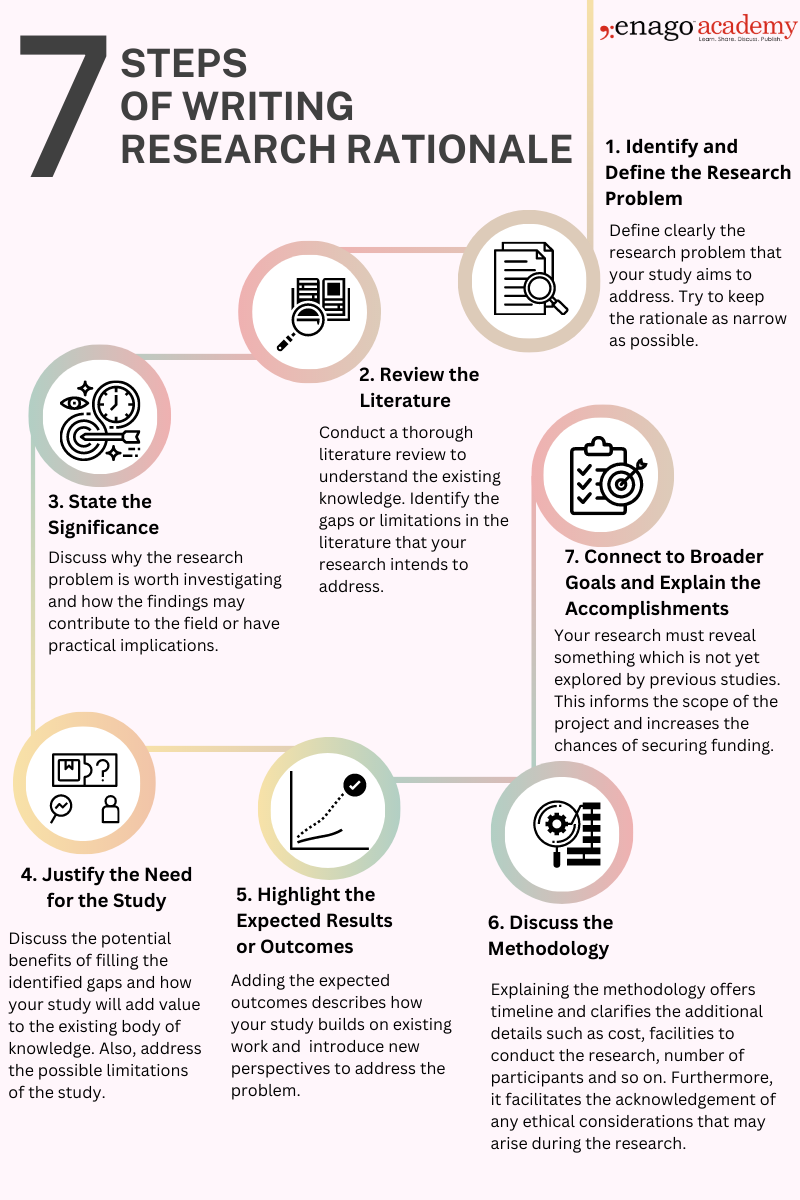
5. Seeing it in Action: An Example Rationale
Theory is useful, but seeing a real-world example is invaluable. The AYUSH guidelines contain an illustrative protocol for an Ayurvedic intervention in COVID-19. Its introduction is a masterclass in synthesizing traditional and modern knowledge to build a strong rationale.
Guidelines for AYUSH Clinical Studies in COVID-19
Let's study a complete rationale from an example protocol. This will show you how all the pieces we've discussed fit together in practice.
Please read the section 'A brief outline of the scientific rationale' in Annexure Four (starting on page 4). Notice how the authors: Frame the disease from both modern ('the virus itself') and Ayurvedic ('the infected person') perspectives. Propose a multi-pronged Ayurvedic approach (addressing fever, cough, immunity, diet). Cite both classical texts (Caraka Samhita) and modern research papers on the antiviral properties of herbs. Justify the 'Whole Systems Research' approach as appropriate for a holistic intervention.
Test your understanding!
Imagine you want to propose a study on the effect of a traditional Ayurvedic formulation for Amavata (often correlated with Rheumatoid Arthritis). Using the 5-question framework, what are some key points you would need to investigate for your literature synthesis?
- Agreement:
- Disagreement:
- Theories:
- Contexts:
- Methodologies:
Show answer
Here are some potential points you could investigate for each question:
- Agreement: It's well-established that Rheumatoid Arthritis is an autoimmune disease characterized by synovial inflammation. It's also likely that some of the individual herbs in your formulation (e.g., Guggulu, Shunthi) have established anti-inflammatory properties in pre-clinical studies.
- Disagreement: Do existing (if any) clinical studies on this formulation show conflicting results? Perhaps some studies show a reduction in pain but not in inflammatory markers like ESR or CRP.
- Theories: You would connect the Ayurvedic concept of Amavata (vitiated Vata and accumulation of Ama) with the modern immunopathology of RA. You would also explain the dravya guna of the formulation—how its ingredients are thought to pacify Vata, digest Ama, and reduce inflammation (shotha).
- Contexts: Have previous studies only included patients with early-stage RA, or have they included those with severe, long-standing disease? Have they controlled for Prakriti?
- Methodologies: What kind of studies exist? Are they mostly observational or small, uncontrolled trials? Is there a lack of a high-quality, double-blind, randomized controlled trial comparing the formulation to a standard modern drug or a placebo? This would be a very strong justification for your study.
Conclusion
Today, you've learned the critical process of building the scientific and conceptual foundation for a research study. A strong rationale is not just a formality; it is the logical backbone of your entire project.
Key Takeaways:
- Literature synthesis is an active process of analyzing and integrating existing knowledge, not just passive summarizing.
- The primary goal of this synthesis is to identify a clear and compelling research gap.
- A powerful framework for synthesis involves asking five questions: What is agreed upon? Where are the disagreements? What are the key theories? What contexts are covered/missing? What methodologies have been used?
- A strong rationale for an Ayurvedic study expertly weaves together evidence from classical texts, modern epidemiology, and preliminary scientific studies to justify the need for the proposed research.
Preview of the Next Lesson:
Now that you know how to establish why a study should be done, the next logical step is to define what you will measure to determine if your intervention works. In our next lesson, we will address the learning outcome: Select appropriate outcome measures that capture both Ayurvedic (e.g., symptom scores) and biomedical (e.g., biomarkers) endpoints.