Hello! Welcome to the next lesson in our module on "Designing Research for Ayurvedic Interventions."
In our last session, we focused on building a strong rationale—the why behind your research. You learned to synthesize literature from both Ayurvedic and modern scientific perspectives to identify a critical research gap. Now that we know how to justify a study, we must decide what to measure to answer our research question. This brings us to today's crucial topic: outcome measures.
Your learning outcome for this lesson is to select appropriate outcome measures that capture both Ayurvedic (e.g., symptom scores) and biomedical (e.g., biomarkers) endpoints.
Mastering this skill is at the heart of your goal to bridge Ayurveda and modern science. It allows you to design studies that are credible to the scientific community by providing objective data, while also remaining true to the holistic and patient-centered principles of Ayurveda.
1. What Are Outcome Measures?
In a clinical study, outcome measures, or endpoints, are the pre-defined measurements used to determine the effect of an intervention. They are the variables you track to see if your treatment worked.
Outcomes are typically classified into two types:
- Primary Outcome: This is the single most important measurement that will determine the study's success. It should directly address the main research question. For example, in a study on a pain-relieving herb, the primary outcome would likely be a measure of pain reduction.
- Secondary Outcomes: These are additional, important measurements that provide more information about the intervention's effects. They might look at other symptoms, side effects, quality of life, or underlying biological changes.
Choosing the right outcomes is one of the most critical steps in designing your research protocol.
2. Capturing the Ayurvedic Perspective: Symptom Scores and Patient-Reported Outcomes
Ayurvedic practice relies heavily on observing lakshanas (signs and symptoms) to assess a patient's condition. For research, we need to translate this qualitative assessment into a quantitative format that can be statistically analyzed. This is often achieved through Symptom Rating Scales and Patient-Reported Outcome Measures (PROMs).
These tools assign numerical scores to the severity, frequency, or duration of symptoms, allowing us to track changes over time. A great resource that formalizes this for Ayurvedic research is a guideline document developed with support from the WHO.
DEVELOPING GUIDELINES FOR CLINICAL RESEARCH ...
Let's explore how Ayurvedic concepts can be structured for clinical research. This document provides a framework for creating scoring systems.
Please read the section titled 'Overall assessment of therapy' (page 11). Focus on the core idea of developing a 100-point scoring system divided into four key Ayurvedic domains: Rogabala (disease strength), Dehabala (physical strength), Agnibala (digestive/metabolic strength), and Chetas/Satvabala (mental strength). Then, quickly review the scoring patterns for Agnibala, Dehabala, and Satvabala on page 96 to see how these holistic concepts are quantified.
This framework is powerful because it allows you to capture the holistic effect of an Ayurvedic treatment, not just its impact on the primary disease. Let's look at a specific disease example to see this in practice.
The same document provides a detailed scoring system for Tamaka Shwasa (often correlated with Bronchial Asthma).
DEVELOPING GUIDELINES FOR CLINICAL RESEARCH ...
Now, let's see how this scoring framework is applied to a specific condition, Tamaka Shwasa.
Scan through the 'Scoring of important symptoms of Tamaka Shwaasa' starting on page 48. You don't need to memorize every detail. Instead, observe how subjective symptoms like Shwaas Vega (frequency of attacks), Sashabda Shwaasa (wheeze), and Kaasa (cough) are broken down into graded scales (e.g., 0-4 or 0-5). Notice that modern biomedical measures like Peak Expiratory Flow Rate (PEFR) and Spirometry are also listed as 'quantitative data'. This demonstrates the integration of both approaches.
By using such graded scales, we transform the clinician's and patient's observations into objective numbers that can be compared before and after treatment.
3. Measuring the Biomedical Perspective: Biomarkers
While symptom scores tell us if the patient feels better, biomarkers can help us understand why they are better on a physiological level.
A biomarker is a "biological molecule found in blood, other body fluids, or tissues that is a sign of a normal or abnormal process, or of a condition or disease." (National Cancer Institute, USA).
Biomarkers provide objective, quantifiable data about biological processes. They can be used for various purposes in a clinical trial.
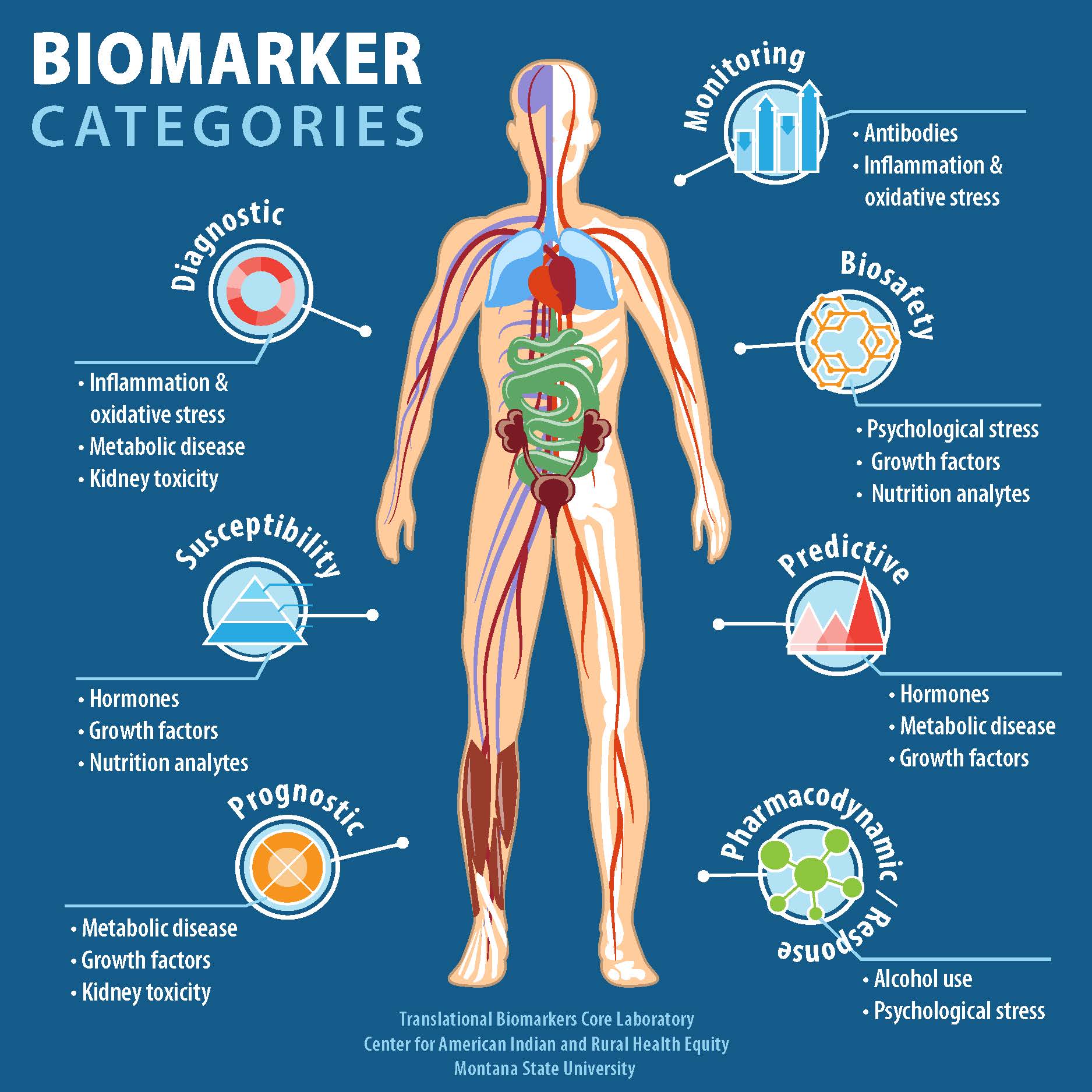
In clinical trials, we are often most interested in:
- Monitoring biomarkers: To track the progression of a disease (e.g., measuring HbA1c in diabetes).
- Pharmacodynamic/Response biomarkers: To show that an intervention is having its intended biological effect (e.g., measuring a reduction in inflammatory markers after giving an anti-inflammatory herb).
Here are some examples relevant to Ayurvedic research:
- Disease: Amavata (Rheumatoid Arthritis)
- Ayurvedic Outcome: A pain and stiffness score.
- Biomarker: C-Reactive Protein (CRP) or Erythrocyte Sedimentation Rate (ESR) to measure systemic inflammation.
- Disease: Madhumeha (Diabetes Mellitus)
- Ayurvedic Outcome: A score for symptoms like Prabhuta Mutrata (polyuria) or Pipasa-Adhikya (polydipsia).
- Biomarker: Fasting Blood Sugar (FBS) and Glycated Hemoglobin (HbA1c).
4. The Power of Integration: A Case Study
The most robust research in Ayurveda often uses a combination of both Ayurvedic-style PROMs and modern biomarkers. This provides a complete picture, demonstrating both clinical improvement (the patient feels better) and a plausible biological mechanism.
Let's analyze a published study that does exactly this.
Proof of Efficacy Study to Evaluate an Ayurvedic Formulation in the Treatment of Allergic Rhinitis
This clinical trial on an Ayurvedic treatment for allergic rhinitis is an excellent real-world example of integrating Ayurvedic and biomedical outcomes.
Read the following parts of the paper: Method (second paragraph): Identify the two main efficacy parameters used. Patient eligibility criteria: Note how the Total Nasal Symptom Score (TNSS) is defined and calculated. This is their primary Ayurvedic-style outcome. Study endpoints: See how the study aims to compare changes in both TNSS and IgE levels. Results (first paragraph and Table 2): Look at how the change in the TNSS symptom score is reported. Results (final paragraph and Table 4): Look at how the change in the IgE biomarker is reported.
In this study:
- The Total Nasal Symptom Score (TNSS) is the primary outcome. It's a PROM that quantifies the patient's subjective experience of their main symptoms (nasal congestion, sneezing, etc.). This captures the clinical reality from an Ayurvedic perspective.
- The serum Immunoglobulin E (IgE) level is a secondary outcome. IgE is a well-known biomarker for allergic reactions. Measuring it provides objective evidence about the treatment's effect on the underlying immune process.
By showing a significant reduction in both the symptom score and the IgE levels, the researchers make a much stronger case for the efficacy of their formulation. This is the bridge-building work you aim to do.
Test your understanding!
You are designing a study to test an Ayurvedic formulation for Sthaulya (often correlated with obesity and dyslipidemia). Based on the principles we've discussed and drawing inspiration from the provided resources, propose:
- One Ayurvedic-style outcome measure (a symptom or sign that can be scored).
- One biomedical outcome measure (a biomarker).
- Explain the rationale for your choices.
Show answer
Here is a sample answer:
-
Ayurvedic Outcome Measure: A graded score for Kshudha-Adhikya (increased appetite). We can create a simple scale:
- 0: Normal appetite, feels satisfied after meals.
- 1: Slightly increased appetite, desires extra meals.
- 2: Moderately increased appetite, feels hungry soon after eating.
- 3: Markedly increased appetite, feels constantly hungry.
This directly measures a key symptom of Medovaha Srotas Dushti and is a patient-centered outcome. (This is similar to the scale for Kshudha-Adhikya in the WHO document, section 4).
-
Biomedical Outcome Measure: A lipid profile measuring Total Cholesterol, LDL, HDL, and Triglycerides.
- Rationale: Sthaulya is fundamentally a disorder of Meda Dhatu (adipose tissue and lipids). While reducing body weight and appetite is important, demonstrating an improvement in the lipid profile provides objective, biochemical evidence that the treatment is correcting the underlying metabolic imbalance. This directly links the Ayurvedic concept of improving Meda Dhatu Agni to a measurable modern parameter.
5. How to Choose the Right Outcome Measures
Selecting an outcome measure isn't arbitrary. A good measure must have several key characteristics to ensure that the results of your study are meaningful and trustworthy.

Here's what these terms mean in practice:
- Validity: Does the tool actually measure what it claims to measure? For example, does a symptom score for Amavata capture the essential features of the disease like sandhi shula (joint pain), sandhi shotha (joint swelling), and stambha (stiffness)?
- Reliability: Is the tool consistent? If a patient's condition hasn't changed, they should get a similar score if they take the test again.
- Responsiveness: This is crucial for a clinical trial. The tool must be sensitive enough to detect real changes in the patient's condition, whether they get better or worse.
- Interpretability: What does a change in score mean? A good outcome measure allows you to say something like, "a 2-point decrease on our 10-point pain scale represents a clinically meaningful improvement for the patient."
- Burden: How difficult is it for the patient and the research staff to use the tool? A questionnaire that is too long or complex can lead to missing data and frustrated participants.
When you choose or create an outcome measure for your study, you should be able to justify that it meets these criteria.
Conclusion
You have now learned how to select the yardsticks by which your intervention will be judged. This is a foundational skill for conducting credible clinical research that honors both Ayurvedic principles and the rigors of modern science.
Key Takeaways:
- Clinical trials rely on pre-defined primary and secondary outcome measures to assess an intervention's effect.
- Ayurvedic endpoints often take the form of symptom rating scales or PROMs, which quantify traditional assessments of lakshanas.
- Biomedical endpoints typically involve biomarkers that provide objective data on physiological processes.
- Integrating both types of outcomes provides a comprehensive assessment, showing that a patient both feels better and has measurable biological changes.
- Good outcome measures must be valid, reliable, responsive, interpretable, and impose a low burden.
Preview of the Next Lesson:
Now that we have our intervention and we know what we will measure, we need to think about how to protect our study from bias. The next lesson will address a major challenge in this area: "Describe the challenges of blinding and placebo control in Ayurvedic research and propose mitigation strategies." We'll explore why giving a "sham" Panchakarma is difficult and what creative solutions researchers have developed.