Hello! Welcome to the next lesson in our module on "Designing Research for Ayurvedic Interventions."
In our last session, we discussed how to select appropriate outcome measures, integrating both traditional Ayurvedic symptom scores and modern biomedical markers. You learned how to define what you are measuring to determine if a treatment is effective.
Now, we must address a fundamental aspect of ensuring our measurements are trustworthy: controlling for bias. This brings us to the "gold standard" in clinical research—blinding and the use of placebos. As you will see, applying these methods to Ayurveda presents unique and fascinating challenges.
Today's learning outcome is to describe the challenges of blinding and placebo control in Ayurvedic research and propose mitigation strategies. This is a critical skill for designing studies that are both methodologically sound and true to Ayurvedic principles.
1. The Gold Standard for Reducing Bias
In clinical trials, our goal is to know with certainty that the observed effects are due to the intervention itself, not other factors. Two of the most powerful tools for achieving this are blinding and placebo control.
What is a Placebo?
A placebo is a substance or procedure that has no therapeutic effect, used as a control in testing new drugs. It is designed to be as indistinguishable as possible from the actual treatment.
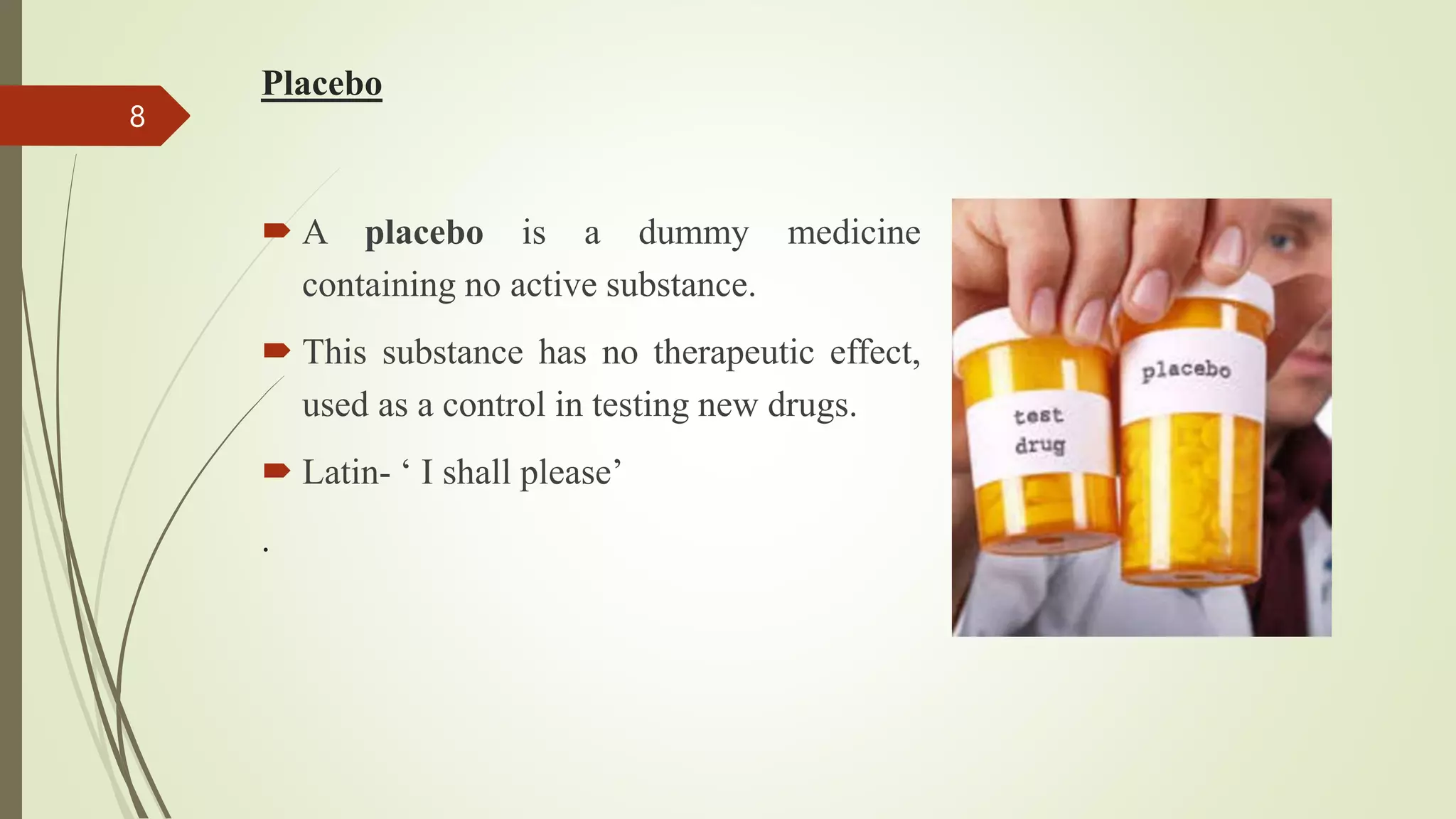
The placebo effect is the measurable, observable, or felt improvement in health not attributable to an actual treatment. It stems from the patient's belief in the treatment and the care they receive. Using a placebo control group allows researchers to subtract this effect from the active treatment group's results, thereby isolating the true effect of the intervention.
What is Blinding?
Blinding is the practice of preventing study participants, investigators, or both from knowing which intervention is being administered.
- Single-Blind: The participant does not know if they are receiving the active treatment or a placebo.
- Double-Blind: Neither the participant nor the investigators interacting with them (e.g., doctors, nurses, assessors) know who is in which group. This is the most rigorous approach.
Blinding is crucial because it prevents conscious or unconscious biases from influencing the results. For example, a patient who knows they are getting the "real" drug might report more improvement (patient bias), or a doctor might assess the treatment group more favorably (investigator bias). A double-blind, randomized, placebo-controlled trial (RCT) is therefore considered the "gold standard" for establishing efficacy.
2. The Core Challenges of Blinding and Placebo Control in Ayurveda
While the RCT model is powerful, its direct application to Ayurveda is often problematic. The very nature of Ayurvedic practice creates significant hurdles for effective blinding and placebo creation.
To understand these challenges in depth, let's read a critical review on the suitability of RCTs for Ayurveda.
RCTs and other clinical trial designs in Ayurveda
This paper, titled 'RCTs and other clinical trial designs in Ayurveda,' clearly explains why the standard RCT model is often incompatible with Ayurvedic practice. It will give you a solid foundation for understanding the core problems.
Please read the section titled '3. Why current RCT models are incompatible with Ayurveda'. Focus on the three main arguments presented: The complexity of Ayurvedic diagnosis (e.g., using prakriti, agni). The complexity and personalization of Ayurvedic treatments (multiple medicines, therapies, diet). The dynamic nature of treatment, where interventions are modified over time.
As you've just read, the challenges can be summarized into three key areas:
-
Sensory Properties of Interventions: Ayurvedic medicines (Aushadhi) are characterized by their distinct rasa (taste), gandha (smell), virya (potency/thermal quality), and physical form. It is nearly impossible to create an inert placebo (like starch powder) that perfectly mimics the bitter taste of a kashayam or the strong aroma of a churna. Patients can often guess their group assignment, which "breaks the blind."
-
Multimodal and Complex Treatments: Ayurvedic therapy is rarely just a single pill. It is often a "whole-system" intervention involving panchakarma procedures, specific ahara (diet), and vihara (lifestyle changes). How does one design a convincing "sham" Basti (medicated enema) or a placebo for a prescribed diet? The complexity makes creating a matching placebo for the entire intervention package practically impossible.
-
Individualization of Therapy: This is perhaps the most fundamental challenge. As the paper highlights, two patients with the same biomedical diagnosis might receive completely different treatments based on their unique Prakriti and Vikriti. A standard RCT requires a uniform intervention for all participants in a group, which directly contradicts the Ayurvedic principle of personalized care. If the treatment isn't standardized, you cannot create a single, corresponding placebo.
3. Mitigation Strategies and Alternative Research Designs
Given these challenges, researchers have developed clever strategies and alternative study designs to rigorously evaluate Ayurvedic treatments. It's not about abandoning scientific principles, but about applying them intelligently.
Let's explore some of these solutions.
Scientific evaluation of Ayurvedic drugs — the use of N- ...
Now, let's look at some proposed solutions. This article, 'Scientific evaluation of Ayurvedic drugs,' discusses specific challenges and practical ways to address them, particularly concerning blinding and trial design.
Please read the section titled 'Challenges in implementation'. Pay close attention to the proposed solutions for the problems of blinding and placebo creation.
Based on the insights from this reading and the broader literature, here are some key strategies:
Strategy 1: Better Placebo Design and Use of Objective Outcomes
- Encapsulation: For single-herb or simple formulations, putting the medicine in a capsule can mask the taste and smell, making it easier to create an identical-looking placebo capsule.
- Active Placebo: Sometimes, a placebo might be designed to mimic the sensory properties or minor side effects (e.g., a specific taste) of the active drug without containing the main therapeutic compounds.
- Focus on Objective Outcomes: As the article you read suggests, if blinding is compromised, strengthening the study by using objective measures can help. A patient's belief might influence their self-reported pain score, but it won't change their levels of an inflammatory biomarker like C-Reactive Protein (CRP) or readings from a wearable device. This links back to our previous lesson on integrating biomedical outcomes.
Strategy 2: Use an Active Comparator (Double-Dummy Design)
Instead of comparing the Ayurvedic treatment to a placebo, you can compare it to the current standard allopathic treatment. This answers a different but very important clinical question: "Is this Ayurvedic intervention as good as, or better than, what is currently used?"
To maintain the blind in such a trial, a double-dummy technique is often used.
- Group A: Receives the active Ayurvedic medicine + a placebo version of the allopathic drug.
- Group B: Receives a placebo version of the Ayurvedic medicine + the active allopathic drug.
Since both groups take two "medicines" that look identical, neither the patient nor the investigator knows who is getting which active treatment.
Strategy 3: Adapt the Trial Design
If the intervention is too complex for a standard placebo-controlled trial, we can use a different research design that is better suited to the question.
RCTs and other clinical trial designs in Ayurveda
The paper on 'RCTs and other clinical trial designs' also introduces several alternative designs that are more suitable for complex, personalized systems like Ayurveda. Let's explore these options.
Please read the sections '4.2. A black box RCT model' and '4.3. N-of-1 RCTs'. For each model, focus on understanding: What is the basic design? What are its advantages for Ayurvedic research? What are its limitations, particularly regarding blinding?
As you've just seen, two powerful alternative designs are:
-
The "Black Box" or Whole System Trial: This design embraces the complexity of Ayurveda. Instead of testing one component, it tests the entire system of care. Patients are randomly assigned to receive either a fully personalized Ayurvedic treatment package (the "black box") or standard conventional care. The study then compares the outcomes. This design doesn't explain which part of the treatment worked, but it pragmatically answers whether the Ayurvedic approach as a whole is effective. Blinding the practitioner is impossible here, but the outcome assessor can often be blinded.
-
N-of-1 Trials: This is a single-patient trial where the patient serves as their own control. The patient undergoes pairs of treatment periods (e.g., Ayurvedic drug vs. placebo, or Ayurvedic drug vs. conventional drug) in a random order, separated by "washout" periods. While blinding is still ideal, the resource LINK notes it can be difficult. However, because you are comparing effects within the same person, you eliminate the confounding factor of inter-patient variability. By combining the results of many N-of-1 trials, you can even estimate the treatment effect for a whole population.
Test your understanding!
You are tasked with designing a study to evaluate the efficacy of Panchakarma therapy (a complex, multi-step purification process) for managing symptoms of Amavata (Rheumatoid Arthritis).
- Why would a standard double-blind, placebo-controlled trial be nearly impossible to conduct for this intervention?
- Which alternative research design that we've discussed would be most appropriate, and why?
Show answer
-
A standard placebo-controlled trial would be nearly impossible because Panchakarma is a highly complex, physical, and sensory intervention. Creating a "sham" Vamana (therapeutic emesis) or Virechana (purgation) that is both convincing and ethical is not feasible. The patient would immediately know they are not receiving the real procedure, completely breaking the blind.
-
The most appropriate design would be a "Black Box" or Whole System Trial. In this design, you could randomly assign patients with Amavata to one of two groups:
- Group 1 (Ayurveda): Receives a full, personalized Panchakarma protocol administered by an expert Vaidya.
- Group 2 (Control): Receives standard conventional care for Rheumatoid Arthritis (e.g., DMARDs, physiotherapy).
You would then compare outcomes like pain scores (e.g., VAS), quality of life questionnaires (PROMs), and inflammatory biomarkers (like CRP, ESR) between the two groups. This design respects the holistic and personalized nature of Panchakarma while still providing a rigorous, comparative evaluation of its overall effectiveness.
Conclusion
Successfully navigating the challenges of bias control is a hallmark of a skilled researcher. It requires a deep understanding of both the intervention being studied and the principles of research methodology.
Key Takeaways:
- Blinding and placebo control are the "gold standard" methods to minimize bias and isolate the true effect of an intervention.
- These methods face significant challenges in Ayurveda due to the unique sensory properties of medicines, the complexity of multi-part treatments, and the core principle of patient individualization.
- Effective mitigation strategies include creative placebo design, focusing on objective outcomes, and using active comparators in a double-dummy design.
- When a standard RCT is not feasible, alternative designs like "Black Box" whole-system trials or N-of-1 trials provide rigorous ways to evaluate Ayurvedic interventions on their own terms.
The key is not to force Ayurveda into a methodological box where it doesn't fit, but to choose the right methodological tool for the question you are asking.
Preview of the Next Lesson:
We've touched on the challenge of personalization multiple times in this lesson. The next topic, "Explain the challenge of standardizing personalized Ayurvedic treatments for clinical trials," will address this issue head-on. We will explore how you can create a study protocol that is standardized enough to be repeatable and scientifically valid, while still allowing for the person-centered approach that is the essence of Ayurveda.