Hello! Welcome to your next lesson in the module "Designing Research for Ayurvedic Interventions."
In our last session, we explored the significant challenges of implementing blinding and placebo controls in Ayurvedic research. We saw that the personalized nature of Ayurvedic therapy is a major reason why creating convincing placebos and maintaining the blind can be so difficult.
Today, we will dive deeper into this specific issue. Our learning outcome is to explain the challenge of standardizing personalized Ayurvedic treatments for clinical trials. This is one of the most debated topics in Ayurvedic research and understanding it is crucial for designing studies that are both scientifically rigorous and true to Ayurvedic principles. This lesson will equip you to articulate this central conflict and begin thinking about study designs that can accommodate it.
1. The Fundamental Conflict: Standardization vs. Personalization
In modern clinical trials, particularly the Randomized Controlled Trial (RCT), standardization is a cornerstone. It means every participant in the intervention group receives the exact same treatment—the same drug, at the same dose, for the same duration. This uniformity is essential for a few key reasons:
- Reproducibility: Other scientists must be able to replicate the study exactly.
- Isolating the Variable: It ensures that the only significant difference between the treatment and control groups is the intervention itself.
- Statistical Analysis: It allows researchers to calculate an average treatment effect across the group.
Ayurveda, as you know from your BAMS training, operates on a fundamentally different principle: personalization. Treatment is not based solely on the disease name (vyadhi), but on the unique state of the individual patient (rogi).
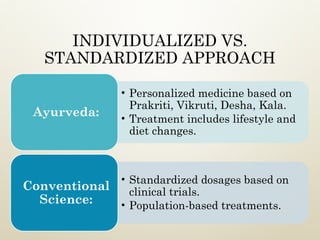
This image clearly illustrates the core tension. While modern science seeks a single, standardized solution that works for a population, Ayurveda seeks a unique, tailored solution for an individual. When we try to evaluate a personalized system using a standardized methodology, a conflict is inevitable.
2. Why Standardization Clashes with Ayurvedic Practice
Let's break down exactly where the standard RCT model clashes with the way Ayurveda is practiced. A key paper on this topic provides an excellent analysis.
RCTs and other clinical trial designs in Ayurveda
The paper 'RCTs and other clinical trial designs in Ayurveda' critically examines why the standard RCT model, which demands standardization, is often a poor fit for evaluating Ayurvedic care. It provides clear, practical examples that will resonate with your understanding of clinical Ayurveda.
Please read section 3 of the article, titled 'Why current RCT models are incompatible with Ayurveda'. As you read, focus on the three distinct challenges the author outlines: Complex diagnostic assessment: How factors like prakriti lead to different treatments for the same biomedical condition. Complexity of treatments: How interventions are often multi-part (diet, therapies, medicines). Dynamic assessment: How physicians adjust treatments over time based on patient response.
Based on the paper you've just read, let's elaborate on these core challenges.
Challenge 1: Individualized Diagnosis and Treatment Path
As the article points out, two patients with the same modern diagnosis—say, osteoarthritis of the knee confirmed by X-ray—may present with very different Ayurvedic profiles.
- One patient might have a Vata-predominant Sandhigata Vata, characterized by severe pain, crepitus, and stiffness.
- Another might have signs of associated Ama, with swelling, inflammation, and digestive issues.
A conventional RCT would put both in the same group and give them the same pill. However, a Vaidya would prescribe entirely different treatment plans. Forcing a single standardized intervention onto both patients means the study is no longer testing Ayurveda as it is actually practiced.
Challenge 2: Multi-component, Holistic Interventions
Ayurvedic treatment (Chikitsa) is rarely just a single herb (Aushadhi). It is a holistic package that may include:
- Multiple herbal formulations
- Specific dietary recommendations (
Pathya) - Lifestyle modifications (
Vihara) - Purification therapies (
Panchakarma)
Standardizing such a complex intervention is incredibly difficult. If you standardize only the herbal pill but allow diet and lifestyle to vary, you introduce confounding variables. If you try to standardize the entire package, you lose the crucial element of personalization. A study that tests only a single herb in isolation may have high internal validity but suffers from poor external validity—its results may not be generalizable to how Ayurveda is used in the real world.
Challenge 3: Dynamic and Adaptive Treatment
An Ayurvedic physician continually monitors the patient's state of Agni, Doshas, and Mala and adjusts the treatment accordingly. A kashayam might be changed after a week, or a new churna might be added to address a new symptom. This dynamic, responsive approach is a hallmark of good clinical practice in Ayurveda.
Standard clinical trial protocols are, by contrast, rigid and fixed. The intervention is predetermined and must not be changed during the trial. This rigidity prevents the study from evaluating the very process of clinical decision-making and adaptation that is integral to the Ayurvedic therapeutic process.
Test your understanding!
A research team proposes a study on Ayurvedic management of Prameha (often correlated with Type 2 Diabetes). To ensure rigorous standardization, they plan to give every participant the same single herbal tablet, Nishamalaki, for 12 weeks, with no other dietary or lifestyle instructions.
What is the fundamental flaw in this study design from an Ayurvedic perspective?
Show answer
The fundamental flaw is that it tests a single, isolated component (Nishamalaki) rather than the holistic and personalized Ayurvedic approach to managing Prameha. In clinical practice, the management of Prameha is highly individualized based on the patient's dosha predominance (e.g., Kaphaja, Pittaja, Vataja Prameha), agni status, strength (bala), and other factors. The treatment would typically involve a personalized combination of diet, exercise, and multiple herbal formulations, not just a single pill. This standardized design has poor external validity because it does not reflect how Ayurveda is actually practiced.
3. Finding a Middle Ground: Research Designs that Accommodate Personalization
Given this fundamental conflict, does it mean we cannot scientifically study personalized Ayurvedic treatments? Not at all. It means we must choose more appropriate research designs that are built to handle this complexity.
We briefly introduced some of these in the last lesson. Let's revisit them now, specifically through the lens of solving the standardization problem.
-
Whole System ("Black Box") Trials: This design directly embraces personalization. Instead of standardizing the treatment, you standardize the practitioners and the principles they follow. Patients are randomized to receive either a fully personalized Ayurvedic management plan from an expert
Vaidyaor standard conventional care. The study then compares the overall outcomes. This design respects personalization while still allowing for a robust, controlled comparison between two different systems of care. The Ayurvedic intervention itself remains a "black box," but its overall effectiveness can be measured. -
N-of-1 Trials: This design represents the pinnacle of personalized research. The entire trial is conducted on a single patient, who acts as their own control. The patient might alternate between periods of receiving a personalized Ayurvedic treatment and a placebo or another treatment. As the article "Scientific evaluation of Ayurvedic drugs — the use of N-of-1 clinical trials" notes, this design is "especially fit for purpose since it accommodates Ayurvedic principles that treat each patient as a unique entity for whom the treatment needs to be tailored."
These alternative designs don't see personalization as a problem to be eliminated, but as a feature of the intervention to be evaluated.
Conclusion
Today we have explored one of the most significant hurdles in bridging Ayurveda and modern research. The key is to recognize the philosophical and practical differences between the two systems and select research tools accordingly.
Key Takeaways:
- The core challenge lies in the conflict between the standardization required by conventional RCTs and the personalization that is central to Ayurvedic practice.
- This conflict appears in three main areas: individualized diagnosis, complex multi-component interventions, and the dynamic adaptation of treatment over time.
- Forcing a standardized, single-intervention model onto a personalized system can lead to research that is not representative of real-world clinical practice (poor external validity).
- Instead of abandoning personalization, we can use alternative research designs like Whole System Trials and N-of-1 Trials that are specifically suited to evaluating complex, individualized interventions.
Preview of the Next Lesson:
We've now identified that designs like "Whole System" and "N-of-1" trials are valuable solutions. In our next lesson, we will explore them in much greater detail. The learning outcome will be to describe research designs suited for whole-system, personalized interventions (e.g., pragmatic trials, N-of-1 trials). We will move from what they are to how they work.