Hello! Welcome back to our fast-paced journey through Grade 12 Accounting.
In our last lesson, we examined Solvency Ratios, which help us understand a company's long-term financial stability and its ability to meet its long-term obligations. We looked at how a company finances its assets through debt and equity.
Today, we shift our focus from financial structure to operational performance. This lesson is designed to help you master Activity Ratios, also known as Turnover Ratios. These ratios measure how efficiently a company uses its assets to generate revenue. In essence, they answer the question: "How well is the business managing its resources?"
By the end of this 60-minute lesson, you will be able to calculate and interpret the three core activity ratios essential for your CBSE exams:
- Inventory Turnover Ratio
- Trade Receivables Turnover Ratio
- Trade Payables Turnover Ratio
1. What are Activity (Turnover) Ratios?
Activity ratios measure the speed at which various accounts are converted into sales or cash. They are called "turnover" ratios because they indicate how many times an asset (like inventory) or a liability (like trade payables) is "turned over" during a year. A higher turnover generally suggests better efficiency.
Let's look at a quick overview of this category of ratios.

To begin, let's watch a brief introduction to what turnover ratios represent.
Turnover Ratios One Shot | Class 12 | Accounting Ratios | Part 4
This clip from Rajat Arora introduces the concept of turnover ratios and lists the main ones we'll be covering.
Watch the segment from 00:50 to 02:44. Pay attention to the idea that these ratios are always calculated in 'times' and represent the efficiency of different business activities.
Now, let's dive into the first and most detailed ratio.
2. Inventory Turnover Ratio (ITR)
The Inventory Turnover Ratio measures how many times a company sells and replaces its inventory during a given period. It's a key indicator of inventory management efficiency.
Formula:
Interpretation:
- High Ratio: Generally positive. It implies that goods are selling quickly and the company isn't holding onto excess or obsolete stock.
- Low Ratio: A warning sign. It could mean weak sales, overstocking, or problems with the inventory itself.
Let's break down the components.
Your NCERT textbook provides the official definitions and formulas for the components of the Inventory Turnover Ratio. This will give you a solid theoretical foundation.
Read section '5.8.1 Inventory Turnover Ratio'. Focus on the formulas for Cost of Revenue from Operations and Average Inventory, and read the 'Significance' part to understand its interpretation.
As you just read, the two key components are:
-
Cost of Revenue from Operations (COGS): This is the direct cost of the goods sold. You can calculate it in two main ways, which you'll remember from your Grade 11 final accounts preparation:
Revenue from Operations - Gross ProfitOpening Inventory + Net Purchases + Direct Expenses - Closing Inventory
-
Average Inventory:
(Opening Inventory + Closing Inventory) / 2
Now, let's see how to apply these formulas in a problem.
Inventory Turnover Ratio | All Types of Questions | Accounting Ratios Class 12 | Don't Miss. 2023-24
This video from Sunil Panda-The Educator provides an excellent walkthrough of the ITR formula, its components, and a solved example. It clearly connects the COGS formula back to the Trading Account you learned in Grade 11.
Watch from 00:20 to 02:55 to understand the concept, then from 03:38 to 10:54 for a detailed explanation of the formulas and a worked-out problem. Pay close attention to how COGS and Average Inventory are calculated.
A Crucial Concept: Gross Profit on Cost vs. Sales
A very common exam question involves a scenario where Revenue from Operations (Sales) is given, but Gross Profit is stated as a percentage of Cost. You cannot directly apply the percentage to sales. You must first convert it.
Here's the rule:
- If Profit is 1/X on Cost, it is 1/(X+1) on Sales.
- Example: 25% on Cost (1/4 on Cost) is equal to 20% on Sales (1/5 on Sales).
- If Profit is 1/X on Sales, it is 1/(X-1) on Cost.
- Example: 20% on Sales (1/5 on Sales) is equal to 25% on Cost (1/4 on Cost).
This conversion is critical. Let's watch two explanations to ensure you master it.
Turnover Ratios One Shot | Class 12 | Accounting Ratios | Part 4
Rajat Arora explains this conversion trick with a clear formula and solves a problem using it. This is a very direct and effective method.
Watch from 13:50 to 18:30. Focus on the formula x/y on cost becomes x/(x+y) on sale. See how he applies it to find the COGS.
Inventory Turnover Ratio | All Types of Questions | Accounting Ratios Class 12 | Don't Miss. 2023-24
Sunil Panda provides a detailed proof of why this conversion works and also shows how to solve the problem using an algebraic 'let cost be x' method. This gives you two ways to tackle the same problem.
Watch from 18:15 to 23:55. This will solidify your understanding of the conversion and give you an alternative method if you prefer algebra.
Test your understanding!
Calculate the Inventory Turnover Ratio from the following information:
- Revenue from Operations: ₹6,00,000
- Gross Profit: 20% on Cost
- Opening Inventory: ₹90,000
- Closing Inventory: ₹1,10,000
Show answer
Step 1: Convert Gross Profit percentage from Cost to Sales.
- Gross Profit is 20% on Cost, which is 1/5 on Cost.
- To convert to Sales, we use the rule
1/Xon Cost =1/(X+1)on Sales. - So, GP on Sales = 1/(5+1) = 1/6 on Sales.
Step 2: Calculate Gross Profit.
- Gross Profit = 1/6 of Revenue from Operations = 1/6 * ₹6,00,000 = ₹1,00,000.
Step 3: Calculate Cost of Revenue from Operations (COGS).
- COGS = Revenue from Operations - Gross Profit
- COGS = ₹6,00,000 - ₹1,00,000 = ₹5,00,000.
Step 4: Calculate Average Inventory.
- Average Inventory = (Opening Inventory + Closing Inventory) / 2
- Average Inventory = (₹90,000 + ₹1,10,000) / 2 = ₹2,00,000 / 2 = ₹1,00,000.
Step 5: Calculate Inventory Turnover Ratio.
- ITR = COGS / Average Inventory
- ITR = ₹5,00,000 / ₹1,00,000 = 5 times.
Interpretation: The company sells and replenishes its entire inventory stock 5 times during the year.
3. Trade Receivables Turnover Ratio
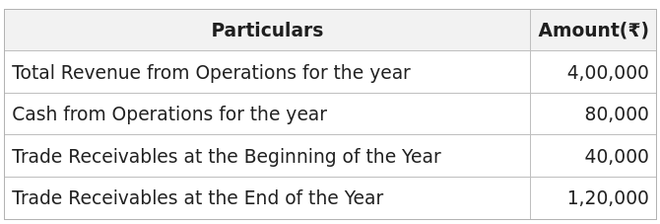
This ratio measures how many times a company converts its credit sales into cash during a period. It indicates the efficiency of a company's credit collection process.
Formula:
Components:
- Net Credit Revenue from Operations:
Total Revenue from Operations - Cash Revenue from Operations. Remember to exclude cash sales! - Average Trade Receivables:
(Opening (Debtors + Bills Receivable) + Closing (Debtors + Bills Receivable)) / 2.
Associated Metric: Average Collection Period
This tells you the average number of days it takes to collect money from customers.
Interpretation:
- High Ratio / Low Collection Period: Good. It means the company is efficient at collecting its debts.
- Low Ratio / High Collection Period: Bad. It could indicate poor credit policies, issues with customer payments, or an increased risk of bad debts.
Let's watch a video that demonstrates how to solve a typical problem.
Turnover Ratios One Shot | Class 12 | Accounting Ratios | Part 4
This clip from Rajat Arora walks through a problem where you need to calculate opening and closing trade receivables when the turnover ratio is given. This is a common variation of the question.
Watch from 24:28 to 28:40. Follow the steps to first find the Average Trade Receivables from the given ratio and then use the additional information to find the opening and closing balances.
4. Trade Payables Turnover Ratio
This ratio is the flip side of the receivables ratio. It measures how quickly a company pays off its suppliers for credit purchases.
Formula:
Components:
- Net Credit Purchases:
Total Purchases - Purchase Returns - Cash Purchases. - Average Trade Payables:
(Opening (Creditors + Bills Payable) + Closing (Creditors + Bills Payable)) / 2.
Associated Metric: Average Payment Period
This shows the average number of days the company takes to pay its suppliers.
Interpretation:
- High Ratio / Low Payment Period: This can be a mixed signal. It shows the company pays its bills promptly, which is good for its reputation. However, it might also mean it's not taking full advantage of the credit periods offered by suppliers.
- Low Ratio / High Payment Period: This could indicate the company has a generous credit period from its suppliers, or it could be a sign of financial distress and an inability to pay bills on time.
To see this ratio in action, let's review a solved example from your textbook.
The NCERT textbook provides a clear definition and a worked-out example for the Trade Payables Turnover Ratio.
Read section '5.8.3 Trade Payable Turnover Ratio'. Focus on the formula, the 'Significance' paragraph, and 'Illustration 16', which shows a straightforward calculation.
Conclusion
Excellent work! You've now covered the essential Activity Ratios. These ratios provide powerful insights into a company's operational efficiency—how well it manages its inventory, collects cash from customers, and pays its suppliers. Mastering these will be a great asset for your exams.
Key Takeaways:
- Activity (Turnover) Ratios measure the efficiency of asset and liability management and are expressed in 'times'.
- Inventory Turnover Ratio =
COGS / Average Inventory. It shows how quickly inventory is sold. - Trade Receivables Turnover Ratio =
Net Credit Sales / Average Trade Receivables. It measures the efficiency of cash collection from customers. - Trade Payables Turnover Ratio =
Net Credit Purchases / Average Trade Payables. It shows the rate at which the company pays its suppliers. - Remember the crucial conversion for Gross Profit on Cost vs. on Sales.
Preview of the Next Lesson:
We have analyzed liquidity (short-term survival), solvency (long-term stability), and now activity (operational efficiency). The final piece of the puzzle is profitability. In our next lesson, we will explore Profitability Ratios, which measure a company's ability to generate profit from its revenue and assets. We will learn to calculate ratios like the Gross Profit Ratio, Operating Ratio, and Net Profit Ratio.