Introduction
Hello! In our last lesson, you did an excellent job learning how to present share capital in the company's Balance Sheet, including how to disclose the amount related to forfeited shares in the Notes to Accounts. We noted that the amount paid on forfeited shares (that have not been re-issued) is added back to the subscribed capital.
Today, we will dive into the accounting process that precedes that presentation. You will learn how to record the journal entries for the forfeiture of shares issued at par for non-payment of allotment or call money. We will break down the logic of the entry, understand what each debit and credit represents, and practice with different scenarios.
This is the first step in a two-part topic. Mastering this will set a strong foundation for the next lesson, where we'll tackle the slightly more complex case of forfeiting shares issued at a premium.
1. The Concept of Forfeiture
Before we jump into the journal entries, let's clarify what "forfeiture" means in this context and why it happens. When a shareholder fails to pay the money due on allotment or any of the calls, the company has the right, if its Articles of Association permit, to cancel their shares. This cancellation is called forfeiture.
When shares are forfeited:
- The person ceases to be a shareholder.
- Their name is removed from the Register of Members.
- Crucially, the money they have already paid to the company on these shares is not refunded. The company keeps this amount.
To understand this concept with a simple story, watch the following video. It clearly explains the difference between 'Calls-in-Arrears' (the non-payment) and 'Forfeiture' (the consequence).
Issue of Shares | Company Accounts Class 12 | Part 7
This video from Rajat Arora introduces the concept of forfeiture using a relatable example. It will help you understand the 'why' behind the accounting entries.
Watch from 00:53 to 05:34. Focus on why the company needs to forfeit the shares and what happens to the money the shareholder has already paid.
2. The Journal Entry for Forfeiture (Shares Issued at Par)
Now, let's construct the journal entry for forfeiting shares that were originally issued at par.
The Logic:
- Cancelling the Capital: When shares are issued, we credit the
Share Capital A/cto create it. To cancel the shares, we must reverse this by debitingShare Capital A/c. - Closing Unpaid Calls: When allotment or call money was due, we debited those accounts (e.g.,
Share Allotment A/c,Share First Call A/c). Since this money was never received, we need to close these accounts by crediting them. - Accounting for the Gain: The amount the company received from the shareholder before forfeiture is a gain. This is transferred to a new account called
Share Forfeiture A/cby crediting it.
Here is the standard journal entry format:
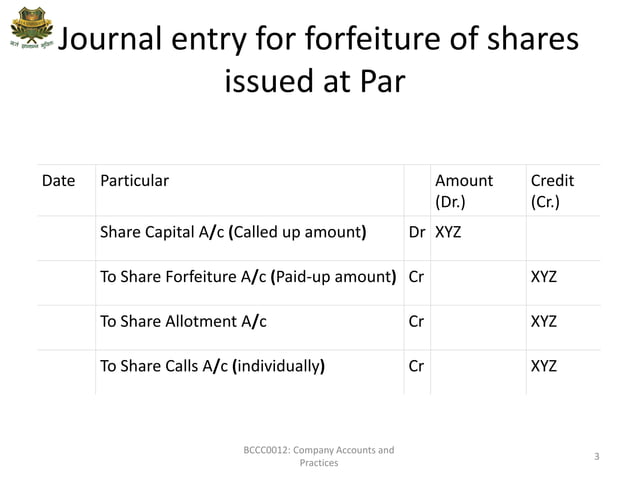
The most important point to remember is the amount debited to Share Capital A/c.
Share Capital A/c is debited with the Called-up Amount per share, not the full face value. The "called-up amount" is the total amount the company has asked shareholders to pay up to the point of forfeiture.
Let's see this entry explained with a numerical example.
Issue of Shares | Company Accounts Class 12 | Part 7
This video continues the example from the previous segment and walks you through the journal entry step-by-step. It clearly shows how to calculate the amounts for each part of the entry.
Watch from 05:34 to 10:08. Pay close attention to how the 'called-up amount' is calculated and used to debit the Share Capital account. This is a critical detail.
3. Worked Examples
To solidify your understanding, let's walk through a couple of examples provided in a clear, written format. These will cover both fully called-up and partly called-up scenarios.
UNIT – 2: ISSUE, FORFEITURE AND RE-ISSUE OF SHARES
This document from BCA FOR CA provides two excellent, concise illustrations of forfeiture entries. Read them carefully to see the theory in practice.
Read the section '2.11.1 Forfeiture of Shares which were issued at Par'. Study ILLUSTRATION 10. This is a case where the shares were 'fully called-up' (₹10). Study ILLUSTRATION 11. This is a crucial variation where the shares were only 'partly called-up' (₹8). Notice how this changes the amount debited to Share Capital.
After reviewing the illustrations, you can see the key difference:
- In Illustration 10, the company had called for the full ₹10, so
Share Capital A/cwas debited with30,000 shares x ₹10. - In Illustration 11, the company had only called up to the first call (Application ₹2 + Allotment ₹4 + First Call ₹2 = ₹8). The final call was not made yet. Therefore,
Share Capital A/cwas debited with20,000 shares x ₹8.
Test your understanding!
Alpha Ltd. forfeited 200 shares of ₹10 each for the non-payment of the first call of ₹3 per share. The final call of ₹2 per share has not yet been made. The shareholder had paid the application money of ₹2 and allotment money of ₹3.
Pass the necessary journal entry for the forfeiture of these shares.
Show answer
First, calculate the key amounts:
- Called-up amount: The final call of ₹2 was not made. So, the called-up amount is ₹10 - ₹2 = ₹8 per share.
- Amount paid: Application (₹2) + Allotment (₹3) = ₹5 per share.
- Amount unpaid: First Call (₹3) per share.
Journal Entry:
| Date | Particulars | L.F. | Debit (₹) | Credit (₹) |
|---|---|---|---|---|
| Share Capital A/c (200 x ₹8) | Dr. | 1,600 | ||
| To Share First Call A/c (200 x ₹3) | 600 | |||
| To Share Forfeiture A/c (200 x ₹5) | 1,000 | |||
| (Being forfeiture of 200 shares for non-payment of first call money) |
4. Alternative Method: Using the 'Calls-in-Arrears' Account
In some accounting practices, instead of crediting the individual unpaid call accounts (like To Share Allotment A/c or To Share First Call A/c), companies maintain a consolidated Calls-in-Arrears A/c.
If this method is used, the forfeiture entry is slightly simplified. You credit the total unpaid amount to Calls-in-Arrears A/c instead of listing each call separately.
Journal Entry (Using Calls-in-Arrears A/c):
- Share Capital A/c Dr. (Called-up amount)
- To Calls-in-Arrears A/c (Total unpaid amount)
- To Share Forfeiture A/c (Total paid amount)
This is just a difference in presentation; the financial result is identical. The image below shows an example where the forfeiture entry credits the Calls in Arrear A/c.

Conclusion
Well done! You have now mastered the fundamental journal entry for forfeiting shares that were issued at par. This is a critical building block in company accounts.
Key Takeaways:
- Forfeiture is the cancellation of shares for non-payment of dues, and the amount already paid is kept by the company.
- The journal entry involves debiting
Share Capital A/cwith the called-up amount on the forfeited shares. - The unpaid call accounts (e.g.,
Share Allotment,Share First Call) or a consolidatedCalls-in-Arrears A/care credited to close them. - The amount already received from the shareholder is credited to a new gain account:
Share Forfeiture A/c.
In our next lesson, we will move on to the next logical step: recording the journal entries for the forfeiture of shares that were originally issued at a premium. This will introduce a new element to our entry – how to handle the Securities Premium account.