Hello! In our last lesson, we established the fundamental journal entry for forfeiting shares issued at par. You learned to debit Share Capital A/c with the called-up amount, credit the unpaid calls, and transfer the amount received to the Share Forfeiture A/c.
Today, we will build directly on that knowledge to tackle a very common scenario in your CBSE exams: recording the journal entries for the forfeiture of shares that were originally issued at a premium.
The logic remains similar, but we introduce one crucial question: Was the securities premium amount received by the company or not? The answer to this question dictates the entire accounting treatment. By the end of this 60-minute lesson, you will be able to confidently handle both scenarios.
1. The Two Golden Rules of Forfeiting Premium Shares
When shares issued at a premium are forfeited, everything depends on whether the shareholder who defaulted had paid the installment that included the premium (usually the allotment). This gives us two distinct cases with two different rules.
Let's start by reading the official guidance from your core textbook. This will lay down the theoretical foundation for our journal entries.
The NCERT textbook provides a clear and concise explanation of the rules for forfeiting shares issued at a premium. Pay close attention to the two distinct scenarios it outlines.
Read the section titled 'Forfeiture of Shares issued at a Premium'. Focus on understanding the difference in treatment when the premium has been received versus when it has not. Also, look at Illustrations 11 and 12, which provide simple, direct examples of each case.
To summarize the rules you just read:
-
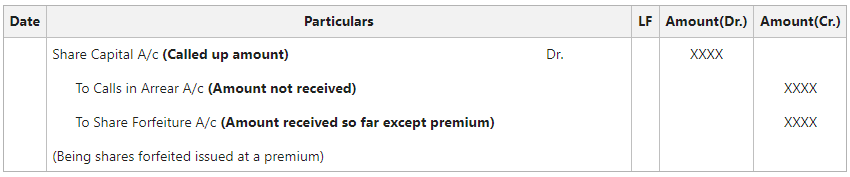
Rule 1: If the premium has been received, you completely ignore the premium at the time of forfeiture. The journal entry will be identical to the one for shares issued at par. The amount paid towards premium stays in the
Securities Premium A/cand is not part of theShare Forfeiture A/c. -
Rule 2: If the premium has NOT been received, you must debit the
Securities Premium A/cto cancel the premium that was made due but never collected.
2. Journal Entries for Both Scenarios
Let's visualize the journal entries for these two rules.
Scenario 1: Premium Has Been Received
Imagine a shareholder paid the allotment money (which included the premium) but failed to pay the first call. Since the premium is already collected, we ignore it. The entry focuses only on the face value components.
Scenario 2: Premium Has NOT Been Received
Now, consider a shareholder who failed to pay the allotment money itself. In this case, the premium was never collected. Therefore, we must reverse the premium amount that we recorded as "due" during allotment.

3. A Step-by-Step Video Walkthrough
Now that you understand the two rules and have seen the journal entry formats, let's watch a video where an instructor applies these concepts to a practical problem. This will help you see the calculations and logic in action.
FORFEITURE of Shares issued at Premium | Share Capital Class 12 Accounts | CA Hardik Manchanda
This video by CA Hardik Manchanda is excellent for understanding this topic. He uses two different defaulting shareholders to perfectly illustrate the two scenarios we've just discussed.
Please watch the following segments carefully: Premium Not Received (01:40 - 11:12): Watch the forfeiture of 'Gump's' shares. He did not pay allotment, so the premium was not received. Observe how Securities Premium A/c is debited. Premium Received (11:12 - 15:03): Now, watch the forfeiture of 'Gogi's' shares. He paid allotment but failed on the call. Notice how the premium is completely ignored in his forfeiture entry. Summary of Rules (20:13 - 22:21): The instructor provides a brilliant summary table. This is a perfect way to consolidate your understanding.
The video makes the distinction very clear. The key is to always ask yourself: "Did the company receive the premium on these specific forfeited shares?"
Test your understanding!
ABC Ltd. forfeited the following shares of ₹10 each, issued at a premium of ₹2 per share. The premium was due on allotment.
- Case 1: 200 shares held by Ram, who had paid the application money of ₹3 and allotment money of ₹5 (including premium), but failed to pay the final call of ₹4.
- Case 2: 300 shares held by Shyam, who had paid only the application money of ₹3 and failed to pay the allotment money of ₹5 (including premium) and the final call of ₹4.
Pass the necessary journal entries for the forfeiture of shares for both Ram and Shyam.
Show answer
Case 1: Forfeiture of Ram's Shares (Premium Received)
- Called-up Capital: Full ₹10 per share.
- Amount Paid (excluding premium): Application (₹3) + Allotment (₹3 face value) = ₹6.
- Amount Unpaid: Final Call (₹4).
- Rule: Since the premium was received (with allotment), we ignore it.
Journal Entry:
| Date | Particulars | L.F. | Debit (₹) | Credit (₹) |
|---|---|---|---|---|
| Share Capital A/c (200 x ₹10) | Dr. | 2,000 | ||
| To Share Forfeiture A/c (200 x ₹6) | 1,200 | |||
| To Share Final Call A/c (200 x ₹4) | 800 | |||
| (Being forfeiture of 200 shares for non-payment of final call) |
Case 2: Forfeiture of Shyam's Shares (Premium Not Received)
- Called-up Capital: Full ₹10 per share.
- Unpaid Premium: ₹2 per share (due on allotment).
- Amount Paid: Application only (₹3).
- Amount Unpaid: Allotment (₹5) + Final Call (₹4) = ₹9.
- Rule: Since the premium was not received, we must debit
Securities Premium A/c.
Journal Entry:
| Date | Particulars | L.F. | Debit (₹) | Credit (₹) |
|---|---|---|---|---|
| Share Capital A/c (300 x ₹10) | Dr. | 3,000 | ||
| Securities Premium A/c (300 x ₹2) | Dr. | 600 | ||
| To Share Forfeiture A/c (300 x ₹3) | 900 | |||
| To Share Allotment A/c (300 x ₹5) | 1,500 | |||
| To Share Final Call A/c (300 x ₹4) | 1,200 | |||
| (Being forfeiture of 300 shares for non-payment of allotment and call) |
Conclusion
Excellent work today. You have now learned how to handle one of the most important adjustments in the topic of Share Capital. By breaking it down into two simple rules, the process becomes much more manageable.
Key Takeaways:
- The accounting treatment for forfeiting shares issued at premium depends entirely on whether the premium has been received.
- If premium is received: Ignore it. The forfeiture entry is the same as for shares issued at par.
Share Forfeiture A/cis credited with the amount paid towards face value only. - If premium is NOT received: You must debit
Securities Premium A/cto cancel the amount that was due but never collected.
In our next lesson, we will complete this topic by learning how to record the journal entries for the reissue of these forfeited shares. This involves selling the forfeited shares to a new shareholder, which can happen at par, at a premium, or even at a discount.