Hello! Welcome back to our course on Company Accounts.
In our last lesson, we mastered the journal entries for forfeiting shares issued at a premium. You learned the crucial difference in accounting treatment based on whether the premium was received or not. The key takeaway was that all money paid by the defaulting shareholder (excluding any premium already received) is transferred to a temporary account called the Share Forfeiture Account.
Today, we'll answer the logical next question: What does the company do with these forfeited shares? It sells them again! This process is called reissue. Our goal is to learn how to record the journal entries for reissuing these shares. A key difference from a fresh issue is that forfeited shares can be reissued at par, at a premium, or even at a discount. Mastering these entries is a vital step toward solving the comprehensive share capital problems you'll face in your CBSE board exams.
1. Understanding Reissue and its Accounting Treatment
When a company reissues forfeited shares, it's essentially a sale transaction. There are no application or allotment stages; the new shareholder typically pays the full amount in a lump sum.
The reissue can happen at three different price points relative to the share's face value:
- At Par: The reissue price equals the face value.
- At Premium: The reissue price is more than the face value.
- At Discount: The reissue price is less than the face value.
Let's watch a video that clearly explains the journal entries for each of these three scenarios. Pay close attention to how the "discount" is handled – it's the most important part of this topic.
Re issue of Shares | Accounts Class 12 | Part 8
The video 'Re issue of Shares' by Rajat Arora provides a concise and clear explanation of the journal entries for all three reissue scenarios. Focus on understanding the accounts debited and credited in each case.
Watch the video from the beginning of the reissue discussion up to the point where the third journal entry (for discount) is explained. Specifically, watch from 03:54 to 09:23. Please stop before he begins discussing the transfer to Capital Reserve, as we will cover that in a future lesson.
2. The Three Journal Entries for Reissue
As you saw in the video, the journal entries are straightforward. The company receives money (debit Bank A/c) and issues share capital (credit Share Capital A/c). The variations come from how any premium or discount is treated.
Let's summarize the entries.
A. Reissue at Par
This is the simplest case. The amount received is equal to the face value (or paid-up value) of the shares.
Journal Entry:
Bank A/c                                Dr.   [No. of shares reissued × Reissue price]
    To Share Capital A/c                           [No. of shares reissued × Paid-up value]
(Being ... shares reissued at par)
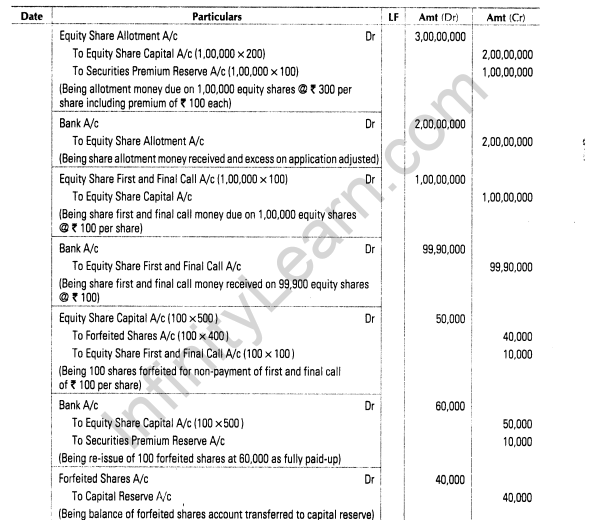
B. Reissue at Premium
Here, the company receives more than the face value. The excess amount is a capital profit and is credited to the Securities Premium A/c.
Journal Entry:
Bank A/c                                Dr.   [No. of shares reissued × Reissue price]
    To Share Capital A/c                           [No. of shares reissued × Paid-up value]
    To Securities Premium A/c                      [No. of shares reissued × Premium amount]
(Being ... shares reissued at a premium)
Here is an example of what this looks like in practice.
C. Reissue at Discount
This is the most critical scenario. When shares are reissued at a discount, the "loss" or "discount" is not debited to a discount account. Instead, it is absorbed by the amount already collected from the original defaulting shareholder, which is available in the Share Forfeiture Account.
Journal Entry:
Bank A/c                                Dr.   [No. of shares reissued × Reissue price]
Share Forfeiture A/c                    Dr.   [No. of shares reissued × Discount amount]
    To Share Capital A/c                           [No. of shares reissued × Paid-up value]
(Being ... shares reissued at a discount)
Let's look at an example.

Test your understanding!
X Ltd. forfeited 50 shares of ₹10 each, fully called-up, for non-payment of the final call of ₹3. The company had received ₹7 per share on these shares. Later, X Ltd. reissued all 50 shares as fully paid-up.
Pass the journal entry for reissue in each of the following independent cases:
- The shares were reissued at ₹10 per share.
- The shares were reissued at ₹13 per share.
- The shares were reissued at ₹8 per share.
Show answer
Case 1: Reissue at Par (₹10)
| Particulars | L.F. | Debit (₹) | Credit (₹) |
|---|---|---|---|
| Bank A/c (50 x ₹10) | Dr. | 500 | |
| To Share Capital A/c | 500 | ||
| (Being 50 forfeited shares reissued at par) |
Case 2: Reissue at Premium (₹13)
| Particulars | L.F. | Debit (₹) | Credit (₹) |
|---|---|---|---|
| Bank A/c (50 x ₹13) | Dr. | 650 | |
| To Share Capital A/c (50 x ₹10) | 500 | ||
| To Securities Premium A/c (50 x ₹3) | 150 | ||
| (Being 50 forfeited shares reissued at a premium) |
Case 3: Reissue at Discount (₹8)
| Particulars | L.F. | Debit (₹) | Credit (₹) |
|---|---|---|---|
| Bank A/c (50 x ₹8) | Dr. | 400 | |
| Share Forfeiture A/c (50 x ₹2) | Dr. | 100 | |
| To Share Capital A/c (50 x ₹10) | 500 | ||
| (Being 50 forfeited shares reissued at a discount) |
3. The Maximum Discount Rule
A logical question arises: how much discount can a company offer on reissue? Is there a limit? Yes, there is a very important limit.
The discount on reissue cannot exceed the amount forfeited on those shares.
The logic is simple: the company must ensure that, in total, it receives at least the face value of the share. The amount received from the new shareholder plus the amount forfeited by the old shareholder must be equal to or greater than the share's face value.
Let's watch a short clip that explains this rule perfectly.
Re issue of Shares | Accounts Class 12 | Part 8
The same video from Rajat Arora also contains a great explanation of the maximum discount rule. This is a very common topic for MCQs in your exam.
Please watch the segment from 14:33 to 16:56. The instructor clearly explains the logic behind the maximum discount and illustrates it with a numerical example.
So, in our earlier example where ₹7 was forfeited on a ₹10 share, the maximum discount the company could offer on reissue is ₹7 per share. This means the minimum reissue price would be ₹3 (₹10 Face Value - ₹7 Forfeited Amount).
Conclusion
Great job today! You have now covered the complete accounting for the reissue of forfeited shares, which is a significant part of this chapter.
Key Takeaways:
- Forfeited shares can be reissued at par, premium, or discount.
- Reissue at Par:
Bank A/cDr. ToShare Capital A/c. - Reissue at Premium: The extra amount is credited to
Securities Premium A/c. - Reissue at Discount: The discount amount is debited to the
Share Forfeiture A/c, not a "Discount" account. - Maximum Discount Rule: The discount on reissue cannot be more than the amount previously forfeited on those specific shares.
In our next lesson, we will formalize our understanding of the maximum permissible discount on reissue. Following that, we'll learn the final and most crucial step: how to calculate the profit on reissue and transfer it to the Capital Reserve. This will complete the entire cycle from forfeiture to the final accounting treatment.