Introduction
Hello! In our recent lessons, we've mastered the journal entries for various scenarios of issuing shares, including for consideration other than cash. Now, we're going to take the final and crucial step: learning how to report all this information in a company's financial statements.
Today's lesson focuses on a key presentation skill for your board exams. You will learn to present Share Capital in the company's Balance Sheet as per Schedule III of the Companies Act, 2013, including the preparation of the supporting Notes to Accounts.
We will cover the specific format required, break down the different categories of share capital, and see how to incorporate adjustments like Calls-in-Arrears and Share Forfeiture into your presentation. This brings together everything you've learned about the 'Issue of Shares' topic.
1. The Format: Balance Sheet Extract and Notes to Accounts
For company accounts, the Balance Sheet follows a vertical format as prescribed by Schedule III of the Companies Act, 2013. This is different from the 'T-format' you used for partnership firms. In your exam, you are typically asked to show only an 'extract' of the Balance Sheet, focusing solely on Share Capital.
The Balance Sheet extract shows the final, consolidated figure for Share Capital. The detailed breakdown and calculations that lead to this figure are presented in a separate schedule called Notes to Accounts.
To start, let's get familiar with this new format.
Extract of Balance sheet | Issue of shares. 6 Marks | Concept & Questions | Class 12 Board Exam 2025
This video from Sunil Panda introduces the concept of the Balance Sheet extract and walks through the vertical format as per Schedule III. It clearly explains why we prepare an extract and outlines the main headings we will use.
Watch from the beginning to 10:47. Pay close attention to the structure of the Balance Sheet extract (Equity and Liabilities -> Shareholder's Funds -> Share Capital) and the three main categories within the Notes to Accounts (Authorised, Issued, and Subscribed Capital).
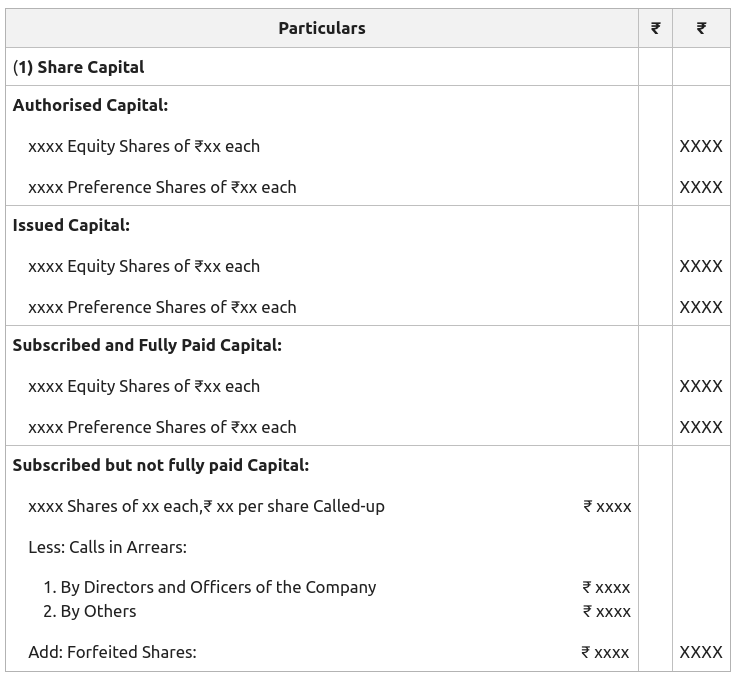
Here is a static image of the standard format for your reference. The structure shown is mandatory.
As you saw, the process involves two parts:
- The Balance Sheet (Extract): This is the main statement.
- Notes to Accounts: This provides the supporting details for the figures in the Balance Sheet.
The key categories in the Notes to Accounts are:
- Authorised Capital: The maximum amount of capital a company is legally authorised to issue, as stated in its Memorandum of Association. This is shown for disclosure purposes and is closed with a double line; it is not part of the main calculation.
- Issued Capital: The portion of the authorised capital that the company has offered to the public for subscription. This is also shown for disclosure and closed with a double line.
- Subscribed Capital: The portion of the issued capital that the public has actually applied for and has been allotted by the company. This is the category from which the final Balance Sheet figure is derived.
2. The Core of the Calculation: Subscribed Capital
Subscribed Capital is the most important section and is further divided into two categories. Understanding this distinction is critical.
-
Subscribed and Fully Paid-up: Shares are classified here only if both of the following conditions are met:
- The company has called up the entire face value of the share (e.g., all ₹10 on a ₹10 share).
- The shareholder has paid the full amount called up.
-
Subscribed but Not Fully Paid-up: This category includes shares where:
- The company has not yet called up the full face value (e.g., called up only ₹8 on a ₹10 share).
- OR, the company has called up the full face value, but the shareholder has failed to pay a part of it (i.e., there are Calls-in-Arrears).
Let's watch a short segment that explains this crucial difference with clear examples.
Extract of Balance sheet | Issue of shares. 6 Marks | Concept & Questions | Class 12 Board Exam 2025
This clip clearly defines the criteria for classifying shares into 'Subscribed and Fully Paid Up' and 'Subscribed but Not Fully Paid Up'.
Watch from 10:47 to 14:09. Write down the two conditions for 'Subscribed and Fully Paid Up' in your own words. This is a common point of confusion, so make sure you grasp it.
3. Handling Adjustments
The 'Subscribed but Not Fully Paid-up' section is where we account for most of the complexities you've learned, like Calls-in-Arrears and Forfeiture.
What to Ignore
First, it's important to know what not to include in the Share Capital note. Several items you've encountered in journal entries have their own place in the Balance Sheet.
Extract of Balance sheet | Issue of shares. 6 Marks | Concept & Questions | Class 12 Board Exam 2025
Before we dive into adjustments, this clip explains which items you must ignore when preparing the Share Capital note. Knowing this will prevent many common errors.
Watch from 25:31 to 29:36. Make a list of the items discussed and where they actually belong in the Balance Sheet (e.g., Securities Premium goes to 'Reserves and Surplus').
Summary of Items to Ignore in Share Capital Note:
- Securities Premium & Capital Reserve: These are shown under the head 'Reserves and Surplus', which is a separate line item under 'Shareholder's Funds'.
- Calls-in-Advance: This is a liability for the company and is shown under 'Other Current Liabilities'.
- Oversubscription: The final number of shares presented is always the number of shares issued and allotted, not the number applied for. Excess money is either refunded or adjusted, so it doesn't affect the final share capital figure.
Treatment of Calls-in-Arrears and Forfeiture
Now, let's see how to handle the adjustments that do affect the Share Capital note.
-
Calls-in-Arrears: When a shareholder fails to pay call money, the unpaid amount is deducted from the amount called-up on those specific shares within the 'Subscribed but Not Fully Paid-up' category.
-
Forfeited Shares: When shares are forfeited but not yet re-issued, they are removed from the subscribed share count. However, the amount that was already paid by the defaulting shareholder (the forfeited amount) is added as a separate line item at the end of the Notes to Accounts.
Let's see these adjustments in action.
Extract of Balance sheet | Issue of shares. 6 Marks | Concept & Questions | Class 12 Board Exam 2025
The following segments demonstrate how to treat Calls-in-Arrears and Forfeited Shares (including partial reissues) with practical examples. This is the application part of the lesson.
Watch from 29:36 to 40:59. Observe carefully: How Calls-in-Arrears are subtracted. How the amount of 'Share Forfeiture' is added back at the end. In the case of partial reissue, only the forfeited amount on shares not reissued is added.
Test your understanding!
ABC Ltd. issued 10,000 equity shares of ₹10 each. All shares were subscribed. The company called up the full amount.
Rohan, a holder of 500 shares, failed to pay the final call of ₹2 per share. His shares were forfeited.
Of the forfeited shares, 300 were re-issued to Shyam as fully paid.
How much will be added to Share Capital on account of 'Forfeited Shares' in the Notes to Accounts?
Show answer
- Total shares forfeited: 500
- Shares re-issued: 300
- Shares forfeited but not yet re-issued: 500 - 300 = 200 shares.
- Amount paid per share by Rohan: ₹10 (Face Value) - ₹2 (Unpaid Call) = ₹8.
- Amount to be shown in 'Forfeited Shares Account' in Notes to Accounts: 200 shares × ₹8 per share = ₹1,600.
Only the amount received on shares that remain forfeited is added to the Share Capital in the Notes to Accounts.
4. Comprehensive Problem Solving
You now have all the components needed to prepare the Balance Sheet extract and Notes to Accounts. Let's apply this knowledge to a comprehensive problem similar to what you might face in your exam.
First, let's review a solved example that combines several elements.
Disclosure of Share Capital in the Balance Sheet
This article from GeeksforGeeks contains an excellent solved problem. It includes shares issued for consideration other than cash, calls-in-arrears, and forfeited shares, bringing together multiple concepts.
Read 'Illustration 2' and its solution carefully. Trace how each piece of information (underwriters, vendors, Sukant's arrears and forfeiture, Sayeba's arrears) is placed in the final Notes to Accounts.
Finally, to see how these concepts are tested in the latest exam patterns, let's analyze a question from a recent CBSE sample paper. This question is broken down into multiple-choice questions based on a single set of data.
Extract of Balance sheet | Issue of shares. 6 Marks | Concept & Questions | Class 12 Board Exam 2025
This final video segment breaks down a 6-mark CBSE sample paper question. This is an extremely valuable exercise to prepare you for your board exam.
Watch from 01:08:20 to 01:21:29. Pause after each of the six sub-questions and try to solve it yourself before watching the explanation. This will test your application of all the rules we've discussed today.
Conclusion
Great job today! You have successfully learned how to present Share Capital in a company's Balance Sheet, a skill that is not only fundamental to corporate accounting but also carries significant weight in your exams.
Key Takeaways:
- Share Capital is presented in a vertical Balance Sheet extract under Equity and Liabilities -> Shareholder's Funds.
- The detailed breakdown is provided in the Notes to Accounts, which shows Authorised, Issued, and Subscribed Capital.
- The final figure for the Balance Sheet comes from the Subscribed Capital section.
- Subscribed and Fully Paid-up requires the full face value to be called and paid. All other subscribed shares fall under Subscribed but Not Fully Paid-up.
- Calls-in-Arrears are deducted from the called-up capital of the specific shares in default.
- The amount forfeited on shares not yet re-issued is added back at the end of the Share Capital note.
- Items like Securities Premium and Capital Reserve are disclosed under 'Reserves and Surplus', not 'Share Capital'.
In the next module, we will begin a detailed study of Forfeiture and Reissue of Shares. While we touched upon its presentation today, our upcoming lessons will dive deep into the journal entries required to forfeit shares (issued at par and premium) and the subsequent accounting for their reissue, including the important calculation of the amount transferred to Capital Reserve.