Hello! Welcome to our next lesson.
In our previous session, we meticulously calculated the total amount due to an outgoing partner by preparing their capital account. We concluded by transferring this final amount to either the retiring partner's Loan Account or the deceased partner's Executor's Account, establishing a liability for the firm.
Today, we will address the next logical step: settling this liability. Our learning outcome is to record the settlement of the amount due to an outgoing partner either in cash, by transfer to a loan account, or to their executors. We will explore the different ways a firm can pay this amount and focus on the preparation of the loan account when the payment is made in installments.
1. The Three Modes of Settlement
Once the final amount due to the retiring partner or deceased partner's executor is determined, the firm must settle it. The method of settlement is usually governed by the partnership deed. In its absence, the firm and the outgoing partner (or their executor) agree on the terms.
Generally, there are three common methods:
- Immediate Lump Sum Payment: The firm pays the entire amount due in cash or by cheque immediately.
- Transfer to a Loan Account: The firm is not in a position to pay immediately, so the entire amount due is treated as a loan from the outgoing partner to the firm. This loan is then repaid over time in installments with interest.
- Partial Payment: A portion of the amount is paid immediately in cash, and the remaining balance is transferred to a loan account.
The following resource from your NCERT textbook clearly outlines these methods and provides the essential journal entries for each scenario.
You have learnt that retirement or death of a
This section from your NCERT textbook, titled 'Disposal of Amount Due to Retiring Partner', explains the different ways to settle the final amount and provides the corresponding journal entries.
Please read section 3.7 Disposal of Amount Due to Retiring Partner. Focus on the journal entries for the three main settlement methods: full cash payment, transfer to a loan account, and partial cash/loan. Also, note the entries for interest and installment payments.
What about a Deceased Partner?
The settlement process for a deceased partner is nearly identical to that of a retiring partner. The key difference, as you'll recall from our last lesson, is that the amount due is transferred to the Deceased Partner's Executor's Account. This account is then settled in the same way a retiring partner's loan account would be—either in a lump sum or in installments.
2. Preparing the Partner's Loan Account for Installment Payments
When the amount due is paid in installments, it is crucial to prepare the Partner's Loan Account (or Executor's Account). This ledger tracks the repayment of the principal along with the interest accrued on the outstanding balance until the loan is fully paid off.
There are two primary ways installments are structured, and it's important to understand the difference. We will use a detailed video to walk through both scenarios.
Preparation of Retiring Partners' Loan A/c | Easiest & Logical Explanation | Class 12 Accounts |
This video by CA Hardik Manchanda is an excellent guide to preparing a partner's loan account. It logically explains the two main types of installment payments and demonstrates the step-by-step accounting treatment for each.
Please watch the video from the beginning until 40:37. The video is divided into two main cases, which we will tackle one by one. Case 1 (00:00 - 24:01): Focus on the scenario where installments are paid 'along with interest'. Understand how the principal installment is fixed and how interest is calculated on the outstanding balance each year. Case 2 (24:01 - 40:37): This covers the scenario where the installment amount 'includes interest'. Pay close attention to how you must first calculate the interest for the year and then deduce the principal portion from the fixed installment payment.
Let's break down the logic from the video.
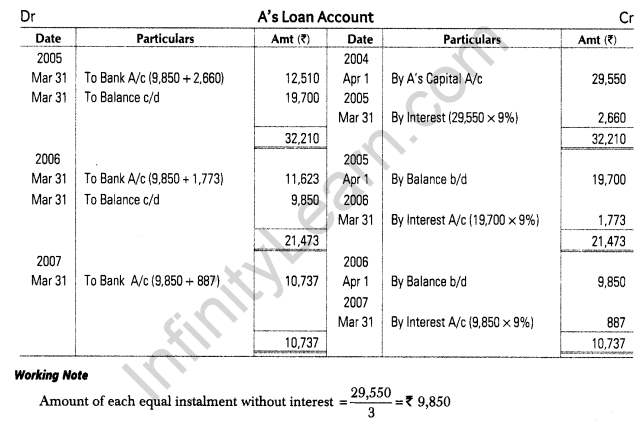
Case 1: Payment in Installments "Along With" (or "Plus") Interest
This is the more straightforward scenario. The agreement specifies that the firm will pay a fixed amount of the principal each year, plus the interest on whatever balance is outstanding.
The Logic:
- Transfer: The Loan Account is credited with the total amount due from the Partner's Capital Account.
- Calculate Interest: At the end of each year, calculate interest on the opening balance of the loan for that year. This interest is credited to the Loan Account (and debited to the Interest Account, as it's an expense for the firm).
- Record Payment: The total payment made at year-end is the sum of the fixed principal installment plus the calculated interest. This payment is debited to the Loan Account.
- Balance: The remaining balance is carried down to the next year. This process repeats until the balance is zero.
The image below shows a completed loan account that follows this logic.
Case 2: Payment in Installments "Including" Interest
In this scenario, the firm agrees to pay a fixed total installment amount each year (e.g., ₹26,000). This fixed payment already includes both the principal repayment and the interest. Your task is to break down this payment into its two components.
The Logic:
- Transfer: The process starts the same way, by crediting the Loan Account with the amount due.
- Calculate Interest: At the end of the year, calculate interest on the opening balance of the loan. This is credited to the Loan Account. The total liability is now
Opening Balance + Interest. - Record Payment: The fixed installment amount (e.g., ₹26,000) is debited to the Loan Account.
- Balance: The closing balance is
(Opening Balance + Interest) - Fixed Installment Payment. This balance is carried down to the next year. The principal portion repaid in any year is simplyFixed Installment - Interest for the year.
Test your understanding!
A partner retires with ₹50,000 due, which is transferred to their loan account. The interest rate is 10% p.a. At the end of Year 1, the firm pays a total of ₹20,000.
- How much of this ₹20,000 payment is for interest?
- How much is for the principal?
- What is the outstanding balance on the loan account at the beginning of Year 2?
Show answer
- Interest for Year 1: 10% of the opening balance (₹50,000) = ₹5,000.
- Principal Repaid: Total Payment - Interest = ₹20,000 - ₹5,000 = ₹15,000.
- Outstanding Balance for Year 2: Opening Balance - Principal Repaid = ₹50,000 - ₹15,000 = ₹35,000.
3. The Deceased Partner's Executor's Account
As mentioned, settling the amount due to a deceased partner's estate follows the exact same accounting procedure. The only difference is the name of the account, which is the "Executor's Account."
The image below illustrates an executor's account being settled in installments. Notice the structure is identical to a partner's loan account.

Conclusion
Great job! You have now mastered the final step in closing the books for an outgoing partner. You know how to ascertain the amount due and, as of today, how to record its settlement.
Key Takeaways:
- Settlement Options: The amount due to an outgoing partner can be paid immediately in cash, transferred entirely to a loan/executor's account, or a combination of both.
- Loan Account Preparation: When paid in installments, a Loan Account (or Executor's Account) is prepared to track the repayment.
- Interest is Key: Interest is always calculated on the outstanding balance of the loan at the beginning of the period.
- Two Installment Types: You must carefully read the terms to determine if the installment payment is for the principal plus interest or if it is a fixed amount including interest, as the calculation differs.
Preview of the Next Lesson:
Having fully settled the account of the outgoing partner, our focus now shifts to the reconstituted firm. In the next lesson, we will learn how to prepare the capital accounts of the continuing partners after a partner's retirement/death. This often involves adjustments to their capital contributions to align with the new profit-sharing ratio.