Hello! Welcome to your next lesson.
In our previous session, we focused on settling the account of an outgoing partner, learning how to prepare their loan or executor's account for installment payments. With the retiring/deceased partner's dues fully accounted for, our attention now shifts to the continuing partners and the reconstituted firm.
Today's learning outcome is to prepare the capital accounts of the continuing partners after a partner's retirement/death. This involves two key aspects: first, the standard process of incorporating all adjustments to find their closing capital balances, and second, the more advanced topic of making specific "capital adjustments" to align their capital contributions with the new profit-sharing ratio.
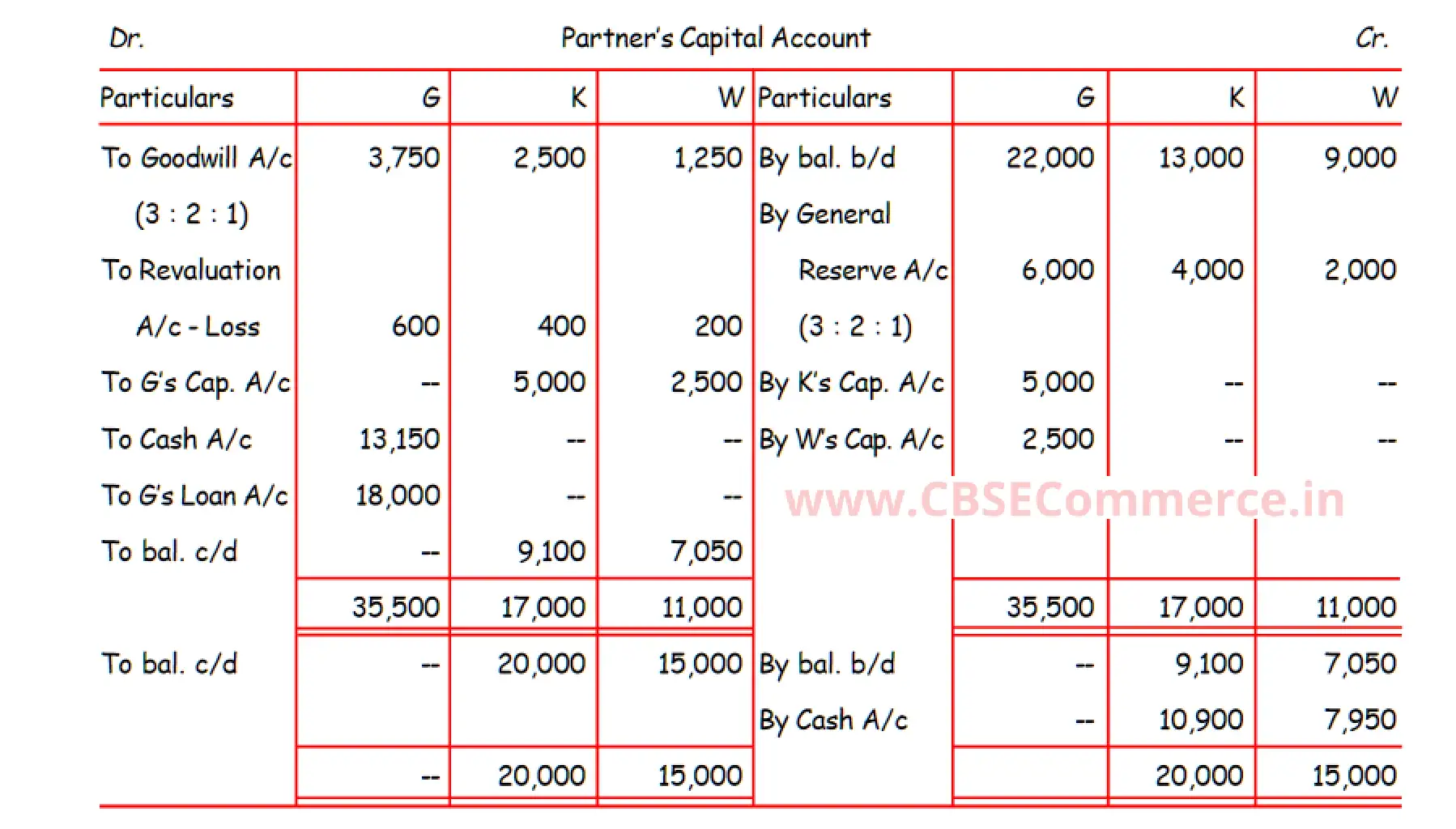
1. Finalizing the Continuing Partners' Capital Accounts
The process of preparing a continuing partner's capital account is very similar to what you've done for a retiring partner, with one crucial difference in the final step. Let's recap the flow:
- Start with the Opening Balance: Credit the account with
By Balance b/d. - Credit all Gains: Add their share of General Reserve, Revaluation Profit, and their portion of the gain from any other distributed reserves (like Investment Fluctuation Reserve).
- Debit all Reductions: Subtract their share of any accumulated losses (e.g., from the P&L A/c on the asset side) and Revaluation Loss.
- Adjust for Goodwill: Debit the gaining partners' accounts for the share of goodwill they are giving to the sacrificing/retiring partner.
- The Final Step:
- For a retiring partner, the balancing figure represents the amount due and is transferred out (
To Retiring Partner's Loan A/corTo Bank A/c). - For a continuing partner, the balancing figure is simply their closing capital, which is carried forward to the new Balance Sheet (
To Balance c/d).
- For a retiring partner, the balancing figure represents the amount due and is transferred out (
This process completes the capital accounts, showing the final capital balances for the partners who will carry on the business.
The following video provides a clear walkthrough of preparing the capital accounts for all partners in a retirement scenario. It effectively demonstrates the difference in treatment between the retiring and continuing partners.
Retiring Partners' Capital A/c & Balance Sheet in Retirement of a Partner Class 12 Term 2 ||
Watch this segment from the video by CA Hardik Manchanda. It walks through a comprehensive problem, focusing on the preparation of the Partners' Capital Accounts.
Please watch the section from 21:50 to 30:01. Pay close attention to how the instructor closes the accounts: Notice how the retiring partner's (Anita's) balance is settled (To Bank A/c and To Anita's Loan A/c). Contrast this with how the continuing partners' (Gaurav and Sonu's) accounts are closed (To Balance c/d).
The image below shows the final output of this process. You can clearly see how the retiring partner's (G's) account is settled via loan and cash, while the continuing partners' (K's and W's) balances are carried down.
2. Capital Adjustments of Continuing Partners
Often, after a partner retires, the continuing partners may decide that their capital balances should be in proportion to their new profit-sharing ratio (PSR). This is a common and important adjustment. It ensures that each partner's investment in the firm reflects their new share of future profits.
This adjustment typically involves the following steps:
- First, calculate the partners' adjusted capital after all entries for revaluation, goodwill, and reserves have been made (this is the
Balance c/dwe calculated in the previous step). - Then, determine the new required capital for each partner based on the specific condition given in the problem.
- Finally, find the difference (surplus or deficit) and adjust it by either having the partner bring in more cash or withdraw the excess.
There are a few common scenarios for how the "new required capital" is determined. The following NCERT resource introduces these scenarios.
You have learnt that retirement or death of a
This section from your NCERT textbook, titled 'Adjustment of Partners’ Capitals', provides a concise overview of the different situations you might encounter when adjusting capital.
Read section 3.8 Adjustment of Partners' Capitals. Focus on understanding the three main situations described: When the total capital of the new firm is specified. When the total capital of the new firm is not specified. When continuing partners contribute to pay the retiring partner.
Now, let's watch a detailed video that solves problems for each of these scenarios. This will help solidify the practical application.
Retirement of a Partner - Capital Adjustments | Class 12 | Accountancy | Part 5
This comprehensive video by Rajat Arora covers five distinct cases of capital adjustments in retirement. We will focus on the most common ones. It's a fantastic resource for mastering this topic.
You'll watch different segments of this video to understand each case. The instructor solves a full problem for each scenario. Case A (13:19 - 19:24): The new firm's total capital is the sum of the continuing partners' adjusted capitals. This is the most fundamental case. Case B (00:00 - 13:19): The total capital of the new firm is a fixed, predetermined amount. Case C (34:36 - 45:47): The continuing partners bring in cash to pay the retiring partner, and their capitals are made proportionate.
Let's summarize the logic from the video and text for each case.
Case A: New Capital Based on Combined Adjusted Balances
This is the scenario where the problem states that the capitals of the continuing partners are to be adjusted in their new PSR, but doesn't give a specific total capital amount.
- Logic (As seen from 13:19 in the video):
- Calculate the adjusted capital balances for the continuing partners (
To Balance c/d). - Add these balances together to get the Total Capital of the New Firm.
- Divide this total capital among the continuing partners in their new PSR to find their required closing capital.
- Compare each partner's adjusted capital (from step 1) with their required capital (from step 3).
- The difference is the cash to be brought in (
By Bank A/c) or withdrawn (To Bank A/c).
- Calculate the adjusted capital balances for the continuing partners (
Case B: New Capital is a Fixed, Predetermined Amount
This is a more straightforward case where the problem explicitly states the total capital of the new firm (e.g., "the capital of the new firm will be ₹2,00,000").
- Logic (As seen from 00:00 in the video):
- Take the given Total Capital of the New Firm.
- Divide this total capital among the continuing partners in their new PSR. This is their required closing capital.
- Compare this required capital with their adjusted capital (calculated after all revaluation/goodwill adjustments) to find the surplus or deficit to be settled via cash or current accounts.
Case C: Cash Brought in to Pay Retiring Partner
Here, the goal is twofold: pay off the retiring partner and make the continuing partners' capitals proportionate.
- Logic (As seen from 34:36 in the video):
- Calculate the adjusted capital balances of the continuing partners.
- Calculate the final amount payable to the retiring partner.
- The Total Capital of the New Firm = (Sum of continuing partners' adjusted capitals) + (Amount payable to retiring partner).
- Divide this new total capital among the continuing partners in their new PSR. This is their required closing capital.
- The cash to be brought in by each continuing partner is the difference between their new required capital (step 4) and their old adjusted capital (step 1). The total cash brought in will exactly equal the amount paid to the retiring partner.
Test your understanding!
X and Y are continuing partners after Z retires. Their new PSR is 3:2. After all adjustments for goodwill, reserves, and revaluation, their capital account balances are:
- X: ₹95,000
- Y: ₹65,000
It is decided that the total capital of the new firm will be fixed at ₹2,00,000, to be shared in the new PSR. Calculate the amount of cash each partner must bring in or can withdraw.
Show answer
This is Case B. The total capital is fixed.
-
Calculate Required Capitals:
- X's new capital = ₹2,00,000 * (3/5) = ₹1,20,000
- Y's new capital = ₹2,00,000 * (2/5) = ₹80,000
-
Calculate Surplus/Deficit:
- For X: Required is ₹1,20,000, but has only ₹95,000. So, X must bring in ₹25,000 (1,20,000 - 95,000).
- For Y: Required is ₹80,000, but has only ₹65,000. So, Y must bring in ₹15,000 (80,000 - 65,000).
Conclusion
Excellent work today! You have now learned how to finalize the books for the continuing partners after a retirement or death. This is a critical skill for solving comprehensive partnership problems.
Key Takeaways:
- The capital accounts of continuing partners are balanced using
To Balance c/d, carrying their final capital forward. - "Capital Adjustment" is the process of realigning the continuing partners' capital balances to their new profit-sharing ratio.
- The method for adjustment depends on the specific instructions in the problem, which could be based on their combined adjusted capital, a fixed total capital, or the amount needed to pay the outgoing partner.
Preview of the Next Lesson:
You are now equipped with all the individual pieces of the puzzle for partner retirement: calculating ratios, treating goodwill, revaluing assets, settling the outgoing partner's account, and adjusting the continuing partners' capitals. In our next lesson, we will put it all together to solve a comprehensive problem on the retirement or death of a partner, from preparing the Revaluation Account all the way to the final Balance Sheet of the reconstituted firm.