Hello! Welcome to the final lesson in our module on the retirement and death of a partner.
In our previous lessons, you've mastered the individual components of this topic: calculating new and gaining ratios, treating goodwill, preparing the Revaluation Account, settling the outgoing partner's claim, and adjusting the capital accounts of the continuing partners.
Today, we will integrate all these skills to achieve our final learning outcome for this module: to solve a comprehensive problem on the retirement or death of a partner. This is a crucial lesson, as it mirrors the format and complexity of questions you can expect in your board exams. We will walk through the entire process, from reading the question to preparing the Revaluation Account, Partners' Capital Accounts, and the final, tallied Balance Sheet.
The 7-Step Method for Comprehensive Problems
Solving a comprehensive problem can seem daunting, but a systematic approach makes it manageable. We'll follow a clear, 7-step process that you can apply to any retirement or death scenario.
- Read and Format: Carefully read the entire question. Identify the old profit-sharing ratio (PSR) and the terms of retirement. Draw the formats for the Revaluation Account, Partners' Capital Accounts, and the new Balance Sheet.
- Post Balance Sheet Items: Transfer the opening capital balances to the credit side of the Partners' Capital Accounts. Then, distribute any accumulated profits (like General Reserve, Profit & Loss A/c on the liabilities side) or losses (P&L A/c on the asset side) to all partners in their old PSR.
- Process Adjustments: Work through each adjustment given outside the Balance Sheet.
- Changes in asset/liability values go to the Revaluation Account.
- The goodwill adjustment is handled through the Partners' Capital Accounts (Gaining Partners Dr. to Retiring/Sacrificing Partner Cr.).
- Close Revaluation Account: Calculate the profit or loss on revaluation. Transfer this profit/loss to the capital accounts of all partners in their old PSR.
- Settle the Outgoing Partner: Total the credit and debit sides of the retiring/deceased partner's capital account. The balancing figure is the total amount due. Settle this as per the question's instructions (e.g., pay in cash/bank, transfer to a Loan Account, or a combination).
- Balance Continuing Partners' Accounts: Calculate the closing balances for the continuing partners (
To Balance c/d). If the question requires capital adjustments, perform them at this stage. - Prepare the New Balance Sheet:
- Liabilities Side: List the closing capitals of the continuing partners, the retiring partner's loan account (if any), and other liabilities at their revised values.
- Assets Side: List all assets at their revalued figures. Remember to adjust the Cash/Bank balance for any payments made or cash brought in.
- Finally, ensure the Balance Sheet totals match.
Walkthrough of a Comprehensive Problem
Let's apply this 7-step method by walking through a complete problem. The following video provides an excellent demonstration. We will break it down to align with our structured approach.
Retirement | Comprehensive Question | 6 marker | Part 6 | Class 12
This video from Rajat Arora, titled 'Retirement | Comprehensive Question', solves a full problem step-by-step. We will watch it in segments to see our 7-step method in action.
Follow the video as it progresses through the solution. I'll guide you on what to focus on in each part. Steps 1 & 2 (00:43 - 02:57): Watch how the problem is introduced, formats are prepared, and the opening capital balances and accumulated profit (P&L Account) are posted to the capital accounts. Step 3 - Goodwill (02:57 - 05:04): See the calculation for the retiring partner's share of goodwill and its adjustment through the continuing partners' capital accounts using the gaining ratio. Steps 3 & 4 - Revaluation (05:04 - 09:04): Observe how adjustments for stock, debtors, outstanding expenses, and the sale of investments are recorded in the Revaluation Account. The account is then closed, and the profit is distributed. Step 5 - Settlement (08:45 - 11:21): Focus on how the total amount due to the retiring partner (C) is calculated and paid in full via the bank, as instructed by the question. Steps 6 & 7 - Final Accounts (11:12 - 14:03): Finally, watch how the closing capital balances of the continuing partners (A and B) are determined, and the new Balance Sheet is prepared and tallied.
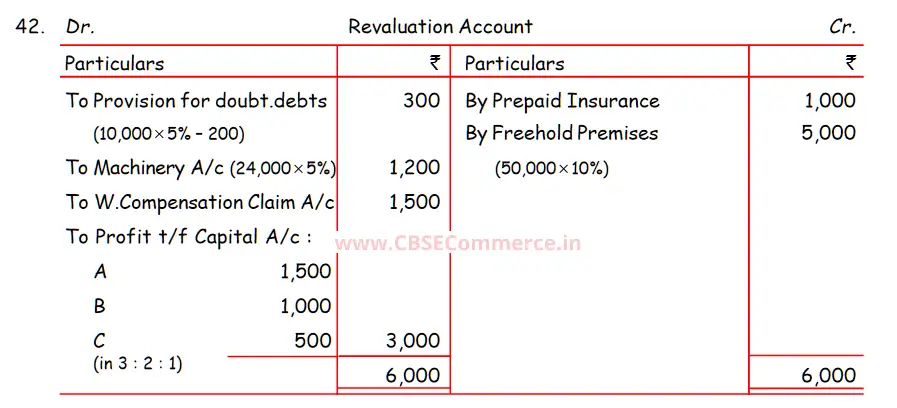
By breaking the problem down and tackling it systematically, you can ensure all adjustments are correctly recorded and the final accounts are accurate. The image below shows a typical Revaluation Account, which is the starting point for most adjustments.
Special Considerations for the Death of a Partner
The accounting process for the death of a partner is almost identical to that of retirement. The main difference lies in the settlement and the calculation of profit.
- Settlement: The amount due to the deceased partner is not transferred to a loan account but to their Executor's Account. The payment is then made to the legal executors.
- Profit up to the Date of Death: Since death can occur at any time during the year, you need to calculate the deceased partner's share of profit from the last Balance Sheet date to the date of their death. This is often recorded using a temporary account called the Profit & Loss Suspense Account.
You have learnt that retirement or death of a
To understand these nuances, please review the relevant section in your NCERT textbook.
Read the section titled 'When Partner Retires in the Middle of the Year', which also applies to death. Focus on the methods for calculating the profit for the intervening period (e.g., based on time or turnover) and the use of the Profit & Loss Suspense Account.
The format below shows how a deceased partner's capital account includes these specific items, ultimately leading to the amount payable to the executor.

Practice Problem
Now it's your turn to apply the 7-step method. Read the following problem carefully and prepare the Revaluation Account, Partners’ Capital Accounts, and the Balance Sheet of the new firm.
Comprehensive Problem
Pankaj, Naresh and Saurabh are partners sharing profits in the ratio of 3:2:1. Naresh retired from the firm due to his illness. On that date, the Balance Sheet of the firm was as follows:
Balance Sheet as at March 31
| Liabilities | Amount (₹) | Assets | Amount (₹) |
|---|---|---|---|
| Sundry Creditors | 15,000 | Bank | 7,600 |
| General Reserve | 12,000 | Debtors | 6,000 |
| Capital Accounts: | Stock | 10,000 | |
| Pankaj | 40,000 | Furniture | 40,000 |
| Naresh | 30,000 | Premises | 80,000 |
| Saurabh | 20,000 | 90,000 | |
| Total | 1,17,000 | Total | 1,17,000 |
Additional Information:
(i) Premises have appreciated by 20%, stock depreciated by 10% and provision for doubtful debts was to be made 5% on debtors. Further, a provision for legal damages is to be made for ₹1,200 and furniture to be brought up to ₹45,000.
(ii) Goodwill of the firm is valued at ₹42,000.
(iii) ₹26,000 from Naresh’s Capital account is to be transferred to his loan account and the balance is to be paid through bank; if required, a necessary loan may be obtained from the Bank.
(iv) The new profit-sharing ratio of Pankaj and Saurabh is decided to be 5:1.
Take your time to solve this using the 7-step method. Once you are done, you can check your answer below.
Show Solution
Here is the step-by-step solution. Compare it with your attempt to see how you did.
NCERT Solutions Class 12 Accounts Ch 3 Reconstitution
The following resource provides a detailed, solved answer to the practice problem.
In this resource, find Numerical Question 3 (the one with partners Pankaj, Naresh, and Saurabh). Review the prepared Revaluation Account, Partners' Capital Accounts, and the final Balance Sheet. Pay close attention to: The calculation of the gaining ratio (New PSR - Old PSR). The goodwill adjustment: Pankaj and Saurabh's accounts are debited, and Naresh's account is credited. The settlement of Naresh's capital: part is transferred to his Loan Account, and the balance is paid from the bank, resulting in a bank overdraft.
Conclusion
Congratulations on completing this crucial lesson and the entire module on a partner's retirement and death! You have successfully integrated all the individual accounting treatments into a single, cohesive process.
Key Takeaways:
- A systematic, 7-step approach is the most effective way to solve comprehensive partnership problems.
- The core accounting for retirement and death is the same: Revaluation -> Goodwill -> Capital Accounts -> Settlement -> New Balance Sheet.
- Key differences for a partner's death include calculating profit up to the date of death (often via P&L Suspense A/c) and transferring the final amount to the Executor's Account.
- Always double-check that your new Balance Sheet tallies. This is your final confirmation that your calculations are likely correct.
Preview of the Next Lesson:
We have now concluded our study of the "reconstitution" of a partnership. In our next module, we will explore what happens when the partnership business itself comes to an end. Our first lesson will be to distinguish between the dissolution of a partnership and the dissolution of a partnership firm. This is a foundational concept that sets the stage for the final closure of a firm's books.